CGM and Strength Training After 40: Does It Help?
This article may contain affiliate links. If you buy through them, we may earn a small commission at no extra cost to you. See our Affiliate Disclosure and Medical Disclaimer.
A $50 sensor on the back of your arm, and a graph on your phone that supposedly tells you how your body is handling carbs, stress, and training. Continuous glucose monitors (CGMs) — once strictly medical devices for people with diabetes — are now marketed directly to healthy adults chasing “metabolic optimization,” and gym-goers over 40 are a prime target audience. The pitch: watch your glucose curve around a workout, and you’ll train and eat smarter.
The honest answer is more complicated than either the marketing or the skeptics suggest. CGMs are a real, validated technology — just not validated for the exact way most lifters are using them. Here’s what the actual device-accuracy research shows, not what the app store description promises.
What a CGM Actually Measures
A CGM doesn’t measure blood glucose directly. It measures glucose in the thin layer of fluid just under your skin (interstitial fluid), then uses an algorithm to estimate what your blood glucose is doing, with a built-in lag of roughly 5 to 15 minutes behind a real blood draw. In someone sitting still, that lag rarely matters. During exercise — when blood flow, hydration, and local tissue chemistry all shift quickly — it matters more.
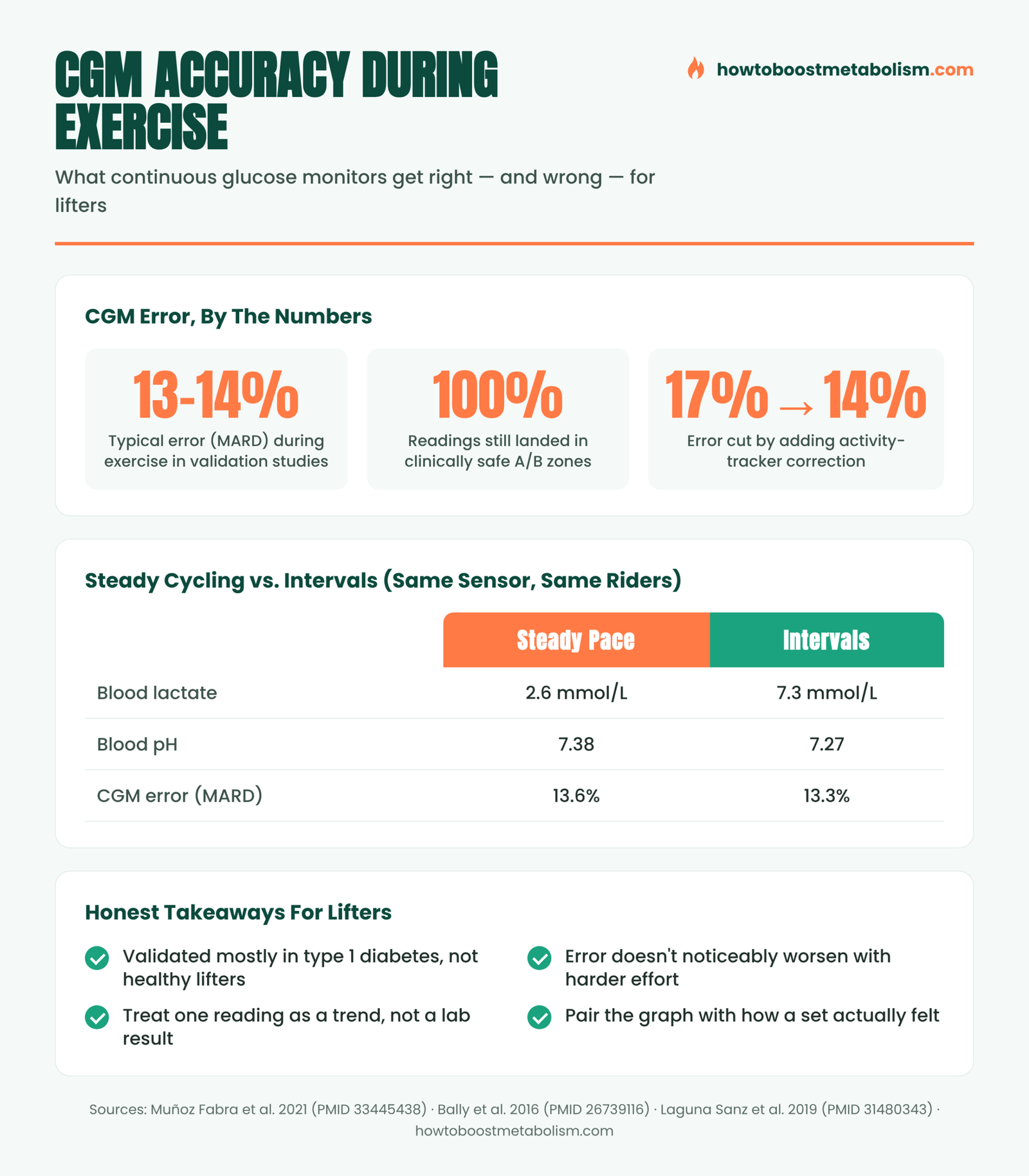
A 2021 review in Sensors pulled together the clinical trial literature on CGM use during exercise in people with type 1 diabetes and found a consistent pattern: CGM accuracy, measured by Mean Absolute Relative Difference (MARD) against a real blood draw, is reliably worse during exercise than at rest (Muñoz Fabra et al., 2021). That’s the starting point for everything else here — the devices work, but “works” has an asterisk during a workout.
Does Harder Training Make It Worse?
Not necessarily — and this is the part that surprised even the researchers. A 2016 study in Diabetes Research and Clinical Practice put ten men with well-controlled type 1 diabetes through two 90-minute cycling sessions wearing a Dexcom G4 Platinum sensor: one at a steady moderate pace, one with 10-second sprints thrown in every 10 minutes. The sprint protocol pushed blood lactate nearly three-fold higher and dropped blood pH significantly — a genuinely different metabolic state. Despite that, CGM accuracy barely moved (Bally et al., 2016).
| Measure | Steady cycling | Interval cycling |
|---|---|---|
| Average blood glucose | 6.7 mmol/L | 7.6 mmol/L |
| Blood lactate | 2.6 mmol/L | 7.3 mmol/L |
| Blood pH | 7.38 | 7.27 |
| CGM accuracy (MARD) | 13.6% | 13.3% |
In plain terms: the CGM was off by roughly 13–14% from a real blood draw in both conditions, with no meaningful difference between “easy cardio” and “hard intervals.” That’s reassuring for anyone worried that a tough strength session will make the numbers meaningless — but it also means a 13–14% error band is just baseline, not something resistance training specifically avoids.
Free download
🔥 The Metabolism Starter Kit
3 honest guides: a 7-day reset plan, a foods cheat-sheet and 12 metabolism myths debunked. No spam — unsubscribe anytime.
Can the Error Be Corrected?
Researchers have tried to shrink that exercise-related error using data from wearables already on the market. A 2019 study used signals from a Fitbit (metabolic equivalent estimates) and a Microsoft Band (skin temperature) to build a correction model, and cut CGM error during activity from about 17.5% down to roughly 13.8% — close to the device’s resting baseline (Laguna Sanz et al., 2019). That’s a meaningful improvement, and it’s the direction modern consumer CGM apps are heading in — but it also confirms the raw, uncorrected number during a workout is less trustworthy than the one you see at rest.
The Part Nobody Puts in the Ad: Who Was Actually Studied
Almost all of the rigorous CGM-and-exercise accuracy research was done in people with type 1 diabetes, using cycling or running protocols in a lab, comparing the sensor to a venous blood draw every few minutes. That’s a very different population and context than a 45-year-old without diabetes doing a strength training session and glancing at an app afterward. The devices and underlying sensor technology are largely the same, so the accuracy findings likely transfer in broad strokes — but nobody has specifically validated CGM accuracy against barbell squats, heavy deadlifts, or circuit training the way they have against steady-state cycling.
That gap matters for strength training specifically because resistance exercise produces its own glucose response — driven by adrenaline and glycogen use in working muscle — that looks different from the glucose response to steady cardio. Until that’s measured directly, reading too much into a glucose spike immediately after a heavy set is speculation dressed up as data.
If what you actually want is a food framework for stable blood sugar and better training energy — without strapping on a $70-a-month sensor — our top pick is a structured Mediterranean-style eating plan built around exactly that goal.
See the Meal Plan →Affiliate link — we may earn a commission at no extra cost to you. Disclosure
Heads up: this program is structured as a quiz-based entry point with a recurring (rebill) subscription component — read the billing terms on the order page before you buy. See our Affiliate Disclosure.
So Is a CGM Worth It If You Don’t Have Diabetes?
For most healthy lifters over 40, the honest case for a CGM is narrower than the marketing suggests. It can be genuinely useful for:
- Spotting your own personal pattern — e.g., whether a late, carb-heavy dinner correlates with worse sleep or a harder next-day training session
- Noticing unusually high fasting or post-meal numbers that are worth mentioning to your doctor, especially with a family history of type 2 diabetes or prediabetes
- Building intuition about how different pre-workout meals feel, as a trend over weeks — not a single reading
It’s on much shakier ground for:
- Making minute-to-minute training decisions off a single glucose number mid-workout
- Treating any one reading as precise rather than roughly 13% off in either direction
- Comparing your numbers against someone else’s as a “metabolic health score” — the devices weren’t built or validated for that
Which Devices Are We Actually Talking About?
The research above was largely done with medical-grade sensors from Dexcom and Abbott (the FreeStyle Libre family) because those are the devices with the longest track record and the most published validation data. The newer wave of over-the-counter “biosensor” products aimed at non-diabetics — Abbott’s Lingo, Dexcom’s Stelo — use closely related or identical sensor hardware, so it’s reasonable to expect broadly similar accuracy characteristics. But “reasonable to expect” is not the same as “independently confirmed,” and the marketing for these consumer products rarely cites exercise-specific accuracy data at all. If a company can’t point you to a published MARD figure for its device during exercise, that’s worth noticing.
A Two-Week Self-Experiment, Done Right
If you want to actually use a CGM to learn something useful about your own training and eating, treat it like a personal experiment with a protocol — not a live dashboard to react to in real time.
- Pick one variable to test — for example, a pre-workout meal timing, or a specific carb source before lifting — and hold everything else as constant as you can for two weeks.
- Log your training (weight, reps, how the session felt on a 1–10 scale) alongside the glucose trend, not just the number.
- Look at the shape of the curve across multiple sessions, not any single peak or dip — one reading carries that ~13% error band, but the pattern across ten sessions is far more informative.
- Change one thing at a time. Changing your pre-workout meal, your sleep, and your training split all in the same week makes it impossible to know what the graph is actually responding to.
- Bring the pattern — not the raw data — to a conversation with your doctor or a registered dietitian if anything looks genuinely unusual (consistently very high fasting numbers, for example).
This turns a gadget with a real but limited evidence base into something closer to a structured food-and-training log with a glucose column attached — which is a legitimately useful tool, just a humbler one than “optimize your metabolism in real time.”
What Moves the Needle More Than Watching a Graph
For most people over 40 who are strength training and want steadier energy and better body composition, the highest-leverage levers aren’t glucose-monitoring technology at all. They’re the same handful of basics that show up across the research on metabolic health and training response: consistent protein intake spread across meals, a short walk after carb-heavy meals, regular resistance training itself (which independently improves insulin sensitivity), and enough sleep. A CGM can make some of these patterns visible faster, but it doesn’t replace any of them, and none of them require a subscription sensor to implement.
A Simpler, Cheaper Starting Point
Before paying for a subscription sensor, it’s worth asking what question you’re actually trying to answer. If it’s “am I eating in a way that supports steady energy for my training,” a basic food log plus how you perform in the gym over two or three weeks will usually answer that more reliably than a device with a known 13% error margin reading a proxy measurement. If it’s “do I have a diagnosable blood sugar problem,” that’s a conversation for a clinician and a fasting blood draw or HbA1c test — not a consumer wearable.
Free download: our Metabolism Starter Kit — a protein calculator, a 7-day meal framework, and a one-page supplement checklist, with zero hype.
Get the Free Starter Kit →At A Glance
| Question | What the research shows |
|---|---|
| What it measures | Interstitial glucose (not blood glucose directly), with ~5–15 min lag |
| Accuracy at rest | Best case for the device |
| Accuracy during exercise | ~13–14% MARD in validated studies, regardless of intensity |
| Studied in lifters specifically? | Not directly — data comes from cycling/running in type 1 diabetes |
| Best realistic use | Spotting personal trends over weeks, not single-session decisions |
None of this means CGMs are a scam — the underlying sensor technology genuinely works, and it has changed diabetes management for the better. The honest framing for a healthy lifter over 40 is simply that it’s a general-purpose trend tool borrowed from a medical context, not a purpose-built performance instrument for strength training. Used that way — as one more data point alongside sleep, training logs, and how you actually feel — it can earn its place. Used as a precise, second-by-second readout to micromanage a workout, it’s being asked to do something the validation data doesn’t support.
Related: If you’re tracking glucose around your training already, it’s worth also reading what the research shows on SGLT2 inhibitor medications and resistance training.
Frequently Asked Questions
Is a CGM accurate enough to guide what I eat before a workout?
It’s accurate enough to show a general trend, but a single reading can be off by roughly 13% from your actual blood glucose during exercise. Use it to spot patterns across several sessions, not to make decisions off one spike or dip.
Does lifting weights make CGM readings less reliable than cardio?
The best available data compares steady cycling to high-intensity interval cycling, not specifically resistance training, and found no meaningful difference in accuracy between the two. There’s no strong reason to assume strength training is uniquely worse, but it hasn’t been tested directly.
Do I need a CGM if I don’t have diabetes or prediabetes?
Most healthy adults can get similar practical insight from tracking meals, sleep, and training performance without one. A CGM may add value if you have a family history of blood sugar issues or want to experiment with meal timing, but it isn’t a required tool for general metabolic health.
Why does my CGM number spike right after a heavy set?
Resistance exercise triggers a release of stress hormones like adrenaline, which pushes stored glycogen into the bloodstream as glucose — a normal, temporary response, not necessarily a sign of a problem. This response hasn’t been specifically validated for CGM accuracy during lifting.
What’s a cheaper alternative to a CGM for tracking metabolic health?
A fasting blood glucose or HbA1c test from your doctor gives a validated clinical snapshot. Day to day, a simple log of meals, sleep, and how your training sessions feel over two to three weeks often reveals the same patterns a CGM would show, without the recurring cost.
Related Reading
- How the glycemic index actually relates to blood sugar and weight
- Evidence-based ways to lower HbA1c
- How long to walk after eating to blunt a blood sugar spike
- HRV and strength training recovery after 40: another wearable, examined honestly
- DEXA vs. BIA vs. skinfolds: which body composition test is worth trusting
- What to eat on a GLP-1 medication, and why protein matters more than ever
This article is educational and not a substitute for medical advice. If you have diabetes, prediabetes, or are managing blood sugar with medication, work with your doctor or a certified diabetes educator on how (and whether) to use a CGM. See our full Medical Disclaimer.