Accommodating Resistance: Bands & Chains After 40
This article may contain affiliate links. If you buy through them, we may earn a small commission at no extra cost to you. See our Affiliate Disclosure and Medical Disclaimer.
Walk into almost any serious strength gym and you’ll eventually see someone squatting or benching with thick rubber bands looped around the bar, or rattling chains piling onto the floor as they stand up. It looks advanced. It looks like it must work. The actual research on accommodating resistance is more interesting — and more limited — than the gym-floor mythology around it.
This article looks at what bands and chains actually do to a lift, what controlled training studies have found after weeks of use (not just one rep), and who over 40 is likely to get something real out of adding them — versus who is just adding complexity to a program that would progress just as well without them.
What “Accommodating Resistance” Actually Means
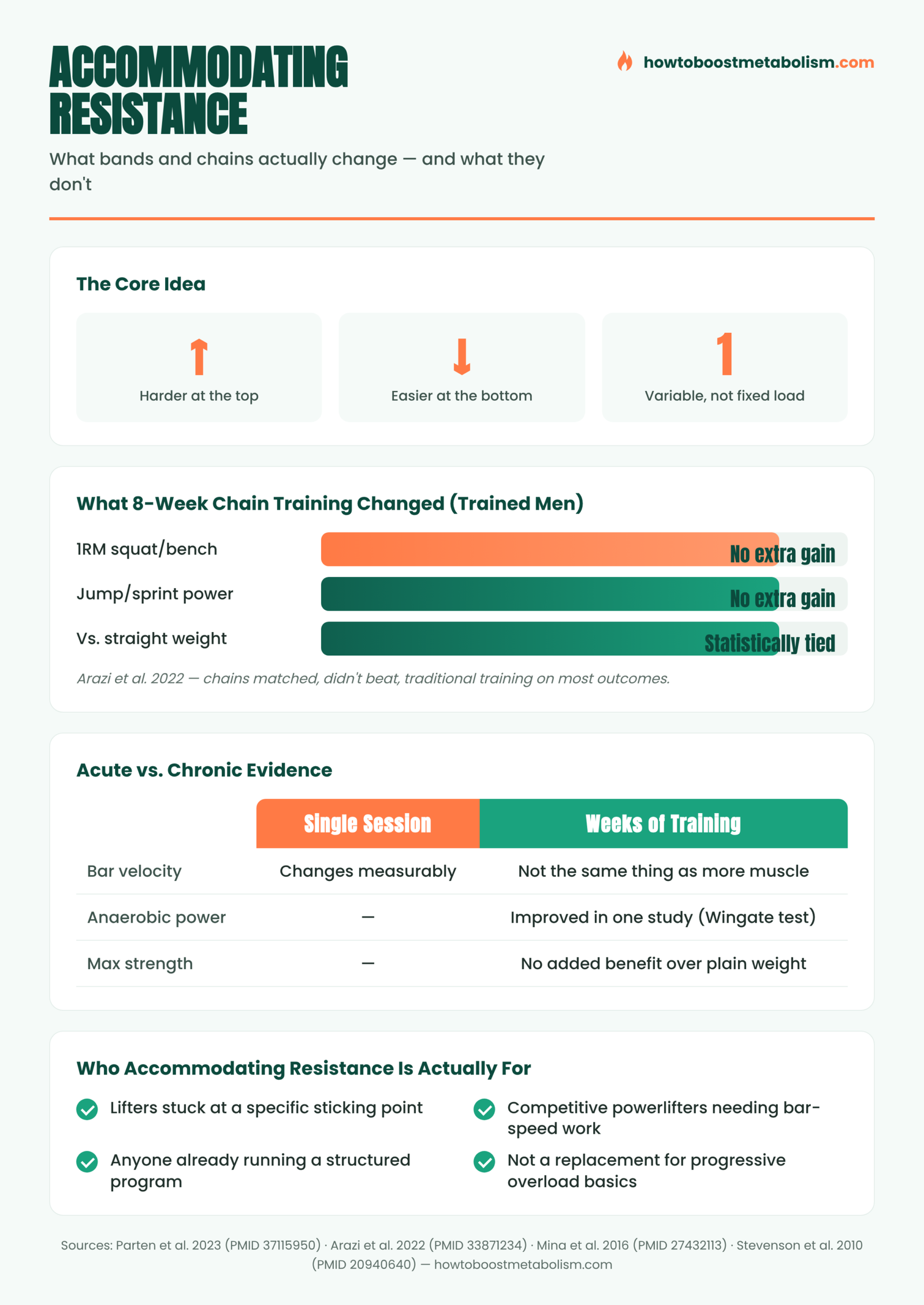
In a normal barbell lift, the resistance is fixed: a 135 lb bar weighs 135 lb at every point in the range of motion. But your own ability to produce force isn’t fixed — in a squat or bench press, you’re mechanically weakest near the bottom (the sticking point) and strongest near the top, where leverage improves. That mismatch is the entire premise behind accommodating resistance.
Bands anchored to the floor stretch as the bar rises, so resistance increases through the top of the lift, right where you’re mechanically strongest. Chains do something similar in reverse: more links pile onto the floor as you descend, so the effective loaded weight is lightest at the bottom and heaviest at the top, because by the top nearly the full chain weight is suspended off the ground. Both tools are trying to make the resistance curve track your strength curve more closely than a plain barbell can.
Why the Strength Curve Mismatch Exists in the First Place
The mismatch comes down to joint leverage, not muscle fatigue. In a squat, your hip and knee extensors have their worst mechanical leverage when your hips and knees are most bent — near the bottom. As you rise, leverage improves and the same muscles can produce more usable force at the bar. A fixed barbell weight doesn’t know that. It’s exactly as heavy at the hardest point of the lift as at the easiest one, which is why the bottom of a squat or the mid-range of a bench press is usually where a lift stalls or fails, even though the lifter clearly has more than enough strength to finish the rep once past that point.
Accommodating resistance is simply an attempt to load the easy part of the range more and the hard part less — or, with bands set up to add resistance at the top, to load the already-strong part of the range even more, forcing it to keep producing force instead of coasting through on momentum. Both setups are legitimate variations on the same underlying idea: match the external load to the body’s own strength curve instead of leaving it flat.
What a Single Session Changes (the Acute Evidence)
Attach bands to a free-weight back squat and you measurably change velocity, power, and force output through the lift — researchers confirmed this directly by comparing squats with and without elastic bands using motion capture and force plates. The kinetic and kinematic profile of the lift genuinely changes (Stevenson et al., 2010, J Strength Cond Res).
There’s also a specific, well-replicated warm-up effect: loading chains onto a bar for a few warm-up sets before a heavy back squat improved subsequent maximal back squat performance compared with a standard warm-up (Mina et al., 2016, Eur J Sport Sci). That’s a real, usable finding — but it’s about priming the nervous system for one heavy set that day, not about building more strength or muscle over months.
Free download
🔥 The Metabolism Starter Kit
3 honest guides: a 7-day reset plan, a foods cheat-sheet and 12 metabolism myths debunked. No spam — unsubscribe anytime.
What Weeks of Training Actually Change (the Part That Matters More)
This is where the story gets honest. A controlled comparison of traditional resistance training against chain-loaded accommodating resistance training in young men found the two approaches produced statistically similar muscular adaptations — chains didn’t outperform plain weight on strength or hypertrophy outcomes over the training block (Arazi et al., 2022, J Sports Med Phys Fitness).
A seven-week accommodating resistance program in strength-trained women told a similarly mixed story: it improved Wingate peak power (a short, maximal anaerobic power test) but did not improve measured muscular strength or endurance compared with the women’s baseline training (Parten et al., 2023, J Strength Cond Res). In plain terms: a narrow, specific power quality moved. General strength did not.
Put those two studies together and the honest summary is this: accommodating resistance can shift how a lift feels and, in some protocols, a specific power output — but it has not been shown to beat straightforward progressive-overload training with plain weight for building strength or muscle over a training block. If you’ve seen a claim online that chains or bands are a shortcut to faster gains, the actual training literature doesn’t back that up.
| Outcome | What the research found | Source |
|---|---|---|
| Acute bar speed/power | Changes measurably within the session | Stevenson et al. 2010 |
| Warm-up performance | Chain warm-up improved the next heavy set | Mina et al. 2016 |
| Weeks of strength training | No advantage over plain weight | Arazi et al. 2022 |
| Weeks of power training (women) | Peak anaerobic power improved; strength/endurance did not | Parten et al. 2023 |
So Who Over 40 Should Actually Use This?
After 40, recovery capacity and joint tolerance usually matter more than squeezing out a marginal training variable. Accommodating resistance isn’t dangerous when used sensibly, but it’s also not a priority tool for most lifters in this age group. A few situations where it’s genuinely worth the setup time:
- You already train with a structured, progressive program and have a specific sticking point (usually the bottom of a squat or bench) you’ve been stuck at for months.
- You compete, or plan to compete, in a sport where bar speed through a specific range matters.
- You enjoy the variation and have the equipment already — as an occasional tool, not your main driver of progress, it’s low-risk.
- You’re using a band or chain warm-up specifically before your heaviest working set, where the acute performance boost has the best evidence behind it.
If none of that describes you, the more useful question isn’t “should I add bands or chains?” — it’s whether your overall program has the basics in place: a sensible rep range, enough weekly volume, and progressive overload over time. A complete structured program built around those fundamentals will do more for a lifter over 40 than any accessory tool layered on top of a weak foundation.
Old School New Body is a full strength program built specifically around training over 40, with the progression and recovery structure most lifters need before fancy accessory tools are worth adding. (Note: some of the program’s marketing claims about age-related muscle loss aren’t independently sourced — judge the program on its actual structure, not its ad copy.)
See the Program →Affiliate link — we may earn a commission at no extra cost to you. Disclosure
The Marketing Claim Worth Pushing Back On
A lot of the enthusiasm for accommodating resistance online comes from powerlifting culture, where chains and bands have a long history and a specific competitive purpose: training explosiveness through a range that matters for a one-rep max on a platform. That context doesn’t automatically transfer to a general fitness or longevity goal. If your goal is more muscle, better body composition, or simply staying strong into your 60s and 70s, the studies above suggest you’re not missing out on much by skipping bands and chains entirely and spending that setup time on an extra set of your main lift instead.
A Few Practical Notes If You Do Try It
- Start light. Banded and chained lifts feel different under tension — your normal working weight will feel heavier at the top of the movement than you expect.
- Bands have a learning curve for setup. Anchor points need to be secure and symmetrical, or you’ll load one side of the bar more than the other.
- Chains are loud and take floor space. Not a performance issue, just a practical one in a home gym or busy commercial gym.
- Don’t abandon straight-weight training. The evidence above supports accommodating resistance as an addition for specific goals, not a replacement for your main strength work.
A Sample Way to Actually Add This to a Training Week
If you decide the acute warm-up effect or the sticking-point work is worth the setup, here’s a reasonable way to add it without overhauling your whole program:
- Keep your main strength lift (squat, bench, or deadlift) as straight barbell weight for your working sets — this is still where the bulk of your strength and muscle gains come from.
- Before your heaviest working set, run 2–3 warm-up sets with light chains added, building toward your top set. This is the specific protocol with the clearest evidence behind it.
- If you want to target a stalled sticking point, add bands or chains to one accessory variation of the lift (for example, a banded box squat) for 2–3 sets of 3–5 reps, once or twice a week, for a block of 4–6 weeks.
- Reassess after that block. If your sticking point hasn’t moved, the tool isn’t the problem — your overall volume, recovery, or technique at that joint angle is more likely the limiting factor.
Notice what this plan does not do: it doesn’t ask you to replace your main lifts with banded or chained versions, and it doesn’t promise that adding either tool will meaningfully speed up general strength or muscle gains. That’s a deliberate reflection of what the research in the table above actually shows — a specific, narrow use case, layered on top of a program that already has the fundamentals covered.
For more on building the foundation these tools sit on top of, see our guides to training volume landmarks (MEV/MAV/MRV), rep tempo and time under tension, and resistance bands vs. free weights if bands alone (without a barbell) are more your setup.
Free download: our Metabolism Starter Kit — a protein calculator, a 7-day meal framework, and a one-page supplement checklist, with zero hype.
Get the Free Starter Kit →Frequently Asked Questions
Do bands or chains build muscle faster than regular weights?
No controlled training study has shown that. A direct comparison of chain-loaded training against traditional training in young men found statistically similar muscle and strength adaptations over the training block — chains didn’t add an advantage.
What’s the real benefit of chains, then?
The best-supported use is as a warm-up tool: loading chains for a few warm-up sets before your heaviest set improved subsequent maximal back squat performance in trained lifters. There’s also evidence that a several-week accommodating resistance block can improve a specific anaerobic power output, even without improving general strength.
Are bands or chains better for someone over 40?
Neither tool has age-specific research behind it. The practical consideration for lifters over 40 is usually setup complexity and joint feel rather than any special benefit or risk tied to age itself. Programming fundamentals (volume, recovery, progression) matter far more at this stage.
Should I replace straight-weight training with accommodating resistance?
The evidence doesn’t support that. Studies comparing the two approaches over weeks of training found accommodating resistance matched, but did not beat, plain-weight training on strength and hypertrophy outcomes. Use it as an addition for a specific goal, not a replacement.
What equipment do I actually need to try this safely?
Resistance bands rated for strength training (not physical-therapy bands) with secure floor anchors, or chains with appropriate collars to attach them to a barbell. Start with a lighter band or shorter chain than you think you need — the added resistance at the top of the lift is easy to underestimate.