Pre-Sleep Protein After 40: Does Casein Before Bed Help?
This article may contain affiliate links. If you buy through them, we may earn a small commission at no extra cost to you. See our Affiliate Disclosure and Medical Disclaimer.
“Eat casein before bed so you don’t lose muscle overnight” is one of those tips that’s been repeated so often in gym culture that it’s treated as settled science. It isn’t entirely wrong — there’s real, well-controlled research behind the basic mechanism. But the full picture, especially for anyone over 40, has an honest gap in it that most articles skip. Here’s what the actual trials show, including where the evidence runs out.
This matters because overnight hours are the longest stretch most people go without eating, and skeletal muscle is in a constantly shifting balance between being built up (synthesis) and broken down (breakdown) all day and night. The question researchers have been testing for well over a decade isn’t whether muscle breaks down a little overnight — some of that is completely normal — but whether a small, well-timed dose of slow-digesting protein can measurably tip that balance in a useful direction, and whether doing so for weeks or months actually shows up as more muscle and strength later.
The Basic Mechanism: Why Casein, and Why Before Sleep
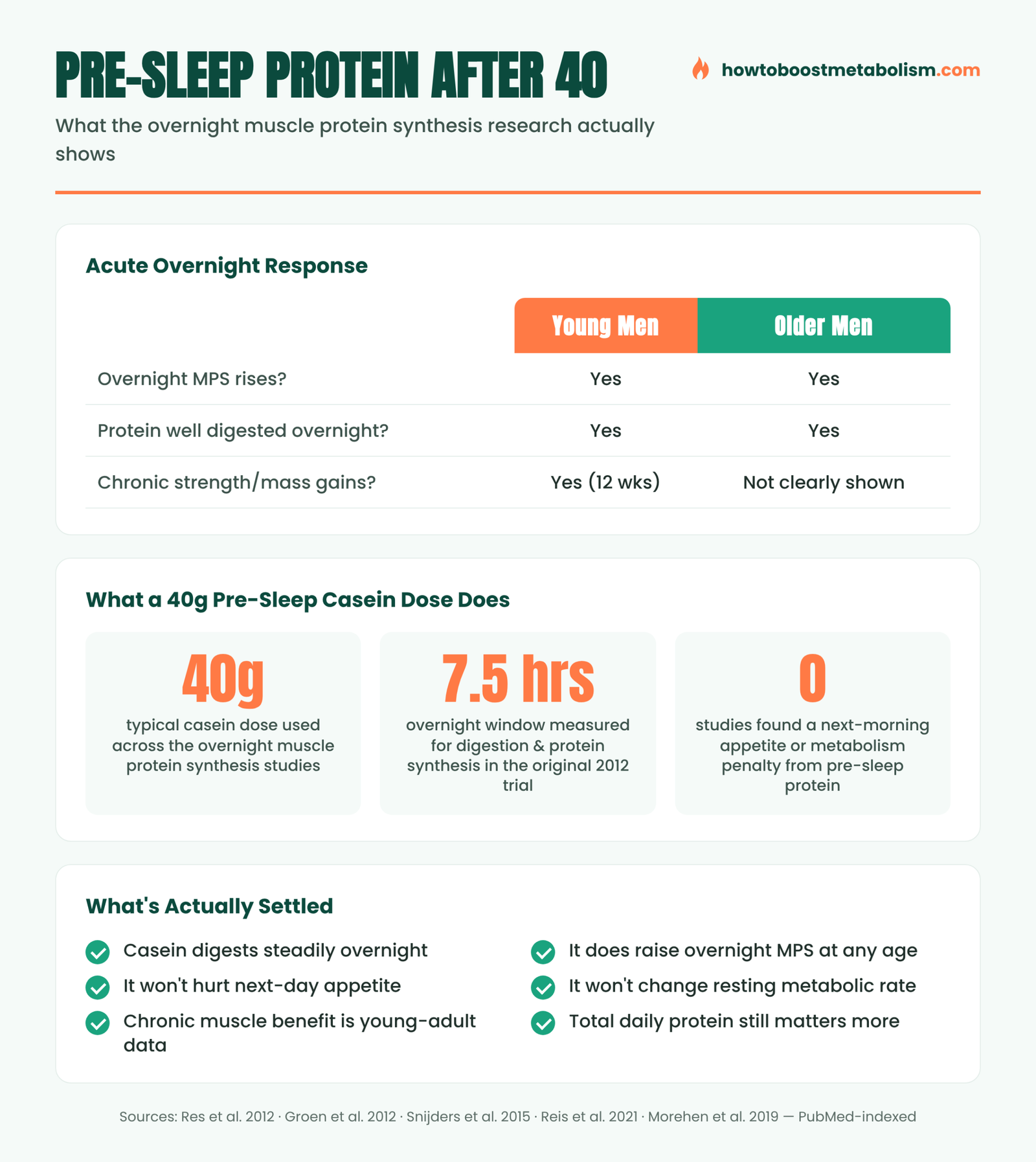
Casein is a slow-digesting milk protein, which is exactly why it was chosen for the foundational trial on this topic (Res et al., 2012, Medicine & Science in Sports & Exercise). Sixteen healthy young men did a single evening resistance workout, ate a normal post-workout meal, and then 30 minutes before sleep drank either 40 grams of casein or a placebo. Using labeled amino acid tracers, the researchers confirmed the casein was digested and absorbed steadily across the roughly 7.5-hour overnight window, keeping blood amino acids elevated all night, and it meaningfully increased whole-body and muscle protein synthesis rates during sleep compared to placebo. That’s a well-controlled, direct demonstration that the mechanism is real: your body can digest and use protein while you sleep, and casein’s slow-release digestion profile suits that window well.
Does It Work the Same Way in Older Adults?
Yes, for the acute overnight response. A companion study using the same tracer methodology (Groen et al., 2012, American Journal of Physiology – Endocrinology and Metabolism) gave a single bolus of labeled casein, with no prior exercise, to 16 healthy elderly men during sleep. Overnight whole-body protein balance turned clearly positive in the protein group compared to placebo, and overnight muscle protein synthesis rates were substantially higher. So the core digestion-and-synthesis mechanism holds up in older adults just as it does in younger men — age doesn’t block it.
A more targeted follow-up asked a sharper question: does pre-sleep protein help build connective tissue, not just contractile muscle protein, in older men (Holwerda et al., 2021, International Journal of Sport Nutrition and Exercise Metabolism)? Thirty-six older men were split into protein-only, placebo, and exercise-plus-protein groups. Pre-sleep protein alone did not significantly increase muscle connective tissue protein synthesis rates. Exercise plus pre-sleep protein did increase it more than exercise alone — but the effect was specific to combining training with the protein, not the protein by itself. It’s a useful reminder that “protein synthesis went up” doesn’t automatically mean every tissue type responds the same way, or that the protein is doing the heavy lifting on its own.
Free download
🔥 The Metabolism Starter Kit
3 honest guides: a 7-day reset plan, a foods cheat-sheet and 12 metabolism myths debunked. No spam — unsubscribe anytime.
The Part Most Articles Skip: Chronic Gains Are Mostly Young-Adult Data
This is the honest nuance that matters most if you’re over 40. A 2021 systematic review that pooled nine studies on this exact question (Reis et al., Journal of Science and Medicine in Sport) concluded that pre-sleep protein consumption “can augment the muscle adaptive response (muscle fiber cross-sectional area, strength and muscle mass) during 10-12 weeks of resistance exercise in young, but not in elderly men.” In plain terms: the long-term training study that actually measured real strength and muscle-mass gains over three months (Snijders et al., 2015, The Journal of Nutrition) was done in 44 young men, and it did find a meaningful benefit from adding nightly casein to a training program. The equivalent long-term training study simply hasn’t shown the same clear benefit in older adults — not because it’s been disproven, but because the chronic (weeks-to-months) research in older adults is thinner and the connective-tissue data above suggests the response may not be identical. That’s a meaningfully different claim than “pre-sleep protein builds muscle,” and it’s the part of this topic most promotional content leaves out entirely.
Does It Mess With Next-Day Appetite or Metabolism?
This is one place the evidence is reassuring and consistent. A randomized crossover study in older adults (Morehen et al., 2019, Nutrients) gave 12 older participants a 40g pre-sleep protein drink, an isocaloric carbohydrate drink, or a placebo and measured next-morning appetite, energy intake at breakfast, resting metabolic rate, and several appetite-related hormones. None of those measures differed meaningfully between groups. A broader systematic review reached the same conclusion (Dela Cruz & Kahan, 2021, Nutrients): across 11 studies, pre-sleep casein in the 24-48g range showed limited to no effect on energy expenditure, lipolysis, appetite, or food intake. In short: it won’t wreck your next-day hunger or secretly slow your metabolism, but it also won’t speed it up — it’s metabolically close to neutral outside of the direct muscle protein synthesis effect.
At a Glance: What the Evidence Actually Supports
| Question | Younger adults | Older adults (40+/elderly) |
|---|---|---|
| Overnight muscle protein synthesis rises | Yes — young men | Yes — older men too |
| Protein digested steadily overnight | Yes | Yes |
| Builds measurable strength/mass over months | Yes (Snijders 2015, 12 wks) | Not clearly shown yet |
| Hurts next-day appetite or metabolism | No | No |
Why This Matters More If You’re Also Working to Preserve Muscle
Pre-sleep protein timing is a small lever on its own, but it’s worth paying more attention to if you’re already in a situation where muscle preservation is a priority — for example, if you’re using a GLP-1 medication and working to protect lean mass while losing weight, or following a structured strength plan alongside Ozempic or a similar medication. In those situations, every practical, low-risk tool for nudging muscle protein synthesis upward is worth considering, precisely because appetite is often suppressed and hitting total daily protein targets can be genuinely difficult. A pre-sleep protein shake or snack is one of the easier ways to add 20-40 grams of protein on a day when a shrunken appetite made the rest of the day’s meals lighter than usual.
Practical Logistics: Timing, Volume, and a Few Mistakes to Avoid
The research protocols are a useful template if you want to copy what was actually tested, rather than guessing:
- Timing: roughly 30 minutes before going to sleep, not hours earlier — closer to bedtime keeps amino acids elevated through more of the overnight window.
- Volume: 20-40 grams of protein, dissolved in a reasonable amount of liquid if you’re using a shake — a thick, hard-to-digest mix right before bed can work against comfortable sleep.
- Don’t double up on dinner. This is meant to be an addition to your normal eating pattern, not stacked on top of an already protein-heavy dinner just because “more must be better.”
- Watch total fluid volume if middle-of-the-night bathroom trips disrupt your sleep — a smaller, more concentrated shake or a solid food option like Greek yogurt may suit you better than a large mixed drink.
- Don’t expect it to replace a poor daily protein intake. This is a refinement for people who are already close to their daily target, not a substitute for fixing an under-protein diet.
So Should You Actually Do This After 40?
Given the evidence, a reasonable, honest position looks like this:
- It’s not going to hurt you. No study found a downside to next-day appetite, metabolism, or hormones from a 20-40g pre-sleep casein dose.
- The acute mechanism is real at any age — your body does digest and use that protein overnight, whether you’re 25 or 65.
- The chronic payoff (actual extra muscle or strength over months) is better established in young adults than in people over 40, simply because the long-duration training studies in older adults haven’t shown the same clear result yet.
- Total daily protein intake still matters far more than timing. If you haven’t sorted out how much protein you actually need per day, fix that first — a pre-sleep snack won’t compensate for being short on protein across the whole day.
- It’s a reasonable, low-risk add-on if you’re already hitting your daily protein target and have room for one more easy snack before bed, not a must-do intervention.
What to Actually Eat
You don’t need a specialty “night-time protein” product. Any slow-digesting protein source in the 20-40g range before bed fits the research above:
- A scoop of casein or a blend — see our comparison of whey vs. plant protein if you’re deciding what to keep on hand.
- Low-fat Greek yogurt or cottage cheese, both naturally high in casein.
- A glass of milk, dairy or fortified plant-based, if you tolerate it well.
- A small high-protein snack from our late-night eating guide, if you’d rather eat real food than mix a shake.
For most people, this fits better as one piece of a day-wide plan than as a stand-alone fix — see our guide to spreading protein intake across the day rather than front- or back-loading it for the bigger-picture strategy pre-sleep protein slots into.
Free download: our Metabolism Starter Kit — a protein calculator, a 7-day meal framework, and a one-page supplement checklist, with zero hype.
Get the Free Starter Kit →Frequently Asked Questions
Does eating protein before bed actually build muscle after 40?
The overnight mechanism works at any age — your body digests casein steadily overnight and does increase muscle protein synthesis. But the long-term training studies showing real strength and muscle-mass gains from this habit were done in young men; a 2021 systematic review found the chronic adaptive benefit was shown in young men but not clearly shown in elderly men. It’s promising, not proven, for older adults.
Will pre-sleep protein make me gain fat or mess up my appetite?
No. Multiple studies, including a randomized crossover trial in older adults, found no significant effect on next-morning appetite, energy intake, or resting metabolic rate from a 40g pre-sleep protein drink.
How much protein should I eat before bed?
Most of the research used 20-40 grams of casein about 30 minutes before sleep. There’s no evidence that more than that adds extra benefit.
Is casein better than whey for this specific purpose?
Casein’s slow digestion is why it was chosen for these studies — it keeps amino acids available over several hours, which suits an overnight window. Whey digests much faster and would likely be absorbed and used well before the later hours of sleep.
Is this more important than just hitting my daily protein target?
No — total daily protein intake has a much larger and better-established body of evidence behind it than the specific timing of a pre-sleep dose. Get your daily total right first; treat pre-sleep protein as a minor refinement, not the main lever.
Can I just eat a bigger dinner instead of a separate pre-sleep snack?
A bigger dinner doesn’t recreate the same overnight digestion pattern the research tested, since most of that protein would be digested and used well before the later hours of sleep. If getting a specific overnight effect matters to you, a smaller dose closer to bedtime matches what was actually studied better than simply front-loading dinner.
This article is for educational purposes and is not medical advice. See our Medical Disclaimer and check with a doctor or dietitian before making major changes to your protein intake, especially if you have kidney disease or another condition affected by protein intake.