
Newbie Gains: Why They Happen and Why They Fade
This article may contain affiliate links. If you buy through them, we may earn a small commission at no extra cost to you. See our Affiliate Disclosure and Medical Disclaimer.
If you’ve ever started lifting weights and been shocked by how fast you got stronger in the first few weeks, you’ve experienced what lifters call “newbie gains.” It feels almost too good to be true, and then, inevitably, it slows down and the same rate of progress stops working. Here’s what’s actually happening physiologically during that window, why it never lasts, and what the research says about getting it back if you take time off.
What ‘Newbie Gains’ Actually Means
The term describes the unusually fast rate of strength and visible-progress improvement that untrained or long-detrained people experience in their first weeks to months of consistent resistance training, compared to the much slower rate of progress experienced by people who’ve been training for years. It’s not a myth or a placebo effect; it reflects a real, well-documented pattern in exercise physiology, where the body’s early response to a novel stimulus is disproportionately large relative to later responses to the same stimulus.
It’s Mostly Your Nervous System at First, Not Your Muscles
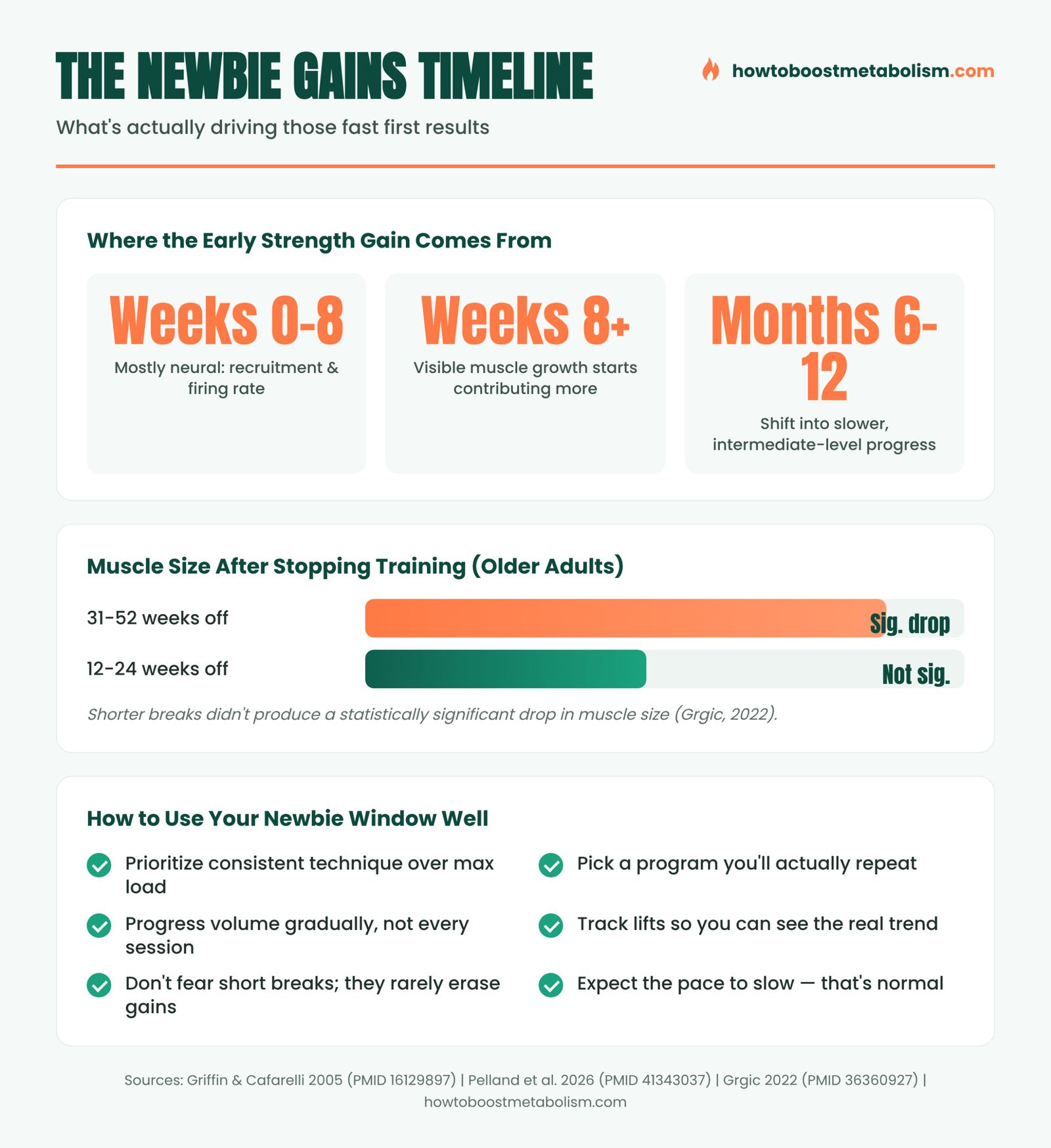
A foundational line of research in exercise physiology established that during the first few weeks of resistance training, maximal force output increases by an amount that can’t be explained by muscle growth alone (Griffin and Cafarelli, 2005, Canadian Journal of Applied Physiology, PMID 16129897). The early force increase instead comes substantially from neural adaptations: decreases in the force threshold at which motor units get recruited, increases in how fast those motor units fire, and better coordination between the muscles doing the work and the ones that would otherwise work against the movement. In plain terms, your nervous system gets dramatically better at using the muscle you already have before that muscle meaningfully grows.
More recent research has added nuance rather than overturning this picture: a 2024 review in The Journal of Physiology notes that some of these early neural adaptations are specific to the exact task you train, and that short-term strength training doesn’t always change the very earliest phase of rapid force production in the way researchers once assumed (Del Vecchio, Enoka and Farina, 2024, The Journal of Physiology, PMID 38686581). The broad takeaway still holds: a large share of the “newbie” strength jump in the first weeks is neurological, not muscular, which is exactly why strength can rise noticeably in week two or three before you see any real change in the mirror.
Free download
🔥 The Metabolism Starter Kit
3 honest guides: a 7-day reset plan, a foods cheat-sheet and 12 metabolism myths debunked. No spam — unsubscribe anytime.
Why the Rate of Gains Always Slows Down
A large 2026 meta-regression analysis covering 67 studies and over 2,000 participants modeled how weekly training volume and frequency relate to strength and muscle-size gains, adjusting for training status and program duration (Pelland et al., 2026, Sports Medicine, PMID 41343037). Both strength and hypertrophy increased as weekly volume increased, but both relationships showed diminishing returns, meaning each additional unit of training produces a progressively smaller benefit, and the researchers found this pattern was considerably more pronounced for strength than for hypertrophy. That’s a mathematical description of exactly what lifters feel: your first few months of consistent training produce an outsized return on a relatively modest amount of work, and from there, squeezing out further progress takes more volume, more time, and more precise programming for a proportionally smaller reward.
This is a normal, expected feature of adaptation, not a sign that you’re doing something wrong. Your body responds most dramatically to a stimulus it hasn’t adapted to yet. Once it has adapted, the same stimulus produces less of a response, and you need a bigger or smarter one to keep progressing, which is the entire premise behind concepts like progressive overload and periodized training.
What Happens If You Stop? Detraining and ‘Muscle Memory’
A reasonable worry during the newbie window is that any break will erase your progress. The evidence suggests that’s generally overstated for shorter breaks. A 2022 meta-analysis pooling data from older adults found that muscle size increased significantly with resistance training, and decreased significantly after training stopped, but the decrease wasn’t statistically significant after 12-24 weeks of detraining; it only became clearly significant after 31-52 weeks off (Grgic, 2022, International Journal of Environmental Research and Public Health, PMID 36360927). In other words, a few weeks or even a few months away from the gym is unlikely to wipe out meaningful muscle; a half-year or more without any training is where the evidence shows real, measurable loss.
There’s also a genuinely interesting cellular explanation for why retraining often feels faster than starting from scratch. A 2024 study that tracked muscle biopsies through training, 16 weeks of detraining, and retraining found that the number of myonuclei (the cellular machinery that supports muscle fiber growth) gained during initial training was largely retained during the detraining period, giving previously trained muscle a structural head start compared to muscle that had never been trained (Cumming et al., 2024, The Journal of Physiology, PMID 39159314). Importantly, the same study found this retained advantage didn’t translate into a clearly larger or faster strength and size response upon retraining in their data, so the honest summary is: the cellular hardware for faster regrowth does appear to stick around, but whether that reliably speeds up visible results in every lifter is still being worked out.
How to Tell Your Newbie Window Is Ending
There’s no single test for this, but a few patterns tend to show up together. Lifts that used to go up every week start requiring two or three sessions to add the same small amount of weight. You can no longer add meaningful load to every single exercise in a workout; some lifts stall while others keep progressing. Workouts that used to leave you only pleasantly tired start requiring real recovery planning, like paying closer attention to sleep and protein intake, to keep progressing at all. None of this means something has gone wrong; it means your body has caught up to the easy, task-specific neural adaptations and is now relying more on the slower process of actually building new muscle tissue and refining technique at the margins, which is a normal and expected transition for every lifter who sticks with training long enough to get there.
| Phase | What’s driving it | What you notice |
|---|---|---|
| 0-8 weeks | Neural adaptations dominate | Rapid strength gains, little visible muscle change |
| 8-24 weeks | Hypertrophy increasingly contributes | Strength gains continue, muscle becomes visible |
| 6-12+ months | Adaptation reserve shrinks | Progress slows to typical intermediate pace |
| 12-24 wks off | Myonuclei largely retained | No significant muscle-size loss (older adults) |
| 31-52 wks off | Fiber size declines further | Significant muscle-size loss (older adults) |
Common Mistakes That Waste the Newbie Window
- Program-hopping every few weeks. Since almost anything works early on, it’s tempting to credit whatever program you’re on and jump to the next trendy one; this makes it hard to build the skill and consistency you’ll need once gains slow down.
- Chasing load over form. Rapid early strength gains can tempt you into adding weight faster than your technique can safely handle, which sets up injuries that interrupt training later, exactly when consistency starts to matter more.
- Assuming the current pace is the new normal. Lifters who expect the fast early progress to continue indefinitely often get discouraged and quit once the rate normalizes, even though the slowdown is expected and not a sign of failure.
- Neglecting recovery because ‘it feels easy.’ Early progress can mask the accumulated fatigue of inconsistent sleep, nutrition, or recovery; those habits catch up once the neural ‘free lunch’ phase ends.
How to Make the Most of Your Newbie Window
- Pick one reasonable program and stick with it for at least 8-12 weeks before judging it, rather than switching every time you read about something new.
- Track your actual numbers (weight, reps, sets) so you can see the real trend rather than relying on how a session felt.
- Build technique now, while the stakes are lower, since the habits you form here carry into heavier, less forgiving training later.
- Add volume and intensity gradually, even though your body can currently handle big jumps, so you don’t outrun your joints and connective tissue.
- Don’t panic about short breaks. A week or two off for illness, travel, or life is not going to meaningfully reverse your progress.
If you want more on how to structure the training itself once the fast gains slow down, see our guides to progressive overload and training volume landmarks, which cover how to keep making progress once your body stops handing it to you for free.
If you want a structured, step-by-step plan to follow through this window instead of guessing at your own programming, Anabolic Fasting combines a fasting protocol with a training structure aimed at building muscle while managing fat.
Learn More →Affiliate link — we may earn a commission at no extra cost to you. Disclosure
Honest note: building muscle and losing fat “at the same time” is a marketing framing, not a guarantee; how much of either happens depends heavily on your training consistency, food intake, and recovery, not the protocol alone.
Free download: our Metabolism Starter Kit — a protein calculator, a 7-day meal framework, and a one-page supplement checklist, with zero hype.
Get the Free Starter Kit →If you’re newer to structured training altogether, our strength training for beginners guide is a good companion to this one for picking your first real program.
Frequently Asked Questions
How long do newbie gains actually last?
There’s no fixed clock, but most of the fastest strength jumps happen in the first 2-3 months of consistent training, driven heavily by neural adaptations, with visible muscle growth increasingly contributing from roughly 8-12 weeks onward. By somewhere around 6-12 months of consistent training, most lifters have shifted from the steep newbie curve into the much slower, grinding progress that defines intermediate and advanced lifting.
Is it really ‘all neural,’ or does muscle grow early too?
It’s not all neural, but neural adaptations dominate the earliest weeks. Classic research on resistance training found strength increases in the first few weeks of training that couldn’t be explained by muscle growth alone, pointing to changes in motor unit recruitment and discharge rates. Muscle fiber growth is happening too, just more slowly and less visibly at first; it becomes a bigger share of the progress as training continues.
If I stop training, do I lose my newbie gains?
Not immediately, and not entirely, especially if the break is short. A meta-analysis in older adults found no statistically significant decrease in muscle size after 12-24 weeks without training, but a significant decrease after 31-52 weeks off. Strength tends to fade a bit faster than muscle size does during a break, since some of it was neural and partly tied to recent practice.
Will I get my gains back faster the second time around?
There’s real evidence for a ‘muscle memory’ effect at the cellular level: one study found that muscle fibers kept elevated numbers of myonuclei even after a long period of detraining, which is a structural head start for regrowth. That said, the same study found this didn’t clearly translate into faster or larger strength and size gains on retraining, so treat quicker-rebound as plausible and commonly reported, not as a guaranteed, fully explained effect.
Does the newbie-gains window mean I can skip proper programming?
No; if anything it’s the opposite. Early on your body responds well to almost any reasonable, progressively loaded training, which makes it tempting to wing it. But the habits and technique you build in these first months, like a sensible exercise selection and a sustainable weekly volume, are what determine how smoothly you transition into the slower, more technical progress that follows. Sloppy form or erratic programming during the newbie window can also set up injuries that cost you training time later.
This article is for educational purposes and is not a substitute for personalized medical or training advice. See our Medical Disclaimer.