Bulgarian Split Squat: The Complete Form & Loading Guide
This article may contain affiliate links. If you buy through them, we may earn a small commission at no extra cost to you. See our Affiliate Disclosure and Medical Disclaimer.
If you’ve spent any time around a serious strength program over the last few years, you’ve probably seen someone wobbling through a set of Bulgarian split squats with a loaded barbell or a pair of dumbbells, rear foot propped on a bench, front leg shaking by rep eight. It looks brutal, and it has a reputation as one of the more punishing single-leg exercises in the gym. The question worth asking before you load it up is simpler: what is it actually doing for you, how much weight should you realistically use, and how do you avoid the form mistakes that turn a good exercise into a knee-nagging one? The research on this exercise has grown substantially in the last few years, and it gives a clearer answer than gym folklore usually does.
What the Bulgarian Split Squat Actually Is
The Bulgarian split squat — also called the rear-foot-elevated split squat (RFESS) in the research literature — is a single-leg squat variation where your rear foot rests on an elevated surface (a bench, box, or step) behind you while your front leg does the vast majority of the work. You lower your back knee toward the floor by bending your front leg, then push back up through your front heel and midfoot.
The name is a bit of gym mythology — there’s no strong documented link to Bulgarian weightlifting programs, though the exercise has been a staple of strength and conditioning for decades. What matters more than the history is the biomechanics, and that’s where the research gets useful.
Is It Really a “Unilateral” Exercise, or Is the Back Leg Helping?
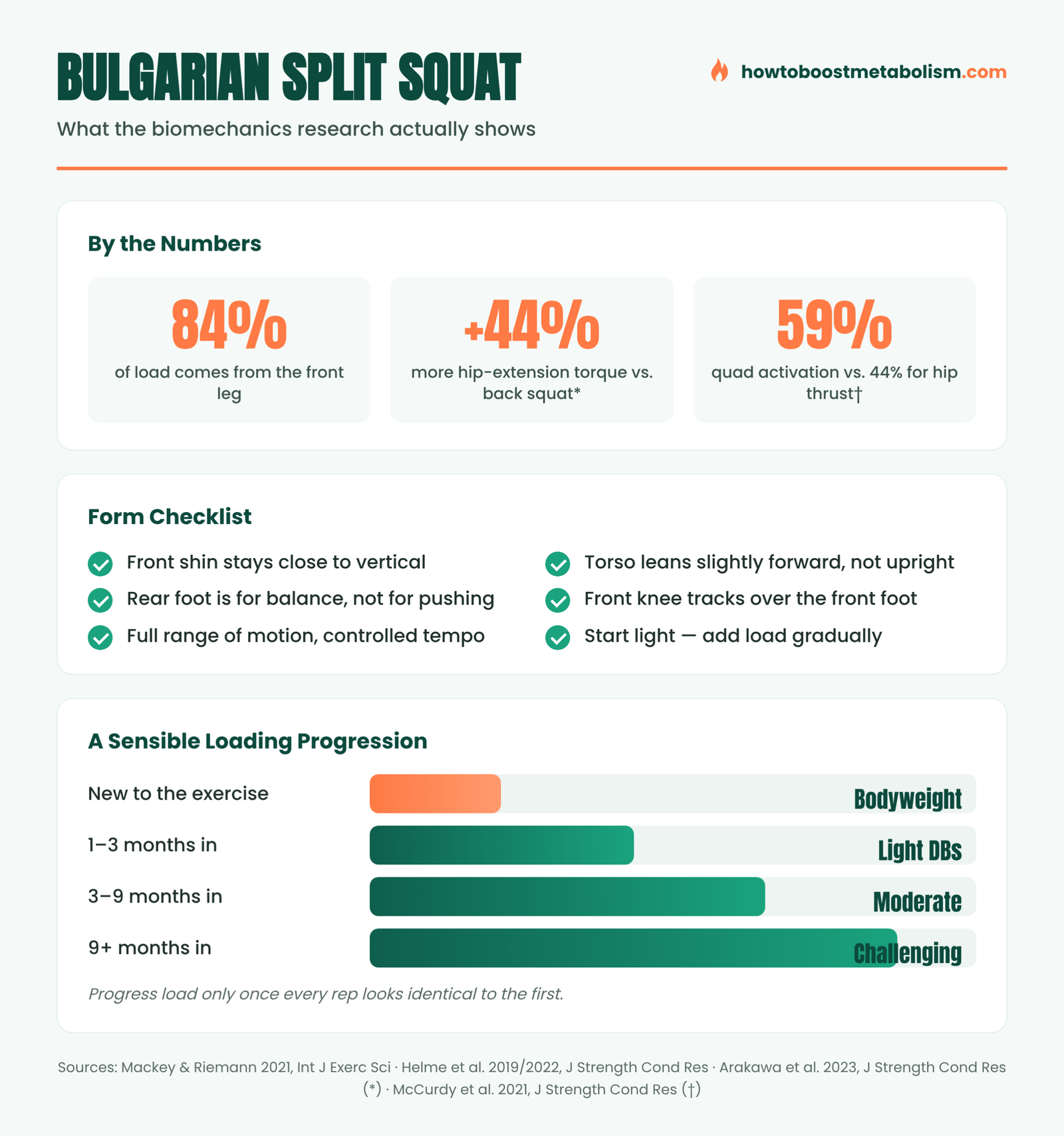
This is a fair question, because the rear foot is still in contact with something. A study out of Leeds Beckett University put this to the test directly, using two separate force plates — one under the front foot, one under a raised block for the rear foot — to measure exactly how much force each leg contributed across 715 analyzed repetitions (Helme et al., 2022). The result: the lead (front) leg produced an average of 84.4% of total vertical force. The researchers also found no meaningful relationship between rear-foot force contribution and how heavy the load was, which supports treating the exercise as a genuinely unilateral movement rather than a two-legged squat in disguise. In the same research group’s earlier validity study, they used the Bulgarian split squat’s 5-rep-max as a field test for measuring leg strength symmetry between sides (Helme et al., 2019) — which only makes sense if the exercise is reliably isolating one leg at a time.
Free download
🔥 The Metabolism Starter Kit
3 honest guides: a 7-day reset plan, a foods cheat-sheet and 12 metabolism myths debunked. No spam — unsubscribe anytime.
How It Compares to the Back Squat
A study from Georgia Southern University directly compared the joint-by-joint mechanical demands of the Bulgarian split squat and the traditional back squat in resistance-trained men (Mackey & Riemann, 2021). Both exercises turned out to be hip-dominant — meaning the hip does more total work than the knee or ankle in either one. The key difference was at the knee: during the Bulgarian split squat, knee joint work was statistically lower than ankle joint work, while during the back squat, knee work was statistically higher than ankle work. In plain terms, the Bulgarian split squat shifts some of the mechanical burden away from the knee relative to the back squat, which is part of why coaches often reach for it during the early stages of knee rehab or when someone needs a hip-focused exercise that doesn’t hammer the knee joint as hard.
A separate study comparing the rear-foot-elevated split squat to the conventional two-leg back squat at matched relative intensity (10-rep-max loads) found the hip extension moment was 44% greater in the elevated split squat at the bottom position, and 47% greater at its peak (Arakawa et al., 2023). That’s a meaningful difference — even though the absolute weight on the bar is lower in the single-leg version, each working hip is doing more, not less.
What Muscles Does It Actually Train?
Electromyography (EMG) research gives a detailed picture of which muscles fire hardest and when. A study in trained female lifters compared the Bulgarian split squat to the hip thrust across the full range of motion (McCurdy et al., 2021). The hip thrust produced its highest muscle activation near the top of the movement; the split squat produced its highest activation near the bottom — the deepest, most stretched position. Across the entire repetition, the split squat produced notably greater vastus lateralis (outer quad) activation than the hip thrust — 59.4% vs. 43.6% of maximum. The researchers’ practical takeaway was to use both exercises for different purposes: the hip thrust for peak-contraction glute work, and the split squat for quad-dominant work through a deep, lengthened range.
Load matters too. A study tracking muscle forces across the back squat, split squat, and step-up at increasing external loads (0–75% of bodyweight) found load-dependent increases in force for the glutes, quadriceps, hamstrings, and calf muscles across all three exercises — and the increases in glute and quad force were often more pronounced in the split squat and step-up than in the back squat (Kipp et al., 2022). A smaller EMG study using suspension-based and trunk-position variations of the Bulgarian split squat found that leaning the torso forward meaningfully increased glute max, biceps femoris (hamstring), and rectus femoris activation, while a suspension-strap version of the rear foot increased lower-back (erector spinae) activation — useful if you’re deliberately trying to bias the exercise toward glutes versus quads (Aygun-Polat et al., 2025).
How Much Weight Should You Actually Use?
This is where a lot of people get it wrong, usually in one of two directions: either they load it like a back squat and wreck their form by rep three, or they never add weight at all and stall out. In the Mackey & Riemann (2021) comparison study, researchers used roughly 35% of back-squat 1-rep-max as the Bulgarian split squat load to create a training stimulus comparable to 70% of back-squat 1-rep-max used bilaterally — a rough 1:2 ratio, though individual mobility, balance, and single-leg strength vary enough that this should be treated as a starting reference, not a formula.
| Experience level | Suggested starting load | What to prioritize first |
|---|---|---|
| New to the exercise | Bodyweight only | Depth, balance, knee tracking, front-shin angle |
| 1–3 months of practice | Light dumbbells (one in each hand, or goblet-held) | Consistency rep to rep on both sides |
| 3–9 months in | Moderate dumbbells or a light barbell on the back | Controlled tempo, especially the lowering phase |
| 9+ months, comfortable with the pattern | Progressively heavier load, tracked over weeks | Small, steady jumps — not sudden big ones |
The practical rule that matters more than any specific percentage: your weaker leg should never be doing a sloppier rep than your stronger leg just to keep up with the weight on the bar. If one side starts losing form earlier than the other, that’s useful information — not a sign to push through it.
Building a single-leg exercise like this into a real, structured plan — rather than bolting it onto the end of a workout — is exactly what a full program does well. Old School New Body is a digital program built specifically around strength training after 40, with a defined progression model. (One honest note: some of the marketing statistics on its sales page about age-related muscle loss rates are not independently sourced — judge the program on its structure, not those numbers.)
Check Availability →Affiliate link — we may earn a commission at no extra cost to you. Disclosure
Common Mistakes That Make This Exercise Worse
- Front foot too close to the bench. This forces your knee far forward and shifts more work onto the knee joint instead of the hip. Step your front foot out further than feels natural at first — most people start too short.
- Letting the front knee cave inward. Keep it tracking in line with your front foot throughout the descent, especially as fatigue sets in near the end of a set.
- Staying too upright. A slight forward lean of the torso is normal and, per the EMG research above, actually increases glute and hamstring involvement (Aygun-Polat et al., 2025) — fighting to stay bolt upright doesn’t make the exercise “more correct.”
- Rushing the eccentric (lowering) phase. The deepest, most stretched position is also where muscle activation peaks (McCurdy et al., 2021) — speeding through it trades away much of the exercise’s value.
- Adding load before depth and balance are consistent. A wobbly, partial-range rep with more weight is a worse training stimulus than a full-range, stable rep with less.
How to Add It to Your Program
Because it’s demanding and skill-dependent, the Bulgarian split squat works best placed early in a session, after a brief warm-up, while your coordination is fresh — not tacked on at the end of a workout when your balance and focus are already fatigued. Two to three sets of 6–12 reps per leg, once or twice a week, is a reasonable starting volume for most lifters; it pairs naturally into either a full-body routine or a lower-body day, and works well alongside other unilateral or bilateral lower-body work without needing to replace your main squat or deadlift pattern.
Free download: our Metabolism Starter Kit — a protein calculator, a 7-day meal framework, and a one-page supplement checklist, with zero hype.
Get the Free Starter Kit →Frequently Asked Questions
Is the Bulgarian split squat better than the back squat?
Not better — different. Research comparing the two found both are hip-dominant movements, but the Bulgarian split squat places relatively less demand on the knee joint and more on the hip, which is part of why it’s popular as a knee-friendly way to build single-leg strength (Mackey & Riemann, 2021). It’s a strong complement to bilateral squatting, not a guaranteed replacement for it.
How much weight should I use for a Bulgarian split squat?
Start lighter than you think. In controlled lab comparisons, researchers used roughly half the relative load on the Bulgarian split squat that they used on the back squat to create a comparable training stimulus (Mackey & Riemann, 2021). In practice, that means starting with just your bodyweight or very light dumbbells until your balance, depth, and knee tracking are consistent on both sides before adding meaningful load.
Is the rear leg doing much work in this exercise?
Very little, and that’s by design. Force-plate research found the front (lead) leg produces an average of 84.4% of total vertical force during the Bulgarian split squat, with the rear leg’s contribution not meaningfully tied to exercise intensity (Helme et al., 2022). That’s good evidence the exercise functions as a genuinely unilateral movement rather than a disguised two-leg squat.
What’s the difference between a split squat and a Bulgarian split squat?
A regular (flat) split squat has both feet on the ground in a staggered stance. The Bulgarian, or rear-foot-elevated, version props the rear foot up on a bench, which increases front-leg knee and hip range of motion and shifts even more of the workload onto the front leg. Research directly comparing rear-foot-elevated squats to flat-ground squats and step-ups found all three scale similarly with added load, but the elevated version tends to demand more from the front-leg glutes and quads through a deeper range (Kipp et al., 2022).
Can the Bulgarian split squat help fix a strength imbalance between my legs?
It can help you train each leg to its own capacity rather than letting a stronger leg compensate, which is the theoretical appeal. But it isn’t an automatic fix: because it’s unilateral, you naturally load each side independently, which is useful — though whether that translates into less asymmetry over time depends on consistency and starting point. If this is a specific concern, our guide on testing and interpreting strength imbalances at home walks through how to check first.