Does HMB Really Prevent Muscle Loss After 40?
This article may contain affiliate links. If you buy through them, we may earn a small commission at no extra cost to you. See our Affiliate Disclosure and Medical Disclaimer.
Walk into any supplement aisle or scroll any fitness ad after you turn 40, and HMB (β-hydroxy-β-methylbutyrate) shows up with the same pitch: take this, and you stop losing muscle as you age. It’s a real compound with real research behind it — not a tonic, not a “metabolism hack.” But the research tells a more specific story than the marketing does, and the honest answer depends almost entirely on who’s taking it.
We read the two most relevant meta-analyses on HMB and muscle loss — one in older adults, one in healthy resistance-trained adults — and they point in different directions. That split is the whole story, so let’s start there.
At a Glance
| Question | Short Answer |
|---|---|
| What is HMB? | A metabolite of the amino acid leucine, naturally produced in small amounts by the body |
| Does it work for older/inactive adults? | Modest evidence of a muscle-mass benefit (~0.35kg) in RCTs on adults 65+ |
| Does it work for healthy lifters? | Meta-analysis found no significant strength or body-composition benefit on top of training |
| Typical dose studied | 3g/day, split into doses, in most RCTs |
| Realistic role | A narrow-use supplement for specific situations, not a general muscle-preserving pill |
What HMB Actually Is
HMB is a downstream metabolite of leucine, the branched-chain amino acid most responsible for triggering muscle protein synthesis. Your body already makes a small amount of HMB on its own whenever you eat protein; supplements simply deliver a larger, standardized dose. The theory is straightforward: if leucine signals your muscles to build and retain tissue, then HMB — one step further down that pathway — should do something similar, and without needing large amounts of dietary protein to get there.
That theory is reasonable enough that HMB has been studied in dozens of trials over the past two decades, mostly in two very different populations: frail or bedridden older adults on one end, and healthy young people doing resistance training on the other. The results from those two groups don’t agree, and understanding why is the key to deciding whether HMB is worth your money.
Free download
🔥 The Metabolism Starter Kit
3 honest guides: a 7-day reset plan, a foods cheat-sheet and 12 metabolism myths debunked. No spam — unsubscribe anytime.
The Case For HMB: Older and Inactive Adults
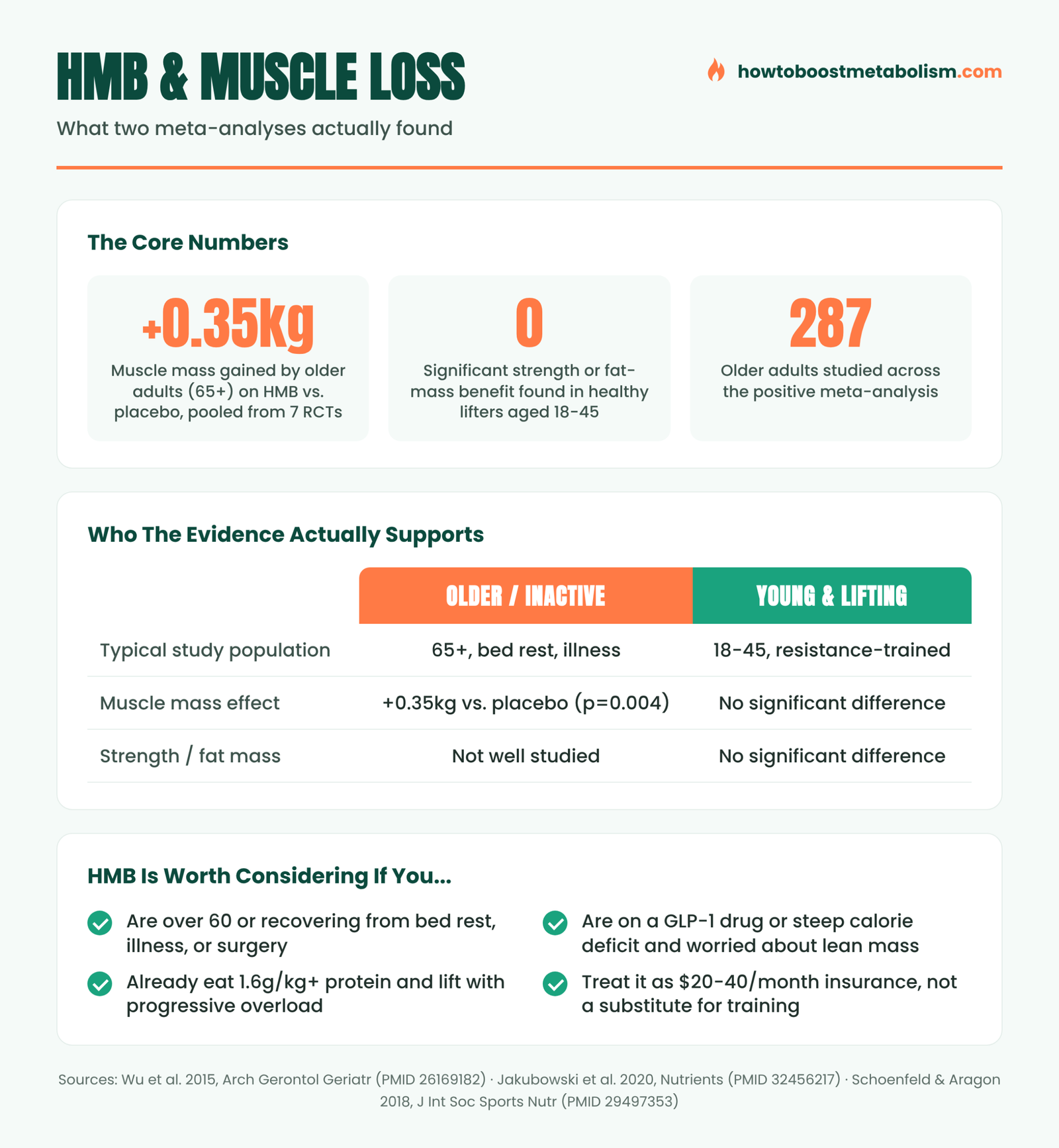
A 2015 systematic review and meta-analysis in Archives of Gerontology and Geriatrics (PMID 26169182) pooled seven randomized controlled trials covering 287 adults aged 65 and older. Across those trials, the HMB groups gained significantly more lean muscle mass than the control groups — a standardized mean difference equivalent to roughly 0.35kg of muscle, a result with a p-value of 0.004, which is a fairly strong signal for a nutrition trial. Fat mass, notably, didn’t change significantly either way; this is a muscle-preservation effect, not a fat-burning one, whatever a sales page might imply.
Why would HMB help this specific group more? Most of the trials behind that number involved adults who were inactive, recovering from bed rest, or dealing with illness — conditions where muscle breakdown accelerates and the normal signal to rebuild tissue (regular resistance training) is largely absent. In that context, a supplement that nudges the needle toward muscle retention has more room to show an effect, because there’s so little else counteracting the loss.
This is also the population most relevant to a newer, unstudied-but-logical use case: people losing significant weight quickly on GLP-1 medications like semaglutide or tirzepatide, who lose meaningful lean mass alongside fat even when eating adequate protein. HMB hasn’t been directly tested in GLP-1 users as of this writing, but the mechanism — preserving muscle during a period of reduced food intake and reduced muscle-building signaling — overlaps closely with the bed-rest and illness populations where it already has some supporting data.
The Case Against HMB: Healthy, Resistance-Trained Adults
A 2020 systematic review and meta-analysis in Nutrients (PMID 32456217) looked at the opposite population: 18-to-45-year-olds doing structured resistance training, pooling data from 302 participants across the body-composition analysis and 248 across the strength analysis. The conclusion was blunt: HMB produced a small effect on total body mass, but that didn’t translate into a significant improvement in fat-free mass, fat mass, or strength compared with training alone. The authors wrote plainly that their findings “do not support the use of HMB aiming at improvement of body composition or strength with resistance exercise training.”
A separate, smaller trial in European Journal of Sport Science reached the same conclusion for both HMB and a related compound (α-HICA), finding no effect on training-induced body composition changes. The pattern across this population is consistent: if you’re already young, healthy, training with progressive overload, and eating enough protein, HMB doesn’t appear to add anything on top of that foundation.
That lines up with what we already know about protein needs from resistance-training research (PMID 29497353): once you’re hitting roughly 1.6-2.2g of protein per kilogram of bodyweight per day, spread across several meals, you’ve likely captured most of the muscle-protein-synthesis benefit leucine and its metabolites can offer. HMB supplementation on top of an already-adequate protein intake is asking a downstream metabolite to outperform the upstream amino acid it’s derived from — and the data says it largely doesn’t.
So Who Should Actually Consider It?
| Your Situation | Does the Evidence Support HMB? |
|---|---|
| Over 60, sedentary or recovering from illness/surgery/bed rest | Modest supporting evidence (RCTs) |
| On a GLP-1 medication, in a steep calorie deficit, worried about lean mass | Plausible by mechanism; not directly tested yet |
| 40s-50s, lifting weights 2-4x/week, eating adequate protein | No added benefit shown over training + protein alone |
| Healthy and under 45, resistance-trained | Meta-analysis found no significant benefit |
If you fall into the first two rows, HMB is a reasonable, low-risk thing to try — think of it as modest insurance, not a guaranteed result. If you fall into the last two, the far more effective and far cheaper intervention is simply making sure your protein intake and training program are already dialed in before you spend $20-40 a month on a supplement whose own meta-analysis found it didn’t move the needle.
How HMB Compares to Things That Definitely Work
It’s worth being direct about priority here. If your goal is preserving or building muscle after 40, the research is far more consistent and far stronger for a short list of basics than it is for HMB: adequate total protein, resistance training with progressive overload, and realistic expectations for the rate of muscle gain after 50. Creatine monohydrate also has a much larger and more consistent evidence base than HMB does — we broke down the actual loading-phase research here. HMB sits well below all of these on the priority list; it’s a “nice to have” refinement for specific situations, not a foundation.
If you’re specifically trying to protect muscle while losing weight on a GLP-1 medication, the training side of that equation matters more than any supplement — see our full breakdown of strength training on Ozempic and similar drugs, and how spreading your protein across the day supports the same goal HMB claims to target.
Free download: our Metabolism Starter Kit — a protein calculator, a 7-day meal framework, and a one-page supplement checklist, with zero hype.
Get the Free Starter Kit →Where the Marketing Gets Ahead of the Science
Most HMB ads borrow the framing from the 65+ meta-analysis — “clinically studied to preserve muscle” — without mentioning that the population studied was frail, bedridden, or recovering from illness, not a 45-year-old doing squats three times a week. That’s not necessarily dishonest, but it is incomplete: the same compound that shows a measurable effect in someone confined to a bed for two weeks does not automatically show the same effect in someone who’s already training and eating well. Extrapolating a result from one population to a completely different one is exactly the kind of gap that separates a legitimate supplement from an overhyped one, even when the underlying research is real.
A second common claim — that HMB “blocks muscle breakdown” in a way training and protein can’t — also overstates things. The proposed mechanism (reducing protein breakdown via ubiquitin-proteasome pathway inhibition) is real in cell and animal studies, but the human RCT evidence for a meaningful real-world effect is, as covered above, inconsistent once you already have training and protein intake in place. Mechanism plausibility and clinical significance are two different things, and HMB’s marketing routinely treats the first as proof of the second.
If You Decide to Try It: A Practical Protocol
If you’re in one of the groups the evidence actually supports — older, inactive, recovering, or specifically concerned about lean mass loss on a GLP-1 medication — here’s how to use HMB in a way that matches what was actually studied, rather than guessing at a label.
- Dose: 3g per day total, typically split into 2-3 doses of 1-1.5g taken with meals, matching the protocol used across most RCTs.
- Form: you’ll see both calcium HMB (CaHMB, the cheaper and more widely studied powder/capsule form) and HMB free acid (HMB-FA, absorbed faster but pricier) — the older-adult meta-analysis above was built primarily on CaHMB trials.
- Timing: take it consistently with food rather than worrying about a precise pre/post-workout window; the research doesn’t show a strong timing-dependent effect the way it does for creatine.
- Duration: give it at least 8-12 weeks before judging results, matching the trial lengths behind the positive findings — shorter trials have been less likely to show an effect.
- Don’t substitute it: HMB should sit on top of adequate protein and, where possible, some form of resistance or load-bearing activity — not replace either one.
Practical Takeaways
- HMB has real supporting RCT evidence in older (65+), inactive, or recovering adults — roughly a 0.35kg muscle-mass advantage over placebo.
- In healthy, resistance-trained adults under 45, the best available meta-analysis found no significant benefit over training and protein alone.
- The mechanism (leucine metabolite, supports muscle protein synthesis) is plausible for GLP-1 users losing lean mass, but this hasn’t been directly tested yet.
- Typical studied dose is 3g/day; it’s inexpensive relative to most supplements, which lowers the downside of trying it in the right population.
- It is not a fat-loss aid — no meta-analysis has found a significant fat-mass effect in either direction.
Supplements like HMB are a small piece; strength training is the main tool against muscle loss after 40. Return to Prime is a program aimed at men over 40 focused on rebuilding strength and muscle — worth a look if you want a ready-made plan.
Learn More →Affiliate link — we may earn a commission at no extra cost to you. Disclosure
Related: HMB isn’t the only nutrient marketed heavily for age-related muscle loss — we did the same honest breakdown for vitamin D and muscle strength after 40.
Frequently Asked Questions
Is HMB the same as BCAAs?
No. HMB is a single downstream metabolite of the amino acid leucine, which is one of the three branched-chain amino acids (BCAAs). BCAA supplements contain leucine, isoleucine, and valine directly; HMB is a more processed, specific compound that some research suggests may be more efficiently used by muscle tissue in certain populations, though it hasn’t been shown to outperform adequate leucine/protein intake in healthy trained adults.
What dose of HMB did the studies use?
Most of the trials behind both meta-analyses used around 3 grams of HMB per day, typically split into two or three doses taken with meals. Doses above this haven’t shown clearly superior results in the available research.
Can HMB help me if I’m losing muscle on Ozempic or Wegovy?
It’s plausible by mechanism — GLP-1 users in a calorie deficit resemble the inactive, catabolic-leaning populations where HMB has shown a modest benefit — but no trial has tested HMB specifically in GLP-1 users as of this writing. Resistance training and adequate protein intake remain the much better-studied interventions for this specific concern.
Does HMB have side effects?
HMB is generally well tolerated in the doses studied, with no serious adverse effects consistently reported across trials. As with any supplement, check with a doctor before starting, particularly if you take other medications or have kidney or liver conditions.
Is HMB worth the money if I’m already lifting weights in my 40s?
Based on the 2020 Nutrients meta-analysis, probably not as a priority. If your protein intake and training program are already solid, the evidence doesn’t support HMB adding a meaningful benefit on top of that. Your money and attention are better spent making sure those fundamentals are actually in place first.
This article is for general educational purposes and is not medical advice. Talk to your doctor before starting any new supplement, especially if you take prescription medications. See our Medical Disclaimer for more.