
Best Fiber Supplement 2026: Ranked by Evidence
This article may contain affiliate links. If you buy through them, we may earn a small commission at no extra cost to you. See our Affiliate Disclosure and Medical Disclaimer.
Walk into any supplement aisle and you’ll see three fibers fighting for the same shelf space: psyllium husk, glucomannan, and inulin. All three get marketed as metabolism and weight-loss helpers. Only one of them has a genuinely strong track record for weight and cholesterol, one is better described as an appetite tool with a thinner weight-loss case, and one shines mainly for blood sugar. We pulled the actual randomized-trial data to rank them honestly, instead of repeating whichever claim sells the most bottles.
At a Glance: How the Three Fibers Compare
| Fiber | Best-documented effect | Evidence base | Best for |
|---|---|---|---|
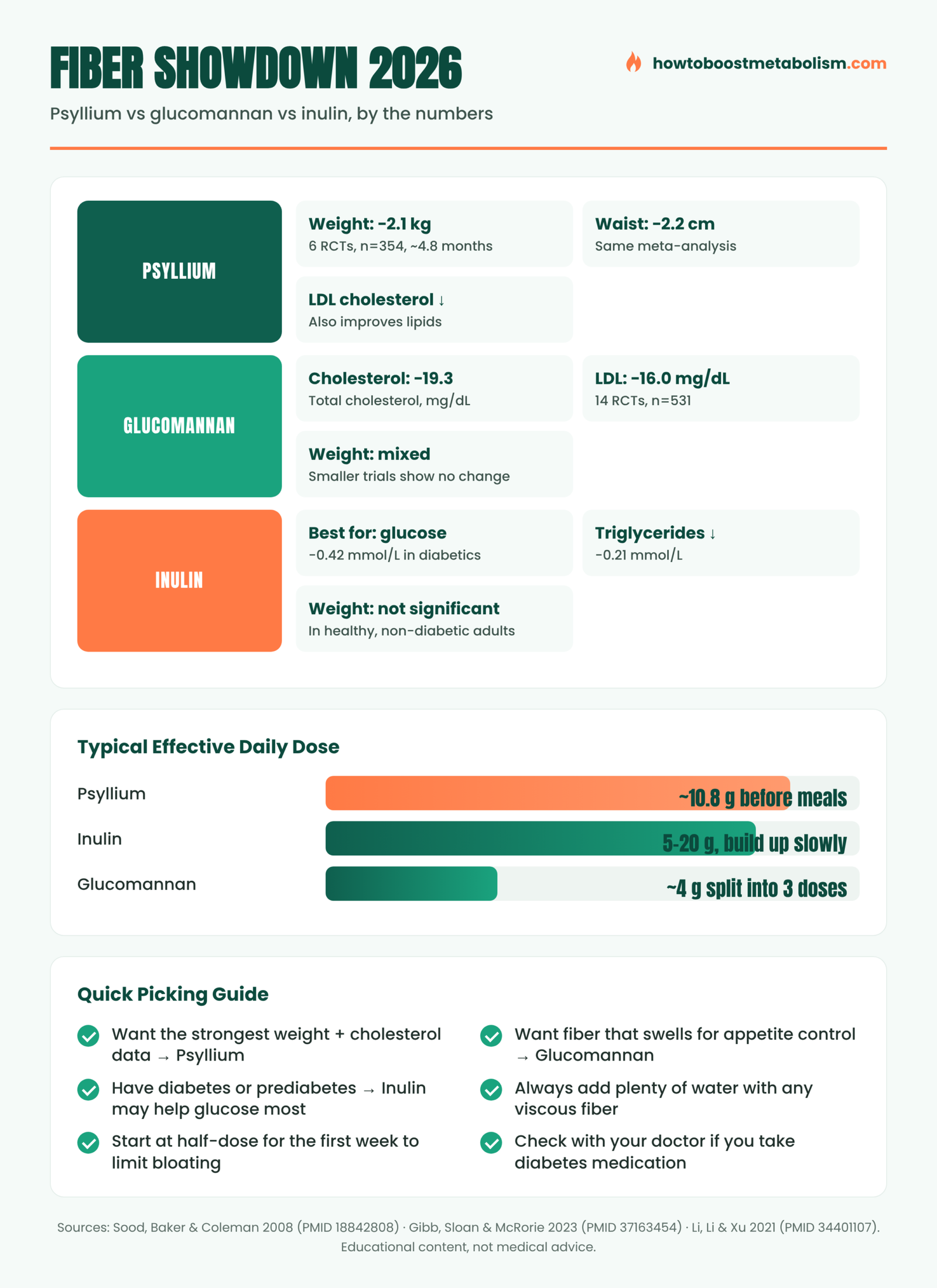
| Psyllium husk | −2.1 kg weight, −2.2 cm waist, lowers LDL | 6 RCTs / 354 people | Weight + cholesterol |
| Glucomannan | −19.3 mg/dL total cholesterol, −16.0 LDL; weight effect inconsistent | 14 RCTs / 531 people | Cholesterol, appetite |
| Inulin | −0.42 mmol/L glucose, −0.21 mmol/L triglycerides (diabetics) | 33 RCTs | Blood sugar support |
Psyllium: The One With the Strongest Weight Data
Psyllium husk — the fiber in products like Metamucil — has the most convincing weight-loss evidence of the three. A 2023 meta-analysis pooling six randomized trials and 354 participants found that roughly 10.8 g per day taken before meals, over an average of 4.8 months, produced a 2.1 kg reduction in body weight, a 0.8-point drop in BMI, and a 2.2 cm reduction in waist circumference, alongside LDL-lowering effects (Gibb, Sloan & McRorie, 2023, PMID 37163454). A separate meta-analysis also found favorable effects on glycemic control (Gibb et al., 2015, PMID 26561625). One honest caveat: the authors of the 2023 meta-analysis include researchers affiliated with Procter & Gamble, which makes Metamucil — a conflict worth knowing about, even though the underlying trial data and effect sizes are consistent with other fiber research.
Free download
🔥 The Metabolism Starter Kit
3 honest guides: a 7-day reset plan, a foods cheat-sheet and 12 metabolism myths debunked. No spam — unsubscribe anytime.
Glucomannan: Great for Cholesterol, Shakier on Weight
Glucomannan is a viscous fiber from the konjac root that swells dramatically in water — which is the whole appeal for appetite control. The strongest data for it is actually on cholesterol: a 2008 meta-analysis of 14 randomized trials and 531 participants found meaningful reductions in total cholesterol (−19.3 mg/dL), LDL (−16.0 mg/dL), triglycerides (−11.1 mg/dL), and fasting glucose (−7.4 mg/dL), plus a modest 0.79 kg average weight loss (Sood, Baker & Coleman, 2008, PMID 18842808). But more recent, smaller trials complicate the weight story: one meta-analysis of 8 studies found the weight effect was not statistically significant (Onakpoya, Posadzki & Ernst, 2014, PMID 24533610), and a controlled trial of glucomannan taken three times daily for eight weeks found no difference from placebo (Keithley et al., 2013, PMC3892933). Translation: glucomannan’s cholesterol benefit looks solid; treat its weight-loss claim with more skepticism than the marketing suggests.
Inulin: The Blood-Sugar Specialist, Not a Weight-Loss Fiber
Inulin is a prebiotic fructan found naturally in chicory root, and it’s increasingly added to protein bars and “gut health” powders. A 2021 systematic review and meta-analysis of 33 randomized trials found its effects were concentrated almost entirely in people with diabetes: significant reductions in fasting glucose (−0.42 mmol/L), total cholesterol (−0.46 mmol/L), and triglycerides (−0.21 mmol/L), with no significant effect on body weight in healthy, overweight, or obese participants without diabetes (Li, Li & Xu, 2021, PMID 34401107). An earlier systematic review of appetite and energy-intake trials reached a similarly modest conclusion — some short-term appetite effects, but nothing dramatic for body weight (2013, PMID 23887189). If you don’t have blood-sugar issues, inulin is better thought of as a gut-health fiber than a metabolism booster.
Do You Even Need a Fiber Supplement?
Before reaching for a bottle, it’s worth asking whether whole food could close the gap instead. Most American adults fall well short of the 25–38 g of daily fiber recommended by dietary guidelines, typically eating closer to 15 g. A cup of cooked lentils, a pear with the skin on, or a serving of raspberries each provide 6–8 g of fiber along with vitamins, minerals, and water that a powder or capsule doesn’t. If your diet is already light on vegetables, legumes, and whole grains, the highest-leverage move is adding those foods back in before layering a supplement on top. Fiber supplements earn their place as a convenient top-up for a specific, measurable gap — cholesterol, blood sugar, or appetite control — not as a substitute for an otherwise low-fiber diet.
How to Actually Use Any of These Without Regretting It
- Start at half the label dose for the first 5–7 days — all three fibers can cause gas and bloating if you jump in at full dose.
- Drink a full glass of water with every dose. Psyllium and glucomannan are viscous and have caused rare esophageal blockage when taken without enough fluid.
- Take fiber supplements at least 1–2 hours apart from medications — fiber can slow or reduce absorption of some drugs.
- Give it 4–8 weeks before judging results. Every trial above measured effects over months, not days.
- Pick one at a time. Stacking all three on day one makes it hard to tell what’s working — and what’s just giving you gas.
Who Should Be Extra Careful
Fiber supplements are low-risk for most healthy adults, but a few groups should talk to a doctor before adding one. People with a history of bowel obstruction, esophageal narrowing, or difficulty swallowing should avoid viscous fibers like psyllium and glucomannan, since both expand significantly in the digestive tract. Anyone on diabetes medication, especially insulin or sulfonylureas, should monitor blood sugar more closely when starting inulin or psyllium, since both can lower glucose enough to matter alongside medication. And because fiber can reduce the absorption of certain oral medications (including some thyroid medications and antibiotics), spacing doses by at least an hour or two is a simple, low-effort precaution worth taking regardless of which fiber you choose.
Free download: our Metabolism Starter Kit — a protein calculator, a 7-day meal framework, and a one-page supplement checklist, with zero hype.
Get the Free Starter Kit →Our Honest Take
If you only pick one fiber and your goal is weight and cholesterol, the evidence points to psyllium husk as the best-supported option of the three. If cholesterol alone is the concern, glucomannan has a long track record there too, with a weaker case for weight. If your actual issue is blood sugar, inulin is the one with the most relevant data — but don’t expect it to move the scale on its own. None of these replace a protein-forward diet and resistance training; they’re a genuinely useful add-on, not a shortcut.
One more point worth remembering: all three fibers in this comparison are feeding your gut microbiome as much as they’re feeding the numbers on a lab report. Psyllium, glucomannan, and inulin are all at least partially fermented by gut bacteria, which is part of why they can cause gas before your system adjusts — and also part of why consistent use tends to work better than occasional use. Give whichever one you pick a fair, multi-week trial before deciding it isn’t working for you.
For the products already covered in depth, see our full reviews of NOW Foods Psyllium Husk and NOW Foods Glucomannan, and for the bigger picture of what else is worth your money, see our evidence-ranked guide to the best metabolism supplements of 2026.
Frequently Asked Questions
Which fiber is best for weight loss: psyllium, glucomannan, or inulin?
Psyllium husk has the strongest weight-loss data of the three, with a meta-analysis of 354 participants showing an average 2.1 kg loss over about 4.8 months (PMID 37163454). Glucomannan’s weight effect is inconsistent across studies, and inulin shows no significant weight effect in people without diabetes (PMID 34401107).
Can I take psyllium, glucomannan, and inulin together?
There’s no known danger in combining them, but doing so makes it hard to tell which one is actually helping, and stacking fibers increases the risk of bloating and gas, especially early on. Most people do better introducing one at a time.
Does glucomannan actually work for weight loss?
The evidence is mixed. An early meta-analysis found a modest 0.79 kg average weight loss alongside strong cholesterol improvements (PMID 18842808), but more recent and smaller trials found no significant weight effect (PMID 24533610, PMC3892933). Its cholesterol benefit is better supported than its weight-loss benefit.
Is inulin good for metabolism if I don’t have diabetes?
The meta-analysis evidence shows inulin’s clearest benefits — on glucose, cholesterol, and triglycerides — show up mainly in people who already have diabetes (PMID 34401107). In healthy or simply overweight adults, it’s a solid prebiotic for gut health but not a strong metabolism tool.
How much water should I drink with a fiber supplement?
A full glass (around 8 oz / 240 ml) with every dose, minimum. Viscous fibers like psyllium and glucomannan expand significantly in the digestive tract, and taking them without enough fluid has been linked to rare cases of esophageal or intestinal blockage.