
Protein Distribution: Does Meal Timing Matter After 40?
This article may contain affiliate links. If you buy through them, we may earn a small commission at no extra cost to you. See our Affiliate Disclosure and Medical Disclaimer.
If you’ve seen advice telling you to eat exactly 30 grams of protein at every meal, evenly spaced, or your muscles will supposedly miss out on growth — the real research is far less tidy than that. Four well-designed studies on this exact question reach genuinely different conclusions, and the most rigorous one done specifically in older adults found no benefit at all to even spacing. Here’s what each study actually measured, and why the honest answer is “probably doesn’t matter as much as you’ve been told.”
Where the “Spread It Out” Advice Comes From
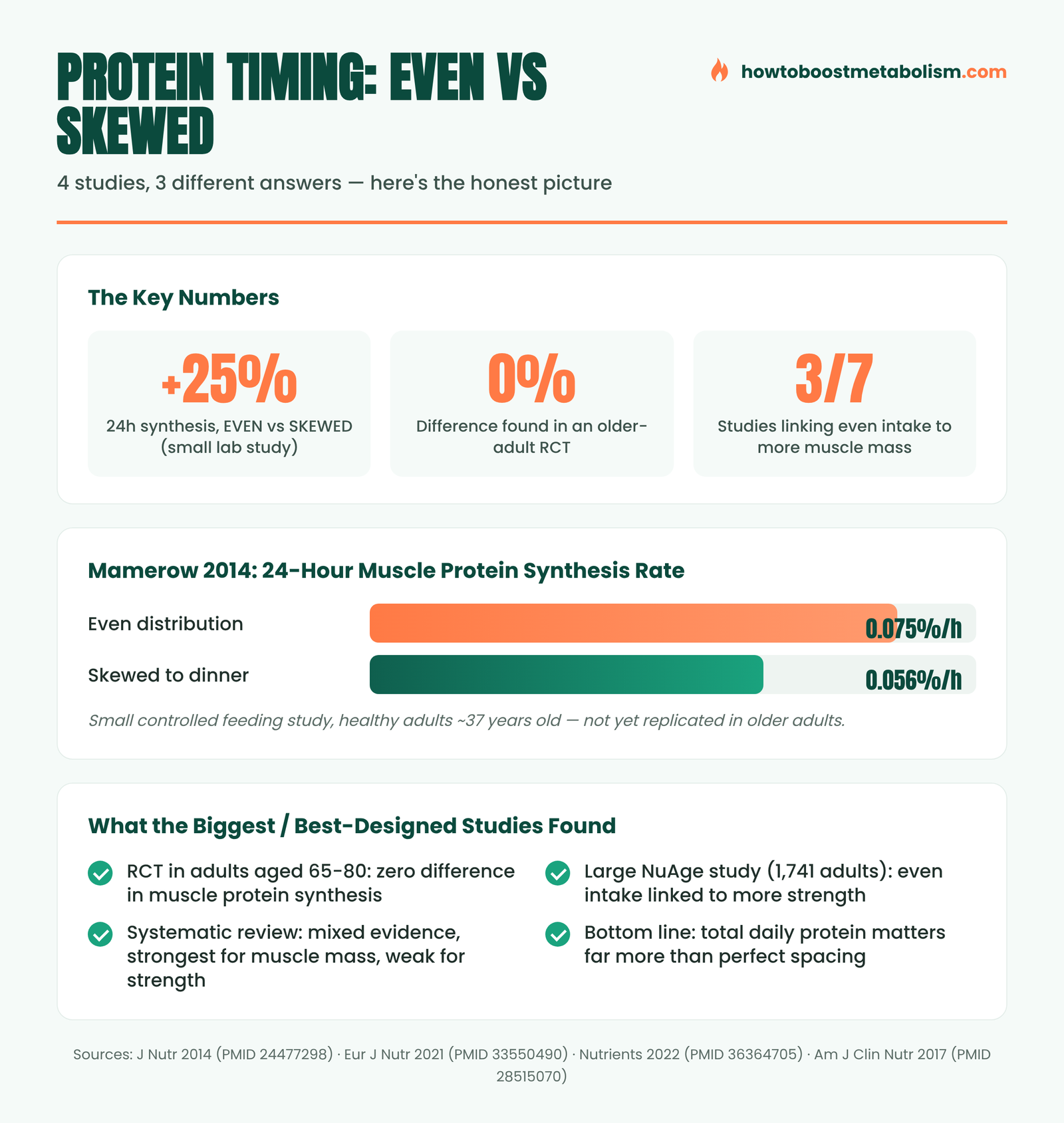
The idea traces back largely to a 2014 study (Mamerow et al., The Journal of Nutrition) that put 8 healthy adults (average age 37) through a 7-day crossover feeding trial. On one diet, protein was distributed evenly across breakfast, lunch, and dinner (about 30g per meal). On the other, it was skewed toward dinner (about 11g at breakfast, 16g at lunch, and 63g at dinner) — mimicking a typical American eating pattern. Using biopsies and isotope tracers to directly measure muscle protein synthesis over 24 hours, the researchers found the even distribution produced a 24-hour muscle protein synthesis rate 25% higher than the skewed pattern (0.075 vs. 0.056 %/hour, p=0.003) — and the difference held up after a week of habituation to each diet.
That’s a genuinely striking result, and it’s the single most-cited study behind “eat protein at every meal” advice. But notice the sample size (8 people) and the age (average 37, not specifically a midlife or older population) — exactly the kind of small, young-adult study that can look very different once tested in the population this site’s readers actually belong to.
What Happened When Researchers Tested It in Older Adults
That test came in 2022 (Justesen et al., Nutrients), a randomized controlled trial in 24 healthy men and women aged 65 to 80 — split evenly into an even-distribution group and a skewed-distribution group for three daily meals, with intrinsically labeled protein tracers used to directly measure both muscle protein synthesis and how much of the ingested protein was actually incorporated into muscle tissue.
The result: muscle protein synthesis was not significantly different between groups (2.16%/day EVEN vs. 2.23%/day SKEWED, p=0.647), and incorporation of the labeled protein into muscle was also not significantly different (p=0.306). The researchers’ own conclusion: “the daily distribution pattern of the dietary protein did not affect muscle protein synthesis or the utilization of dietary protein” in this older population. This is the most direct, apples-to-apples test of the Mamerow finding in exactly the age group most people asking this question care about — and it found no benefit to even spacing.
Free download
🔥 The Metabolism Starter Kit
3 honest guides: a 7-day reset plan, a foods cheat-sheet and 12 metabolism myths debunked. No spam — unsubscribe anytime.
The Observational Data Muddies the Picture Further
A large, real-world study (Farsijani et al., 2017, American Journal of Clinical Nutrition) analyzed 3 years of data from 1,741 free-living older adults aged 67 to 84 in the Quebec NuAge study. Protein distribution evenness, measured independently of total protein quantity, was associated with a higher muscle-strength score throughout the follow-up period in both men and women — but it was not associated with slower decline in strength or mobility over the 3 years, and the association with mobility only held in men, and only before adjusting for other factors.
This is observational data: it shows an association, not proof that eating more evenly causes better strength. People who naturally eat protein more evenly across the day may also differ in other ways (overall diet quality, appetite, activity level) that independently affect strength. The authors themselves call for intervention studies to confirm the relationship — which is exactly what the 2022 RCT above attempted, and which failed to find a synthesis-level mechanism to support it.
What a Systematic Review of All the Evidence Concludes
A 2021 systematic review (Jespersen & Agergaard, European Journal of Nutrition) pooled 15 eligible studies on this exact question across healthy adults aged 20 to 85. The tally: only 3 of 7 studies found an association between even protein distribution and higher muscle mass; only 2 of 7 found an association with greater muscle strength; and only 1 of 6 found a positive association with protein synthesis. The review’s conclusion was that evidence supports an association with muscle mass, but is “currently insufficient to conclude” whether even protein intake meaningfully affects strength or protein turnover.
So What Should You Actually Do?
Putting all four studies together honestly: a small, young-adult lab study found a real synthesis benefit to even distribution; the one RCT designed specifically to re-test that finding in older adults found nothing; a large observational study found an association with strength (but not with slower decline); and a systematic review of the whole literature calls the evidence for muscle mass moderate and for strength weak. That’s not a dataset that supports strict meal-by-meal protein accounting as a priority.
What’s better supported, from research covered elsewhere on this site, is making sure your total daily protein intake is adequate (generally 1.2-1.6 g/kg bodyweight or higher for actively training adults after 40) and that you’re getting a reasonably sized dose — commonly estimated around 25-40g, depending on body size — at the meals around your training, rather than obsessing over perfectly equal grams at every single meal of the day.
| Study | Finding |
|---|---|
| Mamerow 2014 (lab, age ~37, n=8) | EVEN distribution: 25% higher 24h synthesis |
| Justesen 2022 RCT (older adults, 65-80, n=24) | No difference in synthesis or protein incorporation |
| Farsijani 2017 (observational, n=1,741, 67-84) | EVEN linked to more strength, not less decline |
| Jespersen 2021 (systematic review, 15 studies) | Mixed; moderate support for mass, weak for strength |
Why Age Might Change the Answer (Even Though It Didn’t in This RCT)
There’s a plausible biological reason researchers expected even distribution to matter more with age: a well-documented phenomenon called “anabolic resistance,” where older muscle requires a larger single dose of protein to maximally stimulate protein synthesis compared to younger muscle. The theory was that skewing most protein to one meal might waste the “extra” amino acids beyond what that one meal can use, while spreading smaller-but-still-adequate doses across more meals could trigger synthesis more times per day. The 2022 RCT in 65-to-80-year-olds was designed specifically to test this theory directly in the population where it should matter most — and still found no difference. That doesn’t disprove anabolic resistance as a concept; it suggests that once each meal in the “skewed” condition still contained a reasonably sized protein dose (the skewed group’s smallest meal, breakfast, provided about 11g in the original Mamerow protocol, and the Justesen trial used similarly structured meals), the theoretical advantage of perfect evenness didn’t translate into a measurable synthesis difference.
This is a good general lesson about nutrition science: a compelling mechanism (anabolic resistance is real and well-documented) doesn’t automatically guarantee that a specific downstream intervention (perfectly even meal distribution) will show up as a measurable benefit once it’s tested directly. The mechanism can be true while the practical recommendation built on top of it turns out not to matter much in a controlled test.
A Practical Meal Template, Without Overthinking It
Given the mixed evidence above, here’s a reasonable default: aim for a protein source at each main meal that’s large enough to be worth counting (roughly 25-40g, depending on your body size), and let the exact grams vary meal to meal based on what’s realistic and enjoyable, rather than weighing portions to hit an identical number three times a day. If breakfast is naturally your smallest meal and dinner your largest — which is how most people in the U.S. actually eat, and is exactly the pattern tested as the “skewed” condition in the studies above — the evidence doesn’t show that pattern is harmful once total daily protein is adequate. If you do want to shift some protein earlier in the day, a simple swap (adding eggs, Greek yogurt, or a protein shake to breakfast, or cottage cheese to a mid-morning snack) is a low-effort way to do it without restructuring your entire diet.
What About Intermittent Fasting and Time-Restricted Eating?
If you’re intentionally compressing your eating window — common with intermittent fasting approaches — you’re mechanically skewing protein toward fewer, larger meals by definition, since there are fewer eating occasions in which to spread it. Based on the research above, this is not something the evidence specifically flags as a problem for muscle maintenance, provided total daily protein intake stays adequate within that shorter window. The RCT that most directly undermines the “you must spread it out” rule (Justesen et al., 2022) used three meals a day for both groups, not an extreme time-restricted protocol, so it doesn’t directly test very narrow eating windows (like a single daily meal) — but nothing in the broader protein-distribution literature suggests a sudden cliff effect specifically at 3 meals versus 2, or 2 versus 1, as long as the daily total is met.
One more practical note: the “skewed” condition tested in these studies still contained a reasonable amount of protein at every meal — it wasn’t zero protein at breakfast and lunch. If your actual eating pattern is closer to a genuinely protein-skipped breakfast (coffee and little else) followed by two higher-protein meals, that’s a different scenario than what these studies tested, and ensuring every meal clears a minimum reasonable threshold is still a sensible goal — just not one that needs to be mathematically identical.
Pairing This With a Training & Nutrition Plan
If your bigger challenge is simply hitting a consistent eating window and total protein target rather than perfecting meal-by-meal timing, Anabolic Fasting pairs a structured fasting protocol with a resistance-training framework aimed at preserving muscle while managing fat loss. Treat marketing language about building muscle and losing fat “simultaneously” as a general goal of the program, not a guaranteed outcome for every user.
Check Availability →Affiliate link — we may earn a commission at no extra cost to you. Disclosure
Related Reading
For the protein-type question rather than timing, see our comparison of EAA vs. whey protein after 40 and complete vs. incomplete protein. If evening intake is your specific question, our guide to pre-sleep protein covers that angle directly.
Free download: our Metabolism Starter Kit — a protein calculator, a 7-day meal framework, and a one-page supplement checklist, with zero hype.
Get the Free Starter Kit →Related: Hitting a per-meal protein target is easier when you weigh your portions. See our guide to the best food scales for portion control.
Frequently Asked Questions
Do I need exactly the same amount of protein at every meal?
No controlled trial has shown this is necessary. The one RCT designed specifically to test even vs. skewed distribution in older adults (Justesen et al., 2022) found no difference in muscle protein synthesis between the two patterns.
Why did an earlier study find even distribution was better?
Mamerow et al. (2014) found a real 25% difference in 24-hour muscle protein synthesis favoring even distribution — but that study used only 8 participants with an average age of 37, not an older-adult population, and has not been replicated with that result in later, more targeted research.
Is there any benefit to spreading protein out across the day?
A large observational study (Farsijani et al., 2017) found an association between even distribution and greater muscle strength in older adults, independent of total protein intake. Association isn’t proof of cause, but it’s a reasonable tiebreaker if you’re already deciding how to structure meals.
What matters more than timing?
Total daily protein intake. Across the nutrition research covered on this site, hitting an adequate daily total (commonly 1.2-1.6 g/kg bodyweight or higher for people training regularly after 40) has far more consistent support than precise meal-by-meal distribution.
Should I stop eating most of my protein at dinner?
Not based on this evidence. If a dinner-heavy pattern is what you’ll realistically sustain, the data doesn’t show it meaningfully disadvantages older adults specifically — the one RCT in that exact population found no synthesis difference either way.