Satiety Index: Which Foods Actually Keep You Full Longest?
This article may contain affiliate links. If you buy through them, we may earn a small commission at no extra cost to you. See our Affiliate Disclosure and Medical Disclaimer.
Not all calories keep you full for the same length of time, and that single fact explains a lot about why calorie counting alone frustrates so many people after 40. A 240-calorie bowl of boiled potatoes and a 240-calorie croissant are identical on a nutrition label’s calorie line, but one of them will have you opening the fridge again in an hour. The Satiety Index is the oldest and still most-cited attempt to measure that difference directly, and understanding how it works can change which foods you reach for when the goal is staying satisfied on fewer calories, not just hitting a number.
| At a Glance | The Satiety Index |
|---|---|
| What it measures | How full a food keeps you, per calorie, relative to white bread (=100) |
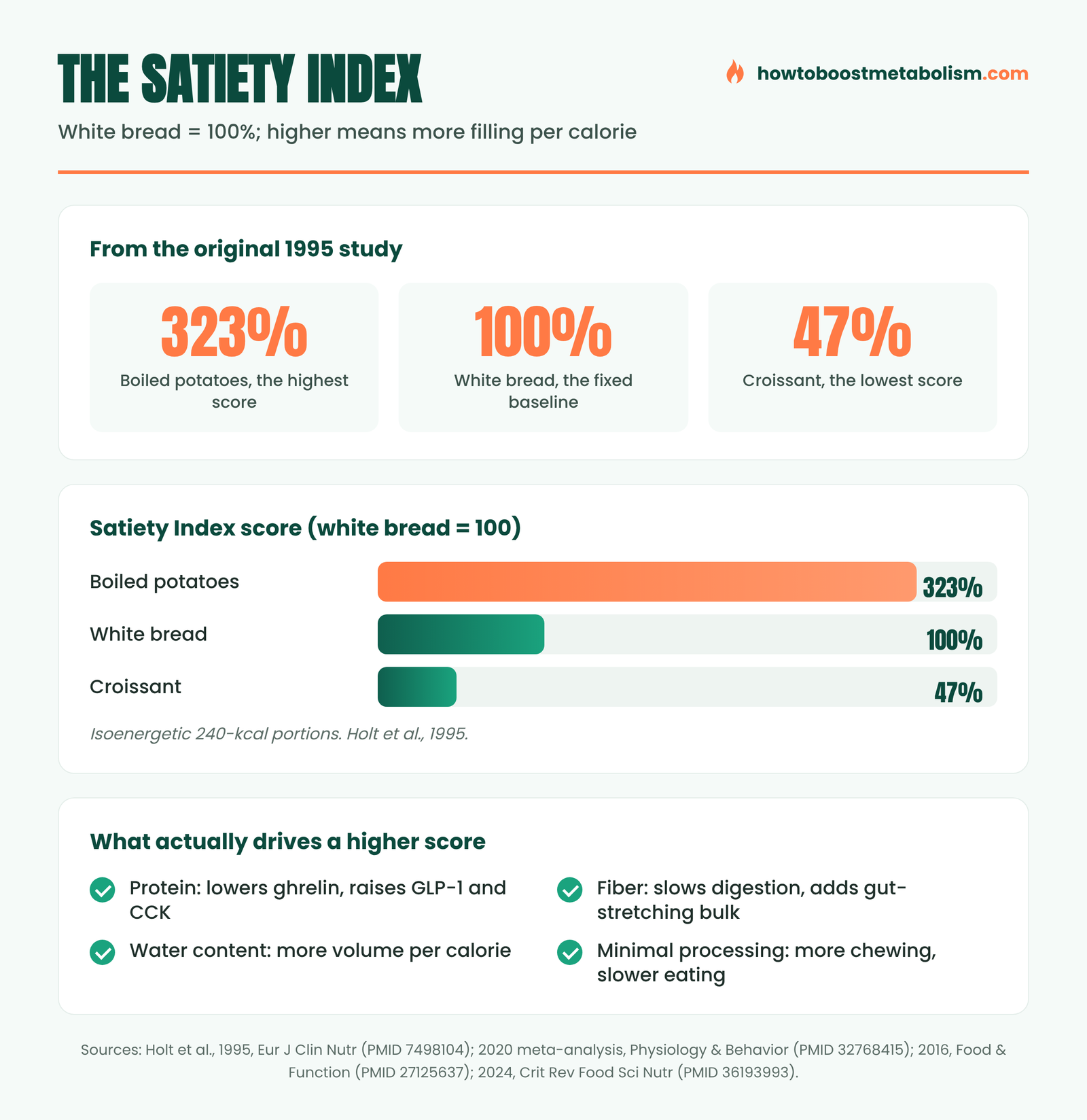
| Highest-scoring food tested | Boiled potatoes, 323% of white bread |
| Lowest-scoring food tested | Croissant, 47% of white bread |
| Biggest drivers of a high score | Protein, fiber, water content, minimal processing |
| Not the same as | The Glycemic Index, which measures blood sugar response, not fullness |
Where the Satiety Index Actually Comes From
The Satiety Index was established in a 1995 study published in the European Journal of Clinical Nutrition (https://pubmed.ncbi.nlm.nih.gov/7498104/). Researchers fed groups of 11-13 subjects isoenergetic, 1,000-kilojoule (240-calorie) servings of 38 common foods across six categories — fruits, bakery products, snack foods, carbohydrate-rich foods, protein-rich foods, and breakfast cereals — then had them rate their fullness every 15 minutes for two hours. After that window, subjects were let loose on a standard buffet, and researchers measured exactly how much they ate. Each food’s Satiety Index score comes from the area under its fullness curve, divided by the same figure for white bread, then multiplied by 100.
The results weren’t subtle. Boiled potatoes scored 323% — more than three times as filling as white bread for the same calories, and about seven times more filling than the lowest scorer, the croissant, at just 47%. Seventy-six percent of the foods tested scored at or above the white bread baseline. Critically, the amount people ate afterward at the buffet correlated negatively with how full the earlier food had kept them (r = -0.37) — in other words, the subjective fullness ratings actually predicted real eating behavior, not just how people felt on a questionnaire.
What Actually Makes a Food More Filling
Protein: A Direct, Hormonal Effect
Protein’s effect on fullness isn’t just a feeling — it shows up in your hormones. A 2020 systematic review and meta-analysis of randomized controlled trials (https://pubmed.ncbi.nlm.nih.gov/32768415/) pooled 49 studies on the acute effects of protein and found it significantly decreased hunger, decreased the desire to eat, and decreased prospective food consumption, while increasing fullness and satiety ratings. On the hormone side, protein intake lowered ghrelin — the hormone that signals hunger to your brain — and raised both cholecystokinin and GLP-1, the same gut hormone that drugs like semaglutide are designed to mimic. The review was candid that long-term trial evidence is less conclusive than the acute, meal-to-meal effect, so this is best understood as protein reliably blunting hunger at a given meal, not a guaranteed long-term appetite reset on its own.
Fiber: Volume, Time, and Gut Signals
Fiber works through a different, mostly mechanical route. A 2024 review in Critical Reviews in Food Science and Nutrition (https://pubmed.ncbi.nlm.nih.gov/36193993/) describes several overlapping mechanisms: fiber physically distends the stomach, slows gastric emptying, blunts post-meal blood sugar swings, and — once it reaches the lower gut — triggers cells that release the same appetite-regulating hormones as protein does, including GLP-1 and peptide YY. A separate systematic review of fiber and satiety (https://pubmed.ncbi.nlm.nih.gov/23885994/) confirmed the general pattern across human trials, though it noted that not all fiber types and doses show equally strong effects — more fiber isn’t automatically more filling in a straight line, and the type of fiber matters.
Food Structure and Processing
Here’s a factor that doesn’t show up on a standard nutrition label at all: how processed a food is. A study comparing 98 ready-to-eat foods (https://pubmed.ncbi.nlm.nih.gov/27125637/) found minimally processed foods were more satiating and produced less of a blood sugar spike than heavily processed foods, even when the two were similar in calories and macronutrients. The likely explanation is that processing changes a food’s physical structure — breaking down fiber matrices, reducing how much chewing is required, and changing how quickly the stomach empties — all of which affect fullness independent of the numbers on the label.
Free download
🔥 The Metabolism Starter Kit
3 honest guides: a 7-day reset plan, a foods cheat-sheet and 12 metabolism myths debunked. No spam — unsubscribe anytime.
A Sense of Where Common Foods Tend to Fall
The original study tested specific branded and generic foods rather than broad food groups, so it’s worth being precise about what we can and can’t say from it. What we can say with confidence, based directly on the published results: within the potato, fish, and oatmeal-type carbohydrate and protein-rich categories tested, scores tended to land well above the white bread baseline, while the bakery and snack-food category — items like croissants and candy bars — tended to land at or below it. The researchers also found that a food’s satiety score correlated positively with its actual serving weight, meaning foods that are bulkier for their calorie count (a large bowl of a watery, fibrous food versus a small, energy-dense pastry) tend to score higher — which lines up neatly with the water-content and fiber mechanisms described above, rather than being a separate, unrelated finding.
This is also a good moment to flag what the Satiety Index can’t tell you. It was measured under controlled lab conditions with specific portion sizes, specific preparation methods, and a specific study population — it is not a precise prediction of how full any individual food will make any individual person feel on any given day. Sleep, stress, how recently you ate, and how much you’re paying attention while eating all shift fullness independently of the food itself. Treat the Satiety Index as a useful general compass pointing toward whole, high-fiber, high-protein, high-water foods — not as a precise calculator you can plug a meal into.
Satiety Index vs. Glycemic Index: Don’t Confuse Them
These two indexes get mixed up constantly, but they measure different things. The Glycemic Index ranks how quickly a carbohydrate-containing food raises blood sugar. The Satiety Index ranks how full a food makes you feel, full stop — regardless of whether it contains carbohydrate at all. A food can have a high glycemic index and still be quite filling (boiled potatoes are a good example of both at once), and a food can have a low glycemic index while being fairly easy to overeat. If your actual goal is eating less without feeling deprived, the Satiety Index — or really, the underlying factors behind it: protein, fiber, water content, and minimal processing — is the more directly relevant tool.
Protein and whole-food fiber are two of the most consistently documented ways to raise a meal’s satiety value without cutting calories further — but getting the balance right across a full day, not just one meal, is where most people actually struggle. The Mediterranean Diet Plan is built around whole foods, fiber, and lean protein in roughly the proportions this research points toward.
Check Availability →Affiliate link — we may earn a commission at no extra cost to you. Disclosure
Note: this program is structured as a quiz-based entry point that leads into a paid plan with a recurring (rebill) billing structure — read the billing terms on the order page carefully before you subscribe, as is true of most subscription-based diet programs.
Practical Ways to Use This After 40
- Anchor meals with a protein source at every meal, not just dinner — the hormonal fullness effect is well documented at the meal level.
- Choose the less-processed version of a food when you have the option — a whole potato over potato chips, whole fruit over fruit juice, steel-cut oats over a sugary cereal.
- Add volume, not just calories cut — foods with high water and fiber content (vegetables, broth-based soups, whole fruit) let you eat a satisfying volume without a satisfying calorie count, which pairs well with the honest approach we take in our GLP-1 and Ozempic food list.
- Don’t judge a food only by its calorie count — two 240-calorie snacks can leave you feeling very differently satisfied two hours later, and that difference is exactly what the Satiety Index was built to capture.
How This Connects to Appetite and Hunger Hormones
If the hormone angle above was interesting, it’s worth reading further into the topic. We cover the broader picture of how resistance to your own fullness signals develops in our guide to leptin resistance, and if you’re curious whether exercise itself changes your appetite the same way food does, our piece on whether strength training makes you hungrier covers the exercise side of the same hormonal system. For a food-first look at supporting your own GLP-1 production through diet rather than medication, see boosting GLP-1 naturally.
None of this requires tracking a formal Satiety Index score at every meal — that’s not realistic, and it’s not how the research was meant to be used day to day. The practical version is simpler: build meals around a protein source, keep whole, fibrous, water-rich foods in regular rotation, and treat heavily processed, low-volume snacks as the foods most likely to leave you hungry again soon, calorie for calorie. That’s the whole idea behind the original 1995 study, translated into something you can actually act on at the grocery store.
Free download: our Metabolism Starter Kit — a protein calculator, a 7-day meal framework, and a one-page supplement checklist, with zero hype.
Get the Free Starter Kit →Frequently Asked Questions
What is the Satiety Index?
The Satiety Index is a scoring system from a 1995 study that fed people isoenergetic (same-calorie) portions of 38 common foods, then tracked how full they reported feeling every 15 minutes for two hours and how much they ate afterward from a standard buffet. Each food’s score is set relative to white bread, which is fixed at 100. A food scoring 200 kept people roughly twice as satisfied per calorie as white bread; a food scoring 50 kept them about half as satisfied.
Which foods scored highest on the original Satiety Index?
Boiled potatoes scored highest in the original study, at 323% of white bread’s satiety value — about seven times higher than the lowest-scoring food, the croissant, at 47%. The researchers found most foods tested (76%) scored at or above white bread, and that satiety scores correlated with the actual serving weight of the food, not just its calorie count.
Does protein really make you feel fuller?
Yes, with real mechanistic backing. A 2020 meta-analysis of randomized controlled trials found that protein intake acutely reduced hunger and the desire to eat, increased fullness ratings, and changed the hormones involved in appetite — lowering ghrelin (the ‘hunger hormone’) and raising cholecystokinin and GLP-1, hormones that signal fullness. The same review noted long-term evidence is less conclusive than the short-term, acute effect, so protein’s fullness effect is best documented meal-to-meal rather than guaranteed to persist indefinitely.
Is the Satiety Index the same as the Glycemic Index?
No, and they don’t always agree. The Glycemic Index measures how quickly a food raises blood sugar; the Satiety Index measures how full a food actually makes you feel per calorie. A food can be low on one scale and unremarkable on the other — fullness depends on fiber, protein, water content, and food volume, not blood sugar response alone.
Does food processing affect how full a food makes you feel?
It appears to. A study comparing 98 ready-to-eat foods found minimally processed foods were more satiating and produced a smaller blood sugar spike than heavily processed versions with similar nutritional labels, supporting the idea that how a food is structured — not just its macronutrient breakdown on paper — changes how your body responds to it.