How Long to Walk After Eating to Blunt a Blood Sugar Spike
This article may contain affiliate links. If you buy through them, we may earn a small commission at no extra cost to you. See our Affiliate Disclosure and Medical Disclaimer.
There’s a specific piece of advice that keeps showing up in science-based nutrition circles: don’t just walk more in general — walk right after you eat. It sounds like one of those vague wellness tips that falls apart the moment you ask for specifics. How long does the walk actually need to be? Does it have to start immediately? Does a slow stroll to the mailbox count, or does it need to be a real walk? The research on this is more specific than most articles let on, and the honest answer involves a bit of nuance worth sitting with for a few minutes.
Why Walking After a Meal Does Anything at All
When you eat, especially a meal with refined carbohydrates, glucose floods into your bloodstream faster than most people’s insulin can smoothly clear it, producing a temporary spike. Working skeletal muscle pulls glucose out of the blood through a pathway that doesn’t require much insulin at all — muscle contraction itself drives glucose transporters (GLUT4) to the cell surface. That’s the whole mechanism: you’re giving your muscles an on-ramp to soak up incoming sugar before it circulates for hours. You don’t need an intense workout for this. Light to moderate walking is enough to meaningfully engage the pathway, which is exactly why this particular piece of advice is realistic for almost anyone, including people who can’t or don’t want to do a hard workout three times a day.
There’s also a reason this particular trick doesn’t “wear off” the way some metabolism tips do. The glucose-clearing effect of muscle contraction runs through a mostly insulin-independent pathway — exercising muscle activates AMPK, which helps move GLUT4 glucose transporters to the cell surface on its own, in parallel with (not instead of) the normal insulin signal. That matters practically because it means the trick still works reasonably well even in people whose insulin signaling is already somewhat impaired, which is exactly the population — people with prediabetes, type 2 diabetes, or run-of-the-mill insulin resistance from being sedentary for a decade — who stand to benefit the most from it.
The Study That Actually Nailed Down a Number
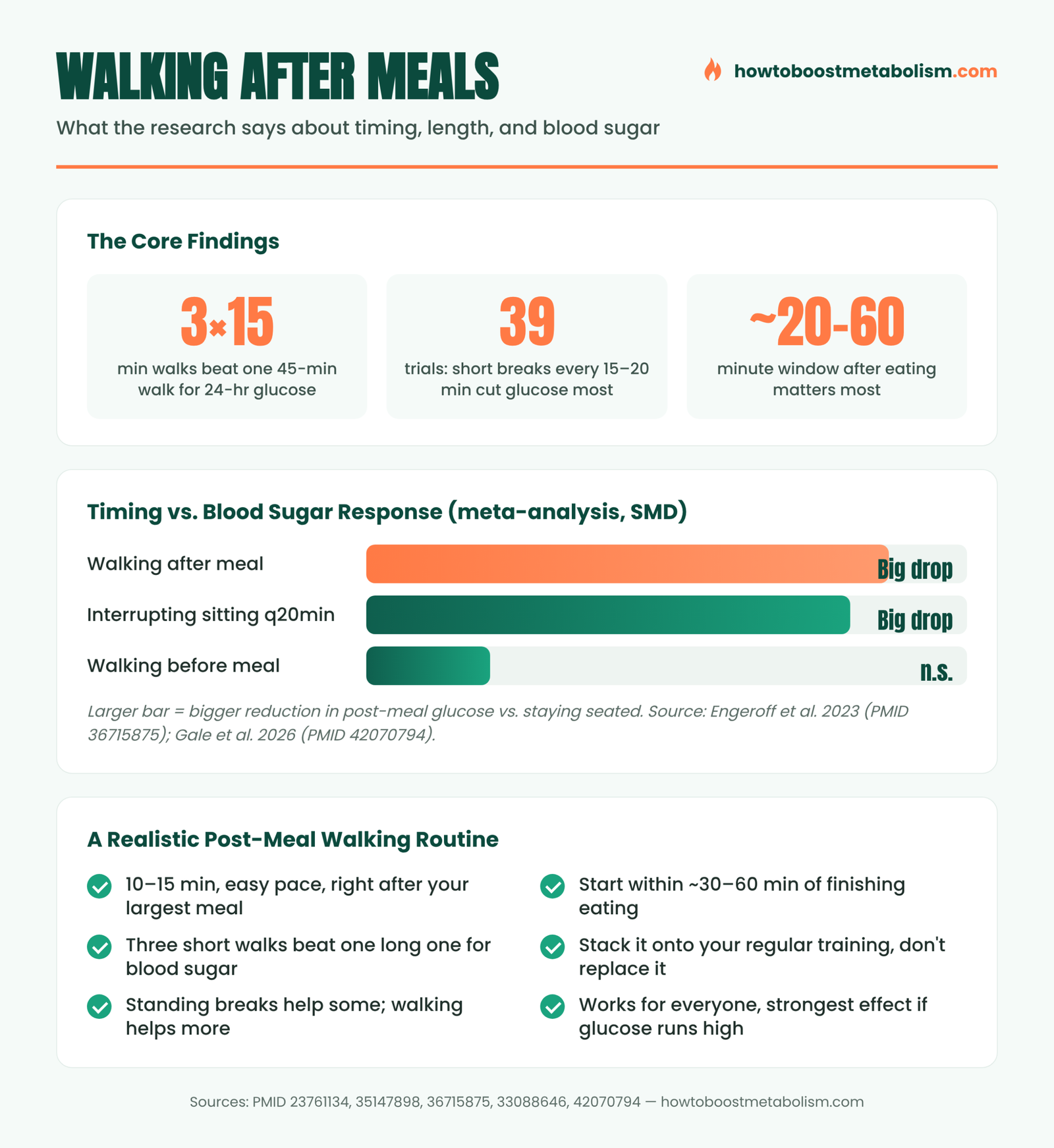
The most specific trial on this, led by researcher Loretta DiPietro and published in Diabetes Care, put ten older adults at risk for impaired glucose tolerance through 48-hour stays in a whole-room calorimeter with continuous glucose monitoring (PMID 23761134). On different days, participants either did one sustained 45-minute walk in the morning or afternoon, or three separate 15-minute walks — one after each meal. Both approaches improved 24-hour blood sugar control compared to a sedentary control day. But the post-meal walking was significantly more effective than the single longer walk, specifically at blunting the 3-hour glucose spike after dinner. That’s a genuinely useful, specific finding: the same total time spent walking did more when it was split up and timed around meals than when it was done all at once, disconnected from eating.
Free download
🔥 The Metabolism Starter Kit
3 honest guides: a 7-day reset plan, a foods cheat-sheet and 12 metabolism myths debunked. No spam — unsubscribe anytime.
A 2026 Meta-Analysis Adds the Bigger Picture
A systematic review and meta-analysis published in Obesity Reviews in 2026 pooled 53 studies (39 in the meta-analysis itself) on interrupting prolonged sitting with activity breaks (PMID 42070794). Compared with sitting still, short activity breaks lowered both post-meal glucose and insulin responses. Walking breaks worked better than standing breaks, and — this is the detail worth remembering — breaking up sitting every 15 to 20 minutes produced the largest reductions in both glucose and insulin, more than less frequent breaks. The people living with obesity in the pooled data saw the largest glucose improvements of all. An earlier 2022 meta-analysis in Sports Medicine found a similar pattern: light-intensity walking breaks reduced post-meal glucose and insulin significantly more than standing breaks, which in turn beat staying seated (PMID 35147898).
Timing Matters More Than People Assume
Here’s the part that surprises most people: it’s not just about walking after eating instead of before — the exact timing within that window matters too. A 2023 systematic review and meta-analysis in Sports Medicine, with the memorable title “After Dinner Rest a While, After Supper Walk a Mile?”, pooled eight randomized crossover trials comparing exercise before meals, after meals, and no exercise at all (PMID 36715875). Exercise after eating reduced post-meal glucose excursions significantly more than exercise before eating (standardized mean difference 0.47) and more than staying inactive (SMD 0.55). Exercise before a meal, by contrast, didn’t produce a statistically significant improvement at all. The researchers also found that the amount of time between the meal and the walk had a measurable moderating effect — the sooner people started moving after eating, the better the glucose response. In plain terms: walking shortly after you finish eating beats walking right before you eat, and beats waiting a long time after the meal to get moving.
Does This Work for People Without Diabetes?
Most of the tightly controlled trials recruited people with type 2 diabetes or impaired glucose tolerance, for a practical reason: their blood sugar swings are bigger and easier to measure a clear effect in. A small Japanese study of eleven people with type 2 diabetes found that a 15-minute moderate-intensity walk 30 minutes after each meal reduced 24-hour glycemic variability compared with a non-exercise day, measured with a continuous glucose monitor (PMID 33088646). But the benefit isn’t exclusive to people with a diagnosis. The 2022 meta-analysis on interrupting sitting recruited mixed-sex adults who were predominantly overweight or living with obesity, not a diabetic sample, and still found significant glucose and insulin improvements from light walking breaks (PMID 35147898). The mechanism — muscle contraction clearing glucose independent of insulin — applies to anyone with functioning skeletal muscle. People with normal glucose tolerance will see a smaller absolute swing to begin with, so the effect is simply harder to detect, not necessarily absent.
| Approach | What the research found | Source |
|---|---|---|
| One 45-min walk (AM or PM) | Improved 24-hr glucose vs. sedentary day, but less than post-meal walking | PMID 23761134 |
| Three 15-min walks after meals | Significantly better 3-hr post-dinner glucose than one long walk | PMID 23761134 |
| Walking before a meal | No significant reduction in post-meal glucose | PMID 36715875 |
| Walking soon after a meal | Significant reduction (SMD 0.47–0.55) vs. before-meal or no exercise | PMID 36715875 |
| Activity break every 15–20 min | Largest glucose/insulin reductions of any break frequency tested | PMID 42070794 |
Does Walking Speed Matter, or Just Movement?
The trials that compared conditions head-to-head consistently found a dose-response-style pattern: standing helps a little, light walking helps more, and the difference between standing breaks and walking breaks was itself statistically significant in the 2022 meta-analysis (PMID 35147898). None of the major trials tested brisk or vigorous walking specifically in this after-meal context, mostly because the whole appeal of the intervention is that it’s easy enough to do right after a meal without getting your heart rate up or feeling uncomfortably full. In practice, a relaxed, conversational pace is what every one of these studies actually used, and it’s also the pace most people can realistically sustain for three short walks a day without it feeling like a chore.
A Realistic Way to Actually Use This
- Aim for 10–15 minutes of easy walking, starting within about 30–60 minutes of finishing a meal — you don’t need to rush out mid-bite.
- If you can only manage one walk a day, attach it to your largest or most carbohydrate-heavy meal, since that’s the meal producing the biggest glucose swing to blunt.
- Three short walks beat one long one for this specific purpose — a walk after breakfast, lunch, and dinner adds up to roughly the same time as one 45-minute session, with a better glucose payoff.
- This is a layer on top of your regular training, not a substitute for it. It won’t build muscle, raise your VO2 max, or replace a structured resistance program.
- If a full walk isn’t practical (meetings, weather, mobility limits), even standing breaks help somewhat — just not as much as actual walking.
None of this requires new equipment, a gym, or a dramatic lifestyle change. It’s one of the few pieces of metabolic health advice that’s genuinely low-cost and backed by randomized, controlled evidence rather than a single small observational study.
Where This Fits With the Rest of Your Eating Pattern
Post-meal walking blunts the spike from a given meal — it doesn’t change what’s in the meal to begin with. If your blood sugar runs high even with regular after-meal walks, the next lever worth pulling is the composition of the meals themselves: more fiber, more protein, fewer refined carbohydrates eaten alone. That’s the territory a structured eating pattern like improving insulin sensitivity through diet and daily habits covers in more depth — walking after meals is one tool in that toolkit, not the whole toolkit.
If a 10-minute walk helps but you also want a structured, day-by-day eating framework built around stable blood sugar and real food — not another fad — The Mediterranean Diet packages that into a guided plan with a short quiz to personalize it. Worth noting upfront: it includes a recurring membership component after the initial plan, so check the pricing page before you commit.
See the Plan →Affiliate link — we may earn a commission at no extra cost to you. Disclosure
Related Reading
For a deeper look at a different low-effort, desk-friendly movement trick, see our breakdown of soleus push-ups and blood sugar, which works through a similar muscle-contraction mechanism while sitting. If you want the bigger-picture case for walking as a metabolic tool generally, we cover that in how walking affects your metabolism. And if lower-intensity cardio is something you’re trying to fit around strength training, our guide to Zone 2 cardio for fat loss covers how the two complement each other.
Free download: our Metabolism Starter Kit — a protein calculator, a 7-day meal framework, and a one-page supplement checklist, with zero hype.
Get the Free Starter Kit →Frequently Asked Questions
How long do I need to walk after eating for it to help my blood sugar?
The clearest single data point comes from a 2013 study in older adults at risk for impaired glucose tolerance: three separate 15-minute walks, one after each meal, controlled 24-hour blood sugar better than a single 45-minute walk done all at once in the morning or afternoon (PMID 23761134). A 2026 meta-analysis of 39 trials found the biggest improvements came from breaking up sitting time every 15–20 minutes with short activity, not from one long continuous walk (PMID 42070794). So the honest answer is: even 10–15 minutes appears to help, and splitting movement across the day seems to matter more than total duration in one go.
Does it matter how soon after eating I start walking?
Yes, based on the best current evidence. A 2023 systematic review and meta-analysis of eight randomized crossover trials found that exercise performed after a meal lowered post-meal blood sugar significantly more than the same exercise done before eating, and the benefit shrank the longer people waited to start moving (PMID 36715875). Walking during the first 20–60 minutes after a meal, while blood sugar is actively rising, appears to matter more than walking at some arbitrary later point in the day.
I can only fit in one walk a day — does it matter which meal I walk after?
The research doesn’t single out one “best” meal, but the mechanism points toward whichever meal is largest or highest in refined carbohydrates, since that’s the meal producing the biggest glucose excursion to blunt. For most people eating a Western dietary pattern, that tends to be dinner. If you can only manage one walk, pairing it with your largest or most carb-heavy meal is a reasonable, evidence-consistent choice.
Can a 10-minute walk after meals replace my regular workouts?
No, and none of the research claims that. These studies measure acute, same-day blood sugar control, not cardiovascular fitness, muscle mass, or long-term metabolic health, which depend on sustained structured exercise over time. Post-meal walking is a low-effort add-on that stacks on top of a regular strength or cardio routine, not a replacement for one.
Is this only useful for people with diabetes or prediabetes?
Most of the strongest trials were done in people with type 2 diabetes or impaired glucose tolerance, where blood sugar swings are largest and easiest to measure (PMID 33088646; PMID 23761134). But the 2022 meta-analysis on interrupting sitting found measurable glucose and insulin benefits in generally healthy and overweight adults too (PMID 35147898), so the effect isn’t limited to people with a diagnosis — it’s just easier to see in people whose blood sugar moves more.
This article is for general educational purposes and is not medical advice. If you have diabetes, take insulin or other glucose-lowering medication, or have a condition affecting your blood sugar, talk to your doctor before changing your exercise or eating routine. See our Medical Disclaimer.