Beta-Alanine for Strength Training: Does It Work After 40?
This article may contain affiliate links. If you buy through them, we may earn a small commission at no extra cost to you. See our Affiliate Disclosure and Medical Disclaimer.
If you’ve spent any time in a supplement aisle or scrolling fitness ads, you’ve probably seen beta-alanine listed on a pre-workout label — often right next to creatine, caffeine, and citrulline. It’s one of the few sports supplements with a genuinely large research base behind it. The question for anyone strength training after 40 isn’t whether beta-alanine “works” in general — it’s whether it does anything meaningful for your kind of training, which for most people in this audience means weight room sets of 5-15 reps, not 60-second all-out efforts.
We dug through the meta-analyses and the resistance-training-specific trials to give you a straight answer, not a marketing pitch. (If you’re also trying to figure out the right rep range for your goals, that’s a more impactful place to start than any supplement.)
What Beta-Alanine Actually Does
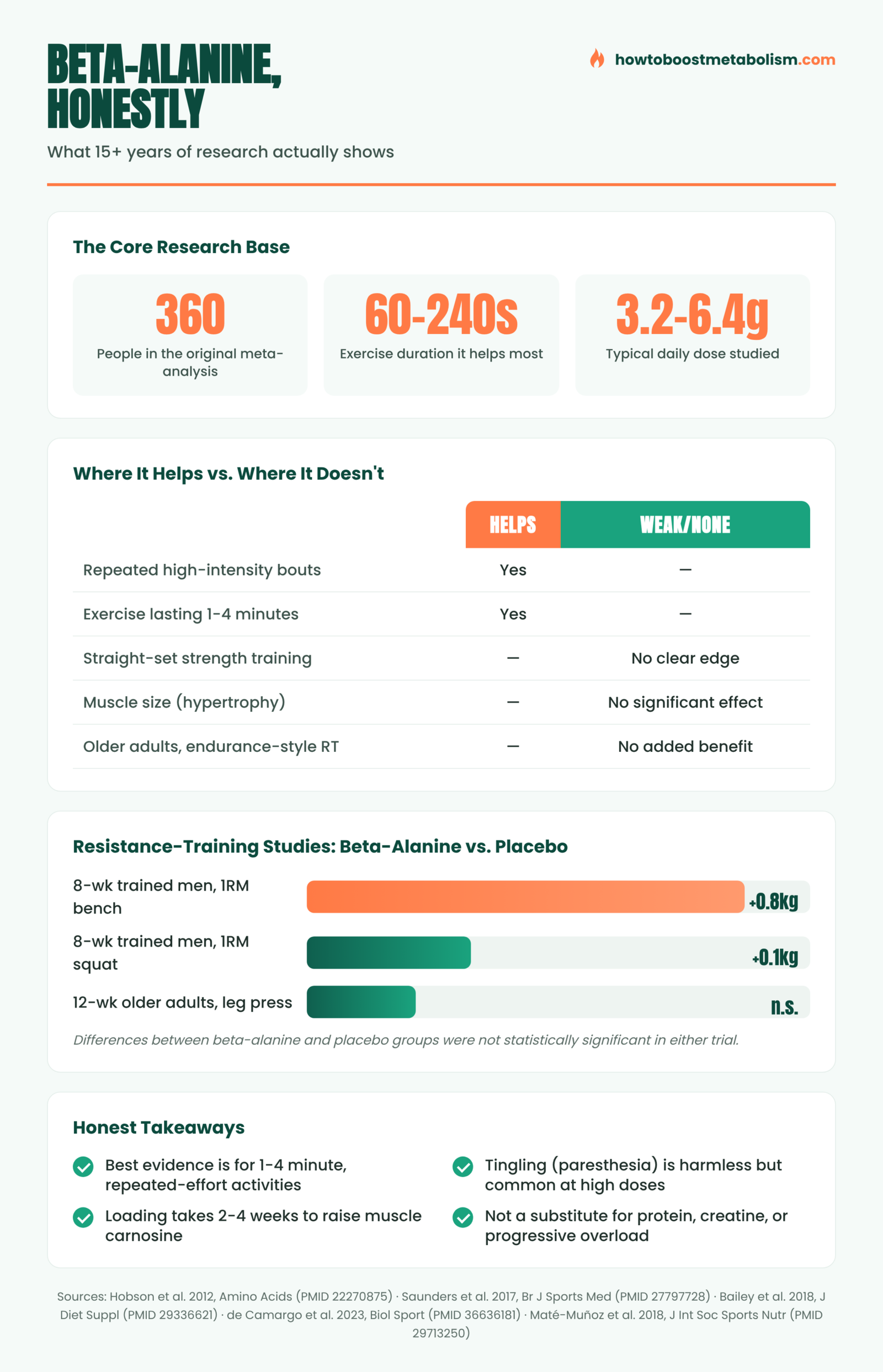
Beta-alanine is a non-essential amino acid. Once inside muscle tissue, it combines with histidine to form carnosine, a compound that helps buffer hydrogen ions — the byproduct of anaerobic metabolism that contributes to the burning sensation and fatigue you feel during hard, sustained effort. Raising muscle carnosine content is believed to be the main mechanism behind any performance benefit, and daily supplementation of roughly 3.2-6.4 grams for several weeks reliably increases it.
The largest early meta-analysis pooling the evidence, led by researcher Richard Hobson, combined 15 studies, 57 performance measures, and 360 total participants (PMID 22270875). It found a real benefit to overall exercise outcomes, but when the authors separated results by exercise type, the improvement was concentrated almost entirely in exercise capacity during efforts lasting about 60 to 240 seconds — things like repeated sprints, rowing intervals, or high-rep circuits — not in single maximal-strength efforts.
The Bigger, More Recent Systematic Review
A 2017 systematic review and meta-analysis in the British Journal of Sports Medicine, led by Bryan Saunders, used a more rigorous three-level statistical model and PRISMA methodology to re-examine the question (PMID 27797728). It confirmed the same pattern: beta-alanine reliably helps exercise capacity in the 1-4 minute range, with a smaller but still real benefit for efforts under a minute. That’s good news if your training includes metabolic conditioning, high-rep circuit work, or sports with repeated sprint demands — rowing, combat sports, soccer, basketball. It’s much less relevant if your main goal is simply getting stronger on compound lifts.
Free download
🔥 The Metabolism Starter Kit
3 honest guides: a 7-day reset plan, a foods cheat-sheet and 12 metabolism myths debunked. No spam — unsubscribe anytime.
Does It Help Straight Resistance Training? The Studies Say No
This is the part most product pages leave out. Several controlled trials have tested beta-alanine specifically inside a structured resistance-training program — exactly the context this audience cares about — and the results have been consistently unimpressive for strength and size outcomes.
- A 2018 randomized, controlled study gave resistance-trained adults 3-6 g/day of beta-alanine during a 5-week strength program and measured strength outcomes directly (PMID 29713250).
- A 2023 double-blind, placebo-controlled trial in Biology of Sport gave 19 resistance-trained men 6.4 g/day for 8 weeks of 4x/week training and used ultrasound to measure actual muscle thickness changes in the biceps, triceps, and quads — not just strength (PMID 36636181). The difference between groups in 1RM bench press (0.8 kg), 1RM squat (0.1 kg), and muscle thickness at all three sites was not statistically significant.
- A 2018 trial specifically in older adults (ages 60-82) tested 3.2 g/day of beta-alanine alongside a 12-week endurance-style resistance program designed for that age group (PMID 29336621). The title of the paper says it plainly: “Beta-Alanine Does Not Enhance the Effects of Resistance Training in Older Adults.” Both the exercise and exercise-plus-beta-alanine groups improved leg press strength similarly — the amino acid added nothing measurable on top of the training itself.
Put together, these trials are a fairly consistent signal: once you’re doing traditional strength training — moderate reps, meaningful rest between sets, not racing the clock — beta-alanine isn’t pulling extra weight. The buffering benefit matters most when hydrogen ion accumulation is the limiting factor, and in a typical 3-5 rep heavy set or an 8-12 rep hypertrophy set with 60-90 seconds of rest, it usually isn’t.
At a Glance: Beta-Alanine by Training Style
| Training style | Likely to help? | Why |
|---|---|---|
| Sprint intervals / rowing repeats | Yes | Falls in the 60-240s window where buffering matters most |
| High-rep circuit / metabolic conditioning | Likely | Repeated near-maximal efforts, sustained burn |
| Traditional strength training (5-15 reps, rest between sets) | Unlikely | Hydrogen ion buffering isn’t usually the limiting factor |
| Pure 1-3 rep max strength work | No | Effort is too short for carnosine buffering to matter |
| Muscle growth (hypertrophy) specifically | No clear evidence | Direct trials found no significant difference in muscle thickness |
The One Real Side Effect — and It’s Harmless
The most commonly reported effect of beta-alanine is paresthesia — a tingling or prickling sensation in the skin, usually in the face, neck, and hands, that shows up within 15-20 minutes of taking a single large dose. It’s uncomfortable for some people but not dangerous, and splitting the daily dose into smaller servings throughout the day (rather than one large scoop) largely avoids it. Research into the underlying carnosine-boosting mechanism, including work looking at how quickly those stores decay after stopping supplementation, confirms the loading and washout process takes weeks, not days — so there’s no benefit to “loading hard” right before a workout.
How Beta-Alanine Is Different From Creatine
It’s easy to lump beta-alanine in with creatine because they’re often sold side by side and both get labeled “performance amino acids.” The mechanisms don’t overlap at all. Creatine works by increasing phosphocreatine stores, which helps regenerate ATP for very short, maximal efforts — exactly the kind of single heavy rep or short set that strength training after 40 is built around, which is why the creatine research looks so different from the beta-alanine research. Beta-alanine, by contrast, helps buffer acid buildup during longer, sustained high-intensity efforts. If you only have budget or willingness for one supplement with strong resistance-training evidence behind it, the research points toward creatine, not beta-alanine.
The Evidence Is Still Evolving — and Not Always Consistent
One more honest wrinkle: not every meta-analysis agrees on how strong the base effect of beta-alanine really is. A 2024 systematic review and meta-analysis specifically testing beta-alanine against sodium bicarbonate (another buffering supplement) pooled 10 studies and 243 participants and found no statistically significant ergogenic effect for beta-alanine taken alone (standardized mean difference 0.18, p = 0.13), or for sodium bicarbonate taken alone (p = 0.16) — but did find a significant benefit when the two were combined (SMD 0.32, p = 0.02) (PMID 38952910). That doesn’t overturn the larger body of evidence showing a benefit for 1-4 minute efforts, but it’s a useful reminder that supplement research is rarely as tidy as a label claim makes it sound, and that beta-alanine’s effect, where it exists, is modest rather than dramatic.
Dosing: What the Studies Actually Used
| Variable | What the research used |
|---|---|
| Daily dose | 3.2-6.4 grams per day |
| Timing | Split into 2-4 smaller doses across the day to reduce tingling |
| Minimum duration before judging it | 4 weeks; most studies ran 5-12 weeks |
| Loading phase needed? | No same-day effect — carnosine rises gradually over weeks |
| Washout after stopping | Weeks, not days — elevated carnosine declines slowly |
If you do decide to try it — say, because your training includes rowing intervals, circuit conditioning, or a combat sport — give it the full 4-6 weeks before judging whether it’s doing anything, and split the dose rather than taking it all at once pre-workout. Taking it right before a lifting session for an acute “pump” or buffering effect isn’t supported by how the compound actually works in the body.
Who Should Actually Consider It
Based on where the evidence is strongest, beta-alanine is most defensible for people whose training regularly includes repeated efforts in the 60-240 second range: rowing or cycling intervals, circuit-style conditioning blocks, combat sports with repeated high-output exchanges, or field sports with repeated sprint demands. If your week is built around traditional strength training — compound lifts, moderate rep ranges, real rest between sets — the direct resistance-training trials simply haven’t found an edge, in muscle size or in strength, worth the cost or the tingling. For comparison, two other popular supplements with a more direct connection to muscle preservation after 40 — HMB and the zinc-magnesium combination sold as ZMA — have their own, separately mixed evidence bases worth reading before you spend money on any of the three.
Where Beta-Alanine Does Fit In — Honestly
If your training genuinely includes repeated high-intensity efforts lasting roughly 1-4 minutes — think hill sprints, rowing machine intervals, circuit-style strength-and-conditioning days, or sports with that demand profile — the research supports a real, if modest, benefit. For most readers of this site doing standard progressive-overload strength training after 40, the honest answer is that your training budget is better spent elsewhere: protein intake, creatine, sleep, and simply progressing your lifts over time will move the needle far more than a buffering supplement whose benefit shows up mainly in a different kind of exercise.
Free download: our Metabolism Starter Kit — a protein calculator, a 7-day meal framework, and a one-page supplement checklist, with zero hype.
Get the Free Starter Kit →Beta-alanine helps most in the 60-to-240-second effort range — moderate-rep sets with short rest, which is exactly the style Old School New Body‘s F4X method uses. If you’re after a program where this supplement is actually relevant rather than wasted, that’s a natural fit. One honest caveat: ignore the age-related statistics on its sales page — they aren’t sourced — and judge the program by its structure, not the copy.
A moderate-rep, short-rest program where beta-alanine actually applies:
Check Availability →Affiliate link — we may earn a commission at no extra cost to you. Disclosure
Frequently Asked Questions
Does beta-alanine help build muscle after 40?
The direct evidence says no. A 2023 double-blind trial measuring actual muscle thickness via ultrasound found no significant difference between beta-alanine and placebo groups after 8 weeks of resistance training in trained men (PMID 36636181), and a 2018 trial specifically in adults aged 60-82 found the same result for strength and anthropometric outcomes after 12 weeks of resistance training (PMID 29336621). If your main goal is hypertrophy, the research-backed priorities are progressive overload, adequate protein, and recovery.
What exercise is beta-alanine actually good for?
Repeated high-intensity efforts lasting about 60 to 240 seconds — rowing intervals, sprint repeats, high-rep conditioning circuits, combat sports with sustained output — show the most consistent benefit across the research (PMID 22270875, PMID 27797728). The benefit shrinks for efforts shorter than a minute and essentially disappears for single maximal-strength attempts.
Why does beta-alanine make my skin tingle?
That tingling, called paresthesia, is a harmless and common response to taking a single large dose at once. It’s a direct nerve-level response to the amino acid itself, not an allergic reaction. Splitting your daily dose into two or three smaller servings spread across the day usually reduces or eliminates it.
How long does it take for beta-alanine to work?
Muscle carnosine content rises gradually over about 2-4 weeks of consistent daily dosing (typically 3.2-6.4 g/day), and most trials run 5-12 weeks before measuring outcomes. It also takes a similarly long washout period to decline once you stop — it is not a same-day, pre-workout effect the way caffeine is.
Should I take beta-alanine if I only do traditional strength training?
Based on the resistance-training-specific trials available — including one specifically in older adults — there’s no strong evidence it adds anything on top of the training itself. Your results will depend far more on protein intake, progressive overload, recovery, and consistency than on this particular supplement.
Bottom Line
Beta-alanine is not a scam supplement — it has a real mechanism, a real effect on muscle carnosine, and a real, repeatable benefit for a specific kind of exercise: repeated high-intensity efforts in the 1-4 minute range. What it is not, based on the direct resistance-training trials, is a muscle-building or strength-building aid for people doing standard weight-room programming. Marketing copy rarely makes that distinction, because “helps with rowing intervals” sells fewer tubs than “build more muscle.” If your training is mostly straight sets of squats, presses, and rows, save the money and the tingling, and put the same budget toward protein, creatine, or simply tracking your progressive overload more carefully — all three have a stronger, more direct connection to the results you’re actually after after 40.