Does Creatine Cause Hair Loss? The DHT Myth Explained
This article may contain affiliate links. If you buy through them, we may earn a small commission at no extra cost to you. See our Affiliate Disclosure and Medical Disclaimer.
If you’ve spent any time in gym forums, you’ve seen the warning: “creatine will make you go bald.” It usually gets repeated with total confidence, as if it were settled science. It isn’t. The entire claim traces back to one small study from 2009 that measured a hormone called dihydrotestosterone (DHT) — it never actually measured anyone’s hair. Here’s what that study really found, why the leap from “DHT went up” to “you’ll go bald” is bigger than most people realize, and what a reasonable, honest answer to “does creatine cause hair loss” actually looks like in 2026.
At a Glance
| Question | Honest Answer |
|---|---|
| Does creatine raise DHT? | Yes, in one 2009 study — by 56% after loading, still 40% up at 3 weeks |
| Does creatine cause hair loss? | Never directly tested. No study has measured actual hair shedding |
| Has the DHT finding been repeated? | Not in any published study since 2009, as far as the literature shows |
| Who could theoretically be affected? | Only people already genetically prone to androgenetic alopecia |
| Should you avoid creatine over this? | Not based on current evidence — but family history is worth knowing |
The One Study Behind the Entire Myth
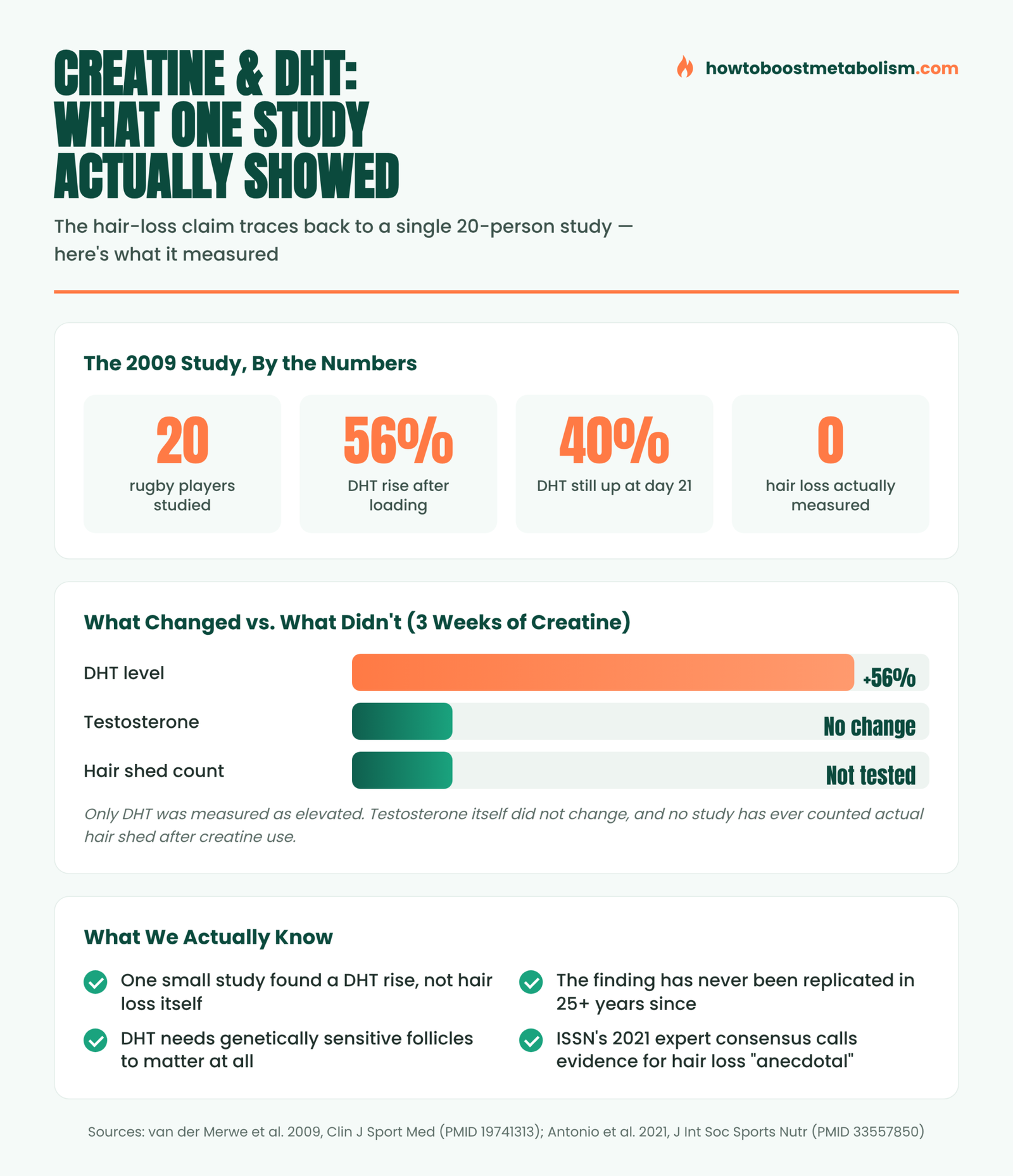
The hair-loss claim has a single origin point: a 2009 double-blind, placebo-controlled crossover study published in the Clinical Journal of Sport Medicine (https://pubmed.ncbi.nlm.nih.gov/19741313/). Researchers at Stellenbosch University gave 20 college-aged rugby players either creatine (25 g/day for 7 days, then 5 g/day for 14 days) or a placebo, then measured testosterone and DHT in their blood.
You may also find this useful: does creatine cause weight gain?
The result: total testosterone didn’t change in either group. But DHT — a more potent, more androgen-receptor-active form of testosterone that your body makes from it — rose by 56% after the one-week loading phase and was still 40% above baseline after two more weeks on a maintenance dose. That’s a real, statistically significant hormonal shift. It is the entire evidence base for the “creatine causes baldness” claim that’s been repeated online for over fifteen years.
What the study did not do is look at a single hair on anyone’s head. No hair counts, no follicle biopsies, no before-and-after photos, no hair-loss questionnaires. It measured a hormone known to be involved in male-pattern baldness, in a population that wasn’t tracked for hair loss at all.
Free download
🔥 The Metabolism Starter Kit
3 honest guides: a 7-day reset plan, a foods cheat-sheet and 12 metabolism myths debunked. No spam — unsubscribe anytime.
Why DHT Isn’t the Same Thing as “You Will Go Bald”
DHT is a genuinely important part of the androgenetic alopecia (male- and female-pattern hair loss) story. Finasteride and dutasteride, the two prescription medications with the strongest evidence for slowing pattern hair loss, work specifically by lowering DHT. So it’s not unreasonable to ask the question — raising a hormone tied to hair loss is worth taking seriously, not dismissing outright.
But “involved in” is a long way from “guaranteed to cause.” Pattern hair loss develops in people whose hair follicles are genetically sensitive to DHT — a trait called androgen sensitivity that’s largely inherited. Someone without that genetic susceptibility can have elevated DHT for years without losing a single follicle to it, which is exactly why some men never go bald regardless of their hormone levels, while others with “normal” DHT lose hair early because their follicles are unusually sensitive to it.
In other words, a 40–56% rise in DHT might matter enormously for someone with strong genetic susceptibility and a family history of early pattern baldness — and essentially not at all for someone without it. The 2009 study couldn’t tell us which category its 20 rugby players fell into, and it didn’t check back in to see who, if anyone, actually lost hair.
The Pushback the Original Study Got — and What Happened Next
The 2009 paper didn’t go unchallenged. A formal response published the following year in the same journal (https://pubmed.ncbi.nlm.nih.gov/20445368/) questioned the clinical significance of the finding and how far it could reasonably be extrapolated. That’s a normal, healthy part of how science is supposed to work: a provocative single study gets scrutinized, and ideally, other labs try to replicate it.
That replication never happened. In the years since, no other published trial has measured creatine’s effect on DHT, in any population, at any dose. For a claim that gets repeated as settled fact in gym locker rooms, the evidence base hasn’t grown by a single additional data point since 2009. One study, 20 subjects, three weeks, never repeated — that’s the entire foundation.
Free download: our Metabolism Starter Kit — a protein calculator, a 7-day meal framework, and a one-page supplement checklist, with zero hype.
Get the Free Starter Kit →What the Sports-Nutrition Field’s Own Consensus Says
In 2021, eleven researchers from the International Society of Sports Nutrition published a consensus paper directly addressing the field’s most common creatine questions, including, explicitly, “does creatine cause hair loss/baldness?” (https://pubmed.ncbi.nlm.nih.gov/33557850/). Their answer, in short: the concern is theoretically plausible given the DHT mechanism, but direct evidence that creatine supplementation causes hair loss in humans doesn’t exist — what exists is one hormone study, not a hair-loss study.
That’s about as honest an answer as the current science allows. It’s not a clean “no, it’s a myth, ignore it” — the DHT rise in that one study was real. But it’s also not evidence that creatine use causes baldness, because nobody has actually measured that outcome. The gap between “we found a hormone change” and “we found hair loss” is exactly where fifteen years of forum folklore has been living.
How Pattern Hair Loss Actually Works, in Plain Terms
It helps to separate two different questions that get blurred together in most forum arguments: “does X raise DHT?” and “does X cause baldness?” Androgenetic alopecia — the clinical name for male- and female-pattern hair loss — happens when hair follicles that carry a specific genetic sensitivity gradually shrink under chronic DHT exposure, a process called miniaturization. Over years, follicles that used to grow thick, long hairs start producing finer, shorter ones, until some stop producing visible hair altogether.
The key word is chronic. This is a years-long process driven by sustained hormone exposure in genetically susceptible follicles, not a switch that flips after a three-week supplement cycle. It’s also why finasteride and dutasteride, which work by blocking the enzyme that converts testosterone into DHT, take months of consistent use before patients see a measurable difference — and why stopping those medications lets hair loss resume gradually rather than instantly. A temporary 40–56% rise in DHT over three weeks, measured in a single small trial, sits on a completely different timescale and scale of evidence than the chronic process those drugs are designed to interrupt.
None of this proves creatine’s DHT effect is harmless long-term — nobody has run the years-long study that would settle it either way. It simply means the honest, current answer is “unknown, with one old and unreplicated data point suggesting a hormonal mechanism exists,” not “proven to cause baldness” and not “completely debunked” either. Both of those confident-sounding versions you’ll see online overstate what a single 2009 hormone study can actually tell us.
A Reasonable Way to Think About This If You’re Worried
- Know your family history first. If pattern baldness runs strongly in your family on either side, you already have the single biggest risk factor — far larger than anything a 40–56% DHT shift from creatine could add on top of it.
- Don’t expect a dramatic effect either way. Even people who do have a genetic susceptibility to pattern hair loss experience it gradually, over years, driven mostly by baseline genetics and age — not by a single supplement.
- Creatine monohydrate is one of the most-studied supplements that exists. It has roughly three decades of safety data for kidney and liver function, hydration, and general tolerability. Hair loss is the one area where the evidence is thin in both directions — not because it’s been disproven, but because it’s barely been tested at all.
- If you’re already losing hair and want to rule out a cause, a dermatologist can check DHT-related markers and discuss evidence-based options (like topical or prescription DHT-blockers) far more precisely than guessing based on supplement use.
- Stopping creatine as an experiment won’t tell you much. Hair loss unfolds over months to years; a short trial off creatine isn’t a controlled experiment and is likely to just add confusion.
Where This Leaves the Bigger Picture
Creatine monohydrate’s actual, well-replicated evidence base is about strength, power output, and lean mass — benefits that matter more, not less, as you get older and start losing muscle mass with age. A stable, well-dosed strength program is still the thing doing most of the work for your metabolism and muscle after 40; creatine is a well-tested add-on to that, not a replacement for it. If you’re building that kind of program and want a structured, no-nonsense framework for lifting consistently as you get older, that’s worth exploring directly.
It’s also worth remembering what creatine’s track record actually looks like outside of this one hair question. Across decades of trials in athletes, older adults, and clinical populations, the consistently-replicated findings are about strength and lean mass gains, not hormone-driven side effects. The hair-loss concern has stayed a single, unreplicated data point for over fifteen years precisely because nobody researching creatine’s many other benefits has found a reason to revisit it — which is itself a small, if inconclusive, piece of reassurance.
Old School New Body’s F4X method is built specifically for lifters over 40 who want a simple, structured strength routine without reinventing their training every few months.
Check Availability →Affiliate link — we may earn a commission at no extra cost to you. Disclosure
Note: the program’s own marketing page uses some unverified statistics about aging and muscle loss that aren’t supported by a specific cited source — treat those numbers skeptically and judge the program on its actual training structure, not its sales copy.
Frequently Asked Questions
Does creatine actually cause hair loss?
There’s no direct evidence that it does. One 2009 study found creatine raised DHT, a hormone linked to pattern baldness, by 40–56% over three weeks — but no study has ever measured actual hair loss from creatine use. The ISSN’s 2021 expert consensus calls the hair-loss claim itself unproven, even while acknowledging the DHT finding is real.
What is DHT and why does it matter for hair?
Dihydrotestosterone (DHT) is a byproduct of testosterone that’s more active at androgen receptors. In people with a genetic sensitivity to it, DHT can shrink hair follicles over time, which is the basis of pattern baldness. Without that genetic sensitivity, elevated DHT doesn’t appear to cause the same effect.
Has the 2009 DHT study ever been repeated?
Not as far as the published literature shows. It drew a critical response the following year questioning its clinical significance, but no later trial has re-tested creatine’s effect on DHT in any population.
Should I stop taking creatine if I’m worried about hair loss?
That’s a personal risk tolerance decision, not a scientific requirement — current evidence doesn’t establish that creatine causes hair loss. If pattern baldness runs in your family, that genetic factor matters far more than creatine use, and a dermatologist can offer evidence-based options either way.
Does creatine affect testosterone levels?
In the 2009 study, no — total testosterone didn’t change in either the creatine or placebo group. Only the downstream DHT level rose. Creatine is not considered an anabolic steroid and doesn’t appear to meaningfully raise baseline testosterone.
Worried about other creatine safety myths? We ran the same evidence-based fact-check on whether creatine damages your kidneys or liver. If you’re new to creatine entirely, our creatine after 40 guide covers the basics, and our loading phase breakdown explains whether the fast-loading protocol used in the 2009 study is even necessary. For the cognitive side of the ledger, see creatine and brain function after 40, and for timing, creatine timing before vs. after a workout.
This article is for educational purposes and is not medical advice. Hair loss has many causes beyond hormones, including genetics, stress, thyroid conditions, nutrient deficiencies, and certain medications. If you’re experiencing unexplained or rapid hair loss, talk to a doctor or dermatologist rather than self-diagnosing. See our full Medical Disclaimer.