Does Creatine Help Your Brain After 40?
This article may contain affiliate links. If you buy through them, we may earn a small commission at no extra cost to you. See our Affiliate Disclosure and Medical Disclaimer.
Affiliate Disclosure · Medical Disclaimer
Creatine has spent three decades as a muscle supplement with one of the strongest safety and effectiveness records in sports nutrition. What’s newer — and a lot less settled — is the question of what it does for the brain. A wave of research since 2018, including a fresh 2026 systematic review focused specifically on older adults, has started mapping out whether the same molecule that helps your muscles regenerate ATP does something similar for memory and attention as you get past 40. The honest answer: probably something, but smaller and more age-dependent than the supplement-aisle headlines suggest.
Why creatine would affect the brain at all
Creatine isn’t just a muscle molecule. It’s a core part of the phosphocreatine energy system that helps regenerate ATP — the cell’s basic energy currency — in any tissue with high, rapid energy demands. The brain qualifies: despite being about 2% of body weight, it consumes roughly 20% of resting energy use. The working hypothesis behind the cognitive research is straightforward: if supplementing with creatine raises the brain’s phosphocreatine reserves the way it raises muscle stores, it could help neurons keep up during periods of high demand — intense mental effort, sleep loss, or the slow decline in brain energy metabolism that comes with aging.
What the early research found (and didn’t)
The first major systematic review on this, published in Experimental Gerontology (Avgerinos et al., 2018), pooled 6 randomized trials and 281 healthy participants. It found evidence that short-term memory and intelligence/reasoning tasks improved with creatine supplementation, but results were conflicting or null for long-term memory, spatial memory, attention, executive function, word fluency, and reaction time. Interestingly, performance stayed essentially unchanged in young individuals — the benefit was already trending toward older or more metabolically stressed people even in this early, small body of evidence.
Free download
🔥 The Metabolism Starter Kit
3 honest guides: a 7-day reset plan, a foods cheat-sheet and 12 metabolism myths debunked. No spam — unsubscribe anytime.
The 2023 memory meta-analysis: age is the key variable
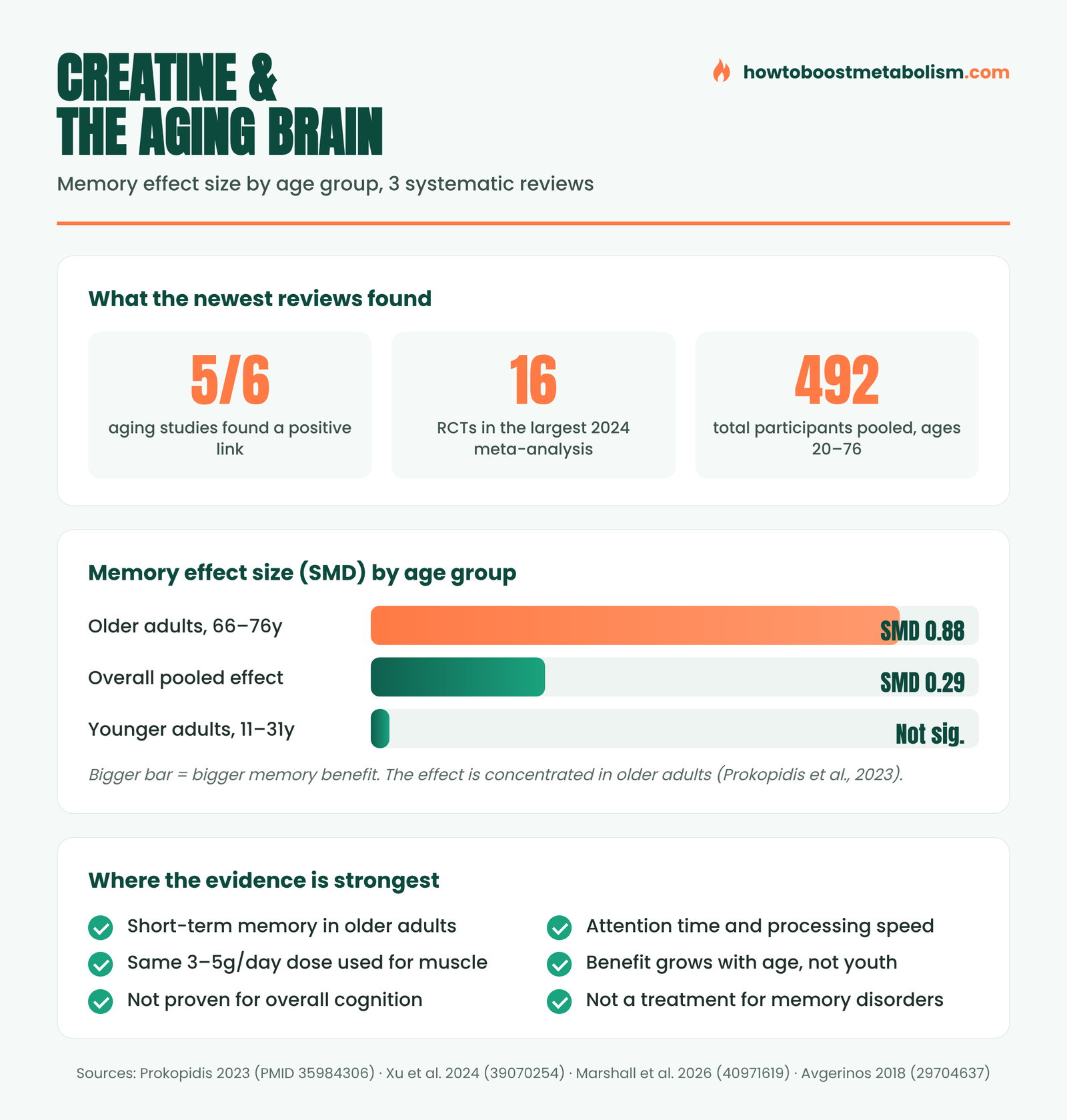
A 2023 meta-analysis in Nutrition Reviews (Prokopidis et al., 2023) is probably the single most useful study for anyone over 40 asking this question. Pooling 8 randomized trials, the researchers found that creatine supplementation improved memory performance overall compared with placebo (standardized mean difference, SMD = 0.29). But the subgroup analysis is the real finding: in older adults aged 66–76, the effect size was SMD = 0.88 — a large effect by conventional standards — while in younger adults aged 11–31, the effect was SMD = 0.03, essentially zero and not statistically significant. Dose (roughly 2.2 to 20 g per day), how long people took it (5 days to 24 weeks), sex, and where the study was done didn’t meaningfully change the results. The pattern is consistent and intuitive: creatine seems to help memory most in brains that are already under more age-related metabolic strain, and does little for young, healthy brains that aren’t.
A larger, newer meta-analysis broadens — and narrows — the picture
A 2024 systematic review and meta-analysis in Frontiers in Nutrition (Xu et al., 2024) expanded the pool to 16 randomized trials and 492 participants aged 20.8 to 76.4, including both healthy people and some with specific health conditions. It confirmed significant benefits for memory (SMD = 0.31) and attention time (SMD = -0.31, meaning faster/better), and a notable improvement in processing speed (SMD = -0.51). But it found no significant improvement in overall cognitive function or executive function — the broader, more complex planning-and-decision-making side of thinking. Subgroup analysis again favored certain groups: people with existing health conditions, those aged 18–60, and women showed more benefit than others. The takeaway holds up across both meta-analyses: the signal is real for specific domains — memory, attention, processing speed — not for cognition as a blanket category.
The newest evidence, built specifically for an older audience
The most directly relevant study for this article is a 2026 systematic review in Nutrition Reviews (Marshall et al., 2026), which looked exclusively at adults aged 55 and older, pooling 6 studies and 1,542 participants. Five of the six studies (83.3%) reported a positive relationship between creatine and cognition, particularly in memory and attention. The honest caveat the authors themselves flagged: only one of the six studies scored ‘good’ on methodological quality, two scored ‘fair,’ and three scored ‘poor.’ Several studies were cross-sectional (comparing people’s existing dietary creatine intake to their cognition) rather than randomized interventions, which is a much weaker form of evidence. Their conclusion was measured: creatine ‘may be associated with’ cognitive benefits in healthy older adults, but high-quality trials are still needed before that becomes a firm recommendation.
What about using it to fight off sleep deprivation?
A more targeted 2024 study in Scientific Reports (Gordji-Nejad et al., 2024) tested something different: a single large dose of creatine monohydrate (0.35 g per kilogram of body weight — roughly 25–30 grams for most adults) during 21 hours of sleep deprivation, with brain scans tracking energy metabolites in real time. The single dose measurably changed brain phosphocreatine and ATP levels, prevented a drop in brain pH, and improved cognitive performance and processing speed compared with placebo. It’s a genuinely interesting proof of concept — but it was a single-session lab study, not a daily-use protocol, and a 25–30 gram single dose is roughly 5–10 times a normal daily maintenance dose. This is not evidence that megadosing creatine before an all-nighter is a good general strategy; it’s evidence that the underlying brain-energy mechanism is real and measurable.
At a glance: what the evidence does and doesn’t support
| Cognitive domain | Evidence strength | Notes |
|---|---|---|
| Short-term memory | Moderate, consistent | Strongest, most reproduced finding — especially after age 60 |
| Attention / processing speed | Moderate | Significant in the largest 2024 meta-analysis |
| Overall cognitive function | Weak / not significant | No clear benefit found in pooled analyses |
| Executive function | Weak / not significant | Conflicting results across studies |
| Young, healthy adults (under ~40) | Little to no effect shown | Benefit concentrated in older age groups |
Vegetarians and vegans may see more of an effect
One detail that shows up repeatedly across this research deserves its own mention: dietary creatine intake varies enormously depending on diet, because the main food sources are meat and fish. People who eat little or no animal protein tend to have lower baseline creatine stores in both muscle and brain, which means they may have more room to benefit from supplementation. The original 2018 review noted that vegetarians responded better than meat-eaters on memory tasks specifically. If you’ve followed a mostly plant-based diet for years and are curious whether creatine might do something noticeable for you, that baseline difference is part of why the answer may be yes, independent of age.
Dosing, timing, and safety notes
None of the studies reviewed here used anything exotic. A typical protocol is 3 to 5 grams of creatine monohydrate per day, taken at any time, with or without food — timing relative to workouts hasn’t been shown to matter much for either the muscle or cognitive literature. Some protocols use an initial loading phase of about 20 grams a day split into 4 doses for 5 to 7 days to saturate muscle stores faster, then drop to a 3–5 gram maintenance dose; this isn’t required, it just speeds up how soon you reach full saturation. Creatine monohydrate remains the most studied, least expensive, and best-tolerated form — the fancier branded versions marketed as superior for absorption or side effects don’t have evidence showing a meaningful edge over plain monohydrate in this research base. As with any supplement, if you have kidney disease or are on medications that affect kidney function, check with a doctor first; for most healthy adults, decades of research point to creatine being one of the better-supported, lower-risk supplements on the market.
A realistic way to think about it
If you’re already taking 3 to 5 grams of creatine monohydrate a day for strength training — which remains the best-supported reason to take it — the cognitive research gives you a reasonable, if modest, bonus to expect as you move into your 40s, 50s, and beyond: somewhat better memory performance and faster processing, more likely to show up the older you get. It is not evidence that creatine treats memory loss, reverses cognitive decline, or belongs in the same category as prescription cognitive treatments. The honest framing, backed by what these reviews actually say, is that creatine is a well-studied, safe muscle supplement that appears to carry a real but secondary cognitive benefit that grows more relevant with age — not a brain supplement that happens to also build muscle.
Creatine’s biggest practical payoff is still what it does for a consistent strength-training habit, and that habit matters more after 40 than any single supplement. If you want a structured 40+ program to build that consistency around, see our honest look at:
See the Program →Affiliate link — we may earn a commission at no extra cost to you. Disclosure
Heads up: the Old School New Body sales page uses some unverified statistics about muscle loss and aging rates that we could not confirm in the research literature — ignore those specific numbers and judge the program on its actual training structure.
Free download: our Metabolism Starter Kit — a protein calculator, a 7-day meal framework, and a one-page supplement checklist, with zero hype.
Get the Free Starter Kit →Related reading
For more on creatine specifically, see our breakdowns of whether a creatine loading phase is actually necessary and the truth about creatine and water retention. If memory and brain health after 40 is the bigger topic you’re after, our guide to vitamin D and muscle strength after 40 covers another nutrient with age-dependent effects worth knowing about.
Frequently Asked Questions
Is creatine actually a ‘brain supplement’ now?
Not in the way nootropics are marketed. The evidence is real but modest: several systematic reviews find small-to-moderate improvements in memory, attention, and processing speed, with the clearest signal in older adults rather than young, healthy people. It isn’t a substitute for sleep, exercise, or treating an actual cognitive condition — it’s a muscle supplement with a secondary brain benefit that shows up more as you age.
What dose supports the cognitive research?
Most of the trials behind these findings used the same creatine monohydrate doses already used for muscle — generally around 3 to 5 grams per day, sometimes with an initial loading phase of roughly 20 grams a day split into smaller doses for 5 to 7 days. There is no evidence that higher ‘brain-specific’ doses do more; one notable single-dose study used a much larger 0.35 g/kg dose, but that was a one-off intervention during sleep deprivation, not a daily protocol.
Does creatine help younger people’s brains too?
The data suggests the effect is age-dependent. A 2023 meta-analysis found a significant memory benefit in older adults aged 66–76 (SMD 0.88) but no significant effect in younger adults aged 11–31 (SMD 0.03). If you’re under 40 and already taking creatine for training, you may simply not notice a cognitive effect — that doesn’t mean the supplement isn’t working for your muscles.
Will creatine fix brain fog or memory problems?
There’s no evidence it treats brain fog, ADHD-type attention issues, or diagnosed memory disorders. The research reviewed here was conducted in generally healthy adults, and even there the effects were inconsistent across cognitive domains — memory and processing speed showed benefits more reliably than overall cognitive function or executive function. If memory problems are new, worsening, or concerning, that’s a conversation for a doctor, not a supplement aisle.
If I’m already taking creatine for the gym, do I need to do anything differently?
No. If you’re already supplementing with 3–5 g of creatine monohydrate daily for strength and muscle, the cognitive research so far suggests you may already be getting a modest side benefit, particularly as you move past 40. There’s no indication a separate ‘brain dose’ or different timing is required.