Soleus Push-Ups: Can This Tiny Exercise Lower Blood Sugar?
This article may contain affiliate links. If you buy through them, we may earn a small commission at no extra cost to you. See our Affiliate Disclosure and Medical Disclaimer.
If you spend most of your day sitting — at a desk, in a car, on a couch — you’ve probably seen the soleus push-up show up in your feed. It looks almost too simple to matter: feet flat on the floor, heels planted, and you just lift and lower the front of your foot, over and over, for an hour or more while you work. The claim attached to it is a big one — meaningfully lower blood sugar spikes after meals, without going to the gym or changing what you eat. That’s the kind of claim this site is built to stress-test. So we went to the actual trials.
What Exactly Is a Soleus Push-Up?
The soleus is the flatter, deeper calf muscle that sits under the more visible gastrocnemius. It’s unusual among human muscles: it’s built almost entirely from slow, fatigue-resistant (oxidative) fibers, and its main job in daily life is quietly stabilizing your ankle while you stand. A research team at the University of Houston, led by exercise physiologist Marc Hamilton, found that if you isolate this one small muscle — about 1% of your total body mass — and keep it gently contracting for hours while seated, it behaves almost like a second, miniature engine for clearing sugar and fat from your bloodstream, without ever getting tired.
The movement itself (often abbreviated SPU in the research) is deliberately low-effort: heels stay on the ground, and only the forefoot lifts and drops in a slow, repeated motion. It’s designed to be done for long stretches — an hour, two hours, even most of a workday — precisely because it’s supposed to feel easy enough that fatigue never becomes the limiting factor.
The Study That Started It All
The foundational paper, published in 2022 in iScience (PMID 36034224), put this to the test directly. Researchers had sedentary volunteers — people with no particular fitness background — perform soleus push-ups while sitting, then measured what happened to their blood sugar and fat markers after they ate or drank a glucose load. Muscle biopsies showed something notable: the muscle was burning through fuel for hours without depleting its glycogen stores, meaning it wasn’t fatiguing the way a muscle does during a normal workout.
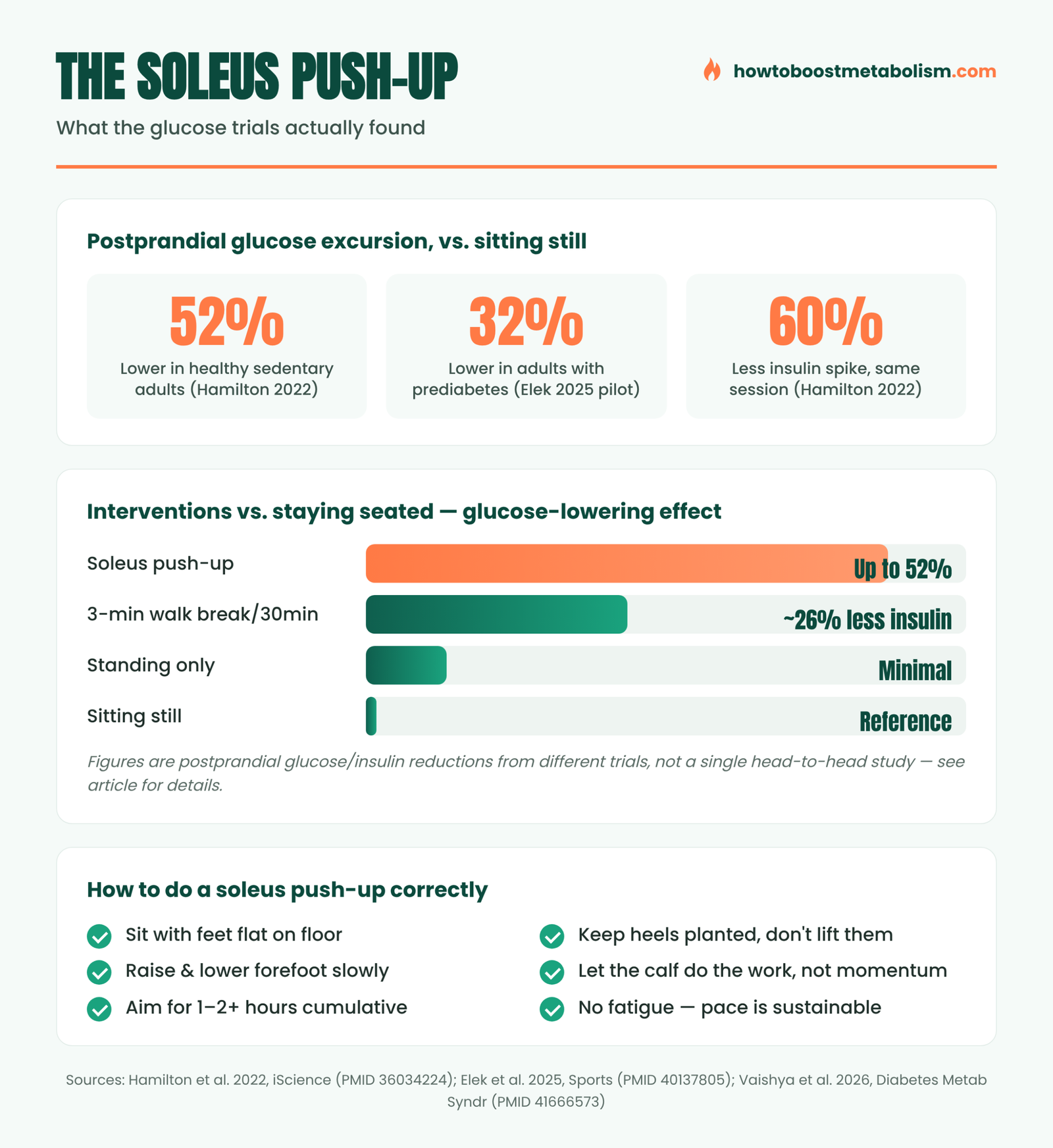
The headline numbers from that trial: 52% less post-meal (postprandial) glucose excursion — roughly 50 mg/dL less of a spike between the one- and two-hour mark — and 60% less hyperinsulinemia, meaning the pancreas didn’t have to work nearly as hard to bring glucose back down. For context, that’s a larger effect than many single lifestyle interventions produce on their own, which is exactly why the study got attention well beyond exercise-science circles.
Free download
🔥 The Metabolism Starter Kit
3 honest guides: a 7-day reset plan, a foods cheat-sheet and 12 metabolism myths debunked. No spam — unsubscribe anytime.
Does It Hold Up Outside the Lab?
A single impressive study in healthy volunteers is a starting point, not proof the effect generalizes — so the honest next question is whether it holds up in people who actually have a blood sugar problem. A 2025 pilot study in Sports (PMID 40137805) tested the soleus push-up in ten adults with prediabetes, average age 53, during an oral glucose tolerance test. The effect was smaller than the original study but still real: a 32% reduction in postprandial glucose excursion compared to sitting still, and it worked whether or not participants used EMG feedback to check their form. That’s a meaningfully smaller number than the original 52% — worth saying plainly, because a shrinking effect size in a sicker, more realistic population is the normal, honest pattern for a promising intervention, not a red flag that the whole idea is bunk.
A broader 2026 narrative review in Diabetes & Metabolic Syndrome (PMID 41666573) pulled together the soleus push-up literature alongside related “seated resistance activity” research and reported a range of 39–52% lower postprandial glucose and about 60% lower insulin response across the trials it covered, plus a related finding that simply breaking up sitting with 3-minute movement snacks every 30 minutes cuts insulin response by about 26% on its own. The same review also noted that moderate lower-body muscular strength, independent of any single exercise, is associated with a 32–35% lower risk of developing type 2 diabetes over time (HR 0.68, 95% CI 0.49–0.94) — a reminder that the soleus push-up is one tool inside a much bigger picture of muscle and metabolic health, not a replacement for it.
Why a Tiny Calf Muscle Can Move the Needle
The proposed mechanism isn’t mysterious. All of your skeletal muscle together normally handles only about 15% of glucose disposal at rest, despite being the body’s largest lean tissue. Most of that capacity sits idle while you’re seated. Repeated, sustained soleus contractions appear to locally trigger AMPK-dependent GLUT4 transporter activity — the same basic glucose-uptake pathway that any muscle contraction uses, just concentrated and prolonged in a muscle that’s unusually good at sustaining it without fatigue. It’s the same family of mechanism behind why walking after a meal helps blood sugar; the soleus push-up is essentially a way to get a similar signal while sitting still, which matters if you have a desk job, limited mobility, or simply can’t take a walk after every meal.
| Strategy | Time cost | Reported glucose effect | Best fit |
|---|---|---|---|
| Soleus push-up (seated) | 1–2+ hrs, low effort | Up to 52% (healthy); 32% (prediabetes) | Desk workers, limited mobility |
| 3-min movement break / 30 min | 6–10 min/hour | ~26% less insulin response | Anyone who can briefly stand |
| 10-min walk after a meal | 10 min | Well-documented, comparable magnitude | Anyone who can walk post-meal |
| Standing instead of sitting | Passive | Minimal glucose effect alone | General activity, not a glucose fix |
How to Actually Do One
- Sit in a normal chair with both feet flat on the floor, knees bent roughly 90°.
- Keep your heels planted on the ground — they should not lift at any point.
- Slowly raise the front of your foot as high as is comfortable, then lower it back down. That’s one rep.
- Keep the pace slow and easy — this is not a calf-raise workout, it should never feel like it’s burning.
- Do it in long, cumulative blocks (ideally 1–2+ hours, broken up however fits your day) rather than short, intense sets.
- Stop and rest if you feel any cramping, strain, or sharp discomfort — it should stay comfortable the whole time.
Who Should — and Shouldn’t — Rely on This
If you sit for long stretches at work, soleus push-ups are a close-to-free way to claw back some of the metabolic cost of that sitting, and the prediabetes pilot study suggests it’s not just a healthy-volunteer effect. But it’s worth being honest about the limits: these trials measured short-term glucose and insulin responses during controlled test meals, not long-term HbA1c, weight, or cardiovascular outcomes, and sample sizes were small (ten to a few dozen people). If you have diagnosed diabetes and take glucose- or insulin-affecting medication, talk to your doctor before treating this as a substitute for anything in your treatment plan — a sustained muscle contraction that measurably changes insulin demand is exactly the kind of thing that can matter for medication timing.
It’s also not a weight-loss trick by itself. The energy cost of a soleus push-up session is modest — this is about glucose and insulin handling, not calories burned. Think of it as one more lever in the same family as resistance training, protein intake, and sleep — not a replacement for any of them.
Soleus push-ups target the glucose spike after you eat. Intermittent fasting is a separate, well-studied lever for the same underlying issue — insulin sensitivity — approached from the meal-timing side instead of the muscle-activity side.
Learn More →Affiliate link — we may earn a commission at no extra cost to you. Disclosure
Honest note: Eat Stop Eat is a fasting-based program, not a clinically validated treatment for blood sugar control. Its author, Brad Pilon, holds a master’s degree in applied human nutrition; the book is listed on Goodreads. If you’re managing diagnosed prediabetes or diabetes, run any fasting protocol past your doctor first.
Free download: our Metabolism Starter Kit — a protein calculator, a 7-day meal framework, and a one-page supplement checklist, with zero hype.
Get the Free Starter Kit →Fitting It Into a Real Workday
The biggest practical barrier isn’t the exercise itself — it’s remembering to do it. Most people who try soleus push-ups report it becomes background noise within a day or two, similar to how you stop noticing you’re tapping a foot. A few things make it easier to sustain for the hour-plus durations the research used: set a recurring reminder for the first week until it becomes automatic, keep your shoes off or wear flat soles so you can actually feel your heel staying planted, and don’t try to layer it onto video calls where you’re worried about the motion being visible — a closed-door stretch of focused work is a more realistic window. Some people find it easier under a standing desk set to sitting height, since the desk surface gives a visual cue to keep going. None of this is in the original trials, but it’s the kind of adherence detail that determines whether a genuinely useful intervention actually gets used.
The Bottom Line
The soleus push-up is one of the rare viral fitness trends where the core claim actually traces back to a real mechanistic study, not just a confident Instagram caption. The original 52% figure came from healthy, sedentary volunteers in a lab; the number that matters more for most readers — the 32% seen in an actual prediabetes pilot — is smaller but still clinically meaningful, and a 2026 review puts the realistic range at roughly 39–52% depending on population. It won’t replace walking, resistance training, or an eye on what you eat, but as a near-zero-cost habit you can do at your desk, it has more evidence behind it than almost anything else in that category.
For more on what actually moves the needle while you’re stuck at a desk, see our guides on non-exercise activity thermogenesis (NEAT), insulin resistance and metabolism, and zone 2 cardio for fat loss. If short movement breaks appeal to you more than a seated exercise, our piece on walking to boost metabolism covers the walking-break research mentioned above in more depth.
Frequently Asked Questions
Is the soleus push-up actually backed by science, or is it just a social media trend?
It’s one of the few viral fitness trends with a genuine peer-reviewed origin: a 2022 study in iScience (PMID 36034224) measured a 52% reduction in post-meal glucose excursion and a 60% reduction in insulin response during supervised lab testing. A 2025 pilot study in people with prediabetes found a smaller but still real 32% reduction, and a 2026 review put the realistic range at 39-52%.
How long do I need to do soleus push-ups for them to help?
The original research used sessions lasting roughly one to several hours, performed while seated at a desk or table. There’s no solid evidence yet for shorter sessions (a few minutes) producing the same glucose effect — the mechanism depends on sustained, low-level muscle activity over time.
Can soleus push-ups replace exercise or help me lose weight?
No. The calorie cost is low, and the studies measured glucose and insulin responses to test meals, not body weight or long-term cardiovascular outcomes. It’s best thought of as an add-on to walking, resistance training, and diet — not a substitute for any of them.
Is this safe for people with diagnosed diabetes who take insulin or other medication?
Likely, but talk to your doctor first. Because the research shows a measurable drop in insulin demand, it could theoretically affect how your current medication dosing lines up with meals — the kind of interaction that’s worth discussing with whoever manages your treatment.
Does standing instead of sitting give the same benefit?
No — the reviewed research found standing alone had a minimal glucose effect compared to the soleus push-up or even short walking breaks. The benefit comes from the specific sustained, repeated muscle contraction, not simply being upright.
This article is for general educational purposes and is not medical advice. Always talk to a qualified healthcare provider before changing how you manage blood sugar. See our Medical Disclaimer.