
Do You Have a Strength Imbalance? 5 Self-Tests
This article may contain affiliate links. If you buy through them, we may earn a small commission at no extra cost to you. See our Affiliate Disclosure and Medical Disclaimer.
“One of my legs feels noticeably weaker than the other.” It’s one of the more common things people notice once they start paying attention to their training — one side struggles to keep up on lunges, one arm shakes more on a single-arm row, one foot feels less stable standing on one leg. The question is whether that’s a real, meaningful strength imbalance worth correcting, or just normal human asymmetry that everyone has to some degree. Sports science actually has a fairly developed body of research on exactly this question — and it comes with an honest, slightly less tidy answer than most “check for muscle imbalances” content online suggests.
Everyone Has Some Asymmetry — the Question Is How Much
Humans are not symmetrical machines. Handedness, dominant kicking leg, old minor injuries, and simple daily habits all nudge strength slightly in one direction over the other. The real question researchers have tried to answer isn’t “do I have an imbalance” — almost everyone does, to some small degree — but rather, how much difference is normal variation, and at what point does a gap start to actually matter for performance or injury risk.
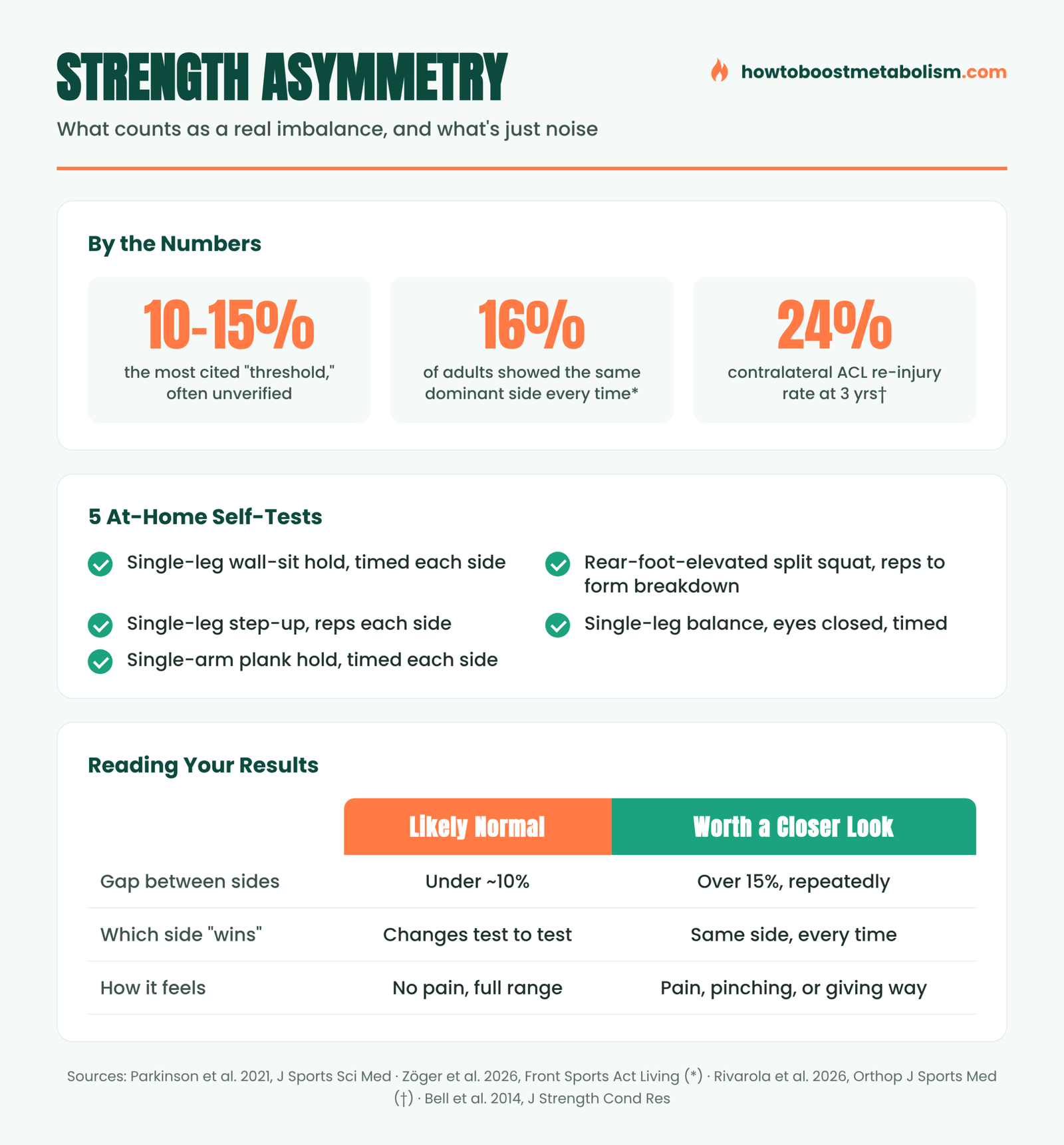
A systematic review out of Nottingham Trent University dug specifically into where the commonly cited “10–15% asymmetry threshold” actually comes from (Parkinson et al., 2021). After screening 3,594 articles down to 53 that met their criteria, the researchers found that of the studies that applied a cutoff to flag “abnormal” asymmetry, the large majority used something in the 10–15% range — but tracing that number back to its original evidence basis was often difficult, and in many cases the threshold wasn’t well supported by the data being cited. Their conclusion was candid: an individualized approach to interpreting asymmetry may be necessary, because a single universal cutoff doesn’t hold up well across different people, tests, and sports.
Why Your Test Results Might Not Even Be Consistent
Here’s a detail that rarely makes it into popular fitness content: which side tests as “dominant” often isn’t fixed. A 2026 study out of the University of Applied Sciences Wiener Neustadt tested 25 recreationally active adults on unilateral leg-press strength across two different knee angles and two different contraction speeds, on two separate days (Zöger et al., 2026). The measurement itself was reasonably consistent overall — but only 16% of participants showed the same dominant leg across every single test condition and session. For the rest, which leg tested stronger shifted depending on the joint angle, the speed of the movement, or simply the day. The researchers also found that normal measurement error (3%–20%, depending on the specific test) frequently overlapped with the very thresholds people use to call something clinically meaningful — their practical conclusion was that universal cutoffs like 10–15% should be interpreted cautiously rather than treated as a firm diagnostic line.
None of this means asymmetry testing is useless — it means a single test on a single day tells you less than it feels like it does. A pattern that repeats across several different tests and several different days is far more informative than one isolated number.
Free download
🔥 The Metabolism Starter Kit
3 honest guides: a 7-day reset plan, a foods cheat-sheet and 12 metabolism myths debunked. No spam — unsubscribe anytime.
5 Simple Self-Tests You Can Do at Home
These aren’t lab-grade measurements, but they’re a reasonable, low-equipment way to get a rough read on left-right differences — and critically, to repeat the same test more than once before drawing conclusions.
- Single-leg wall sit, timed. Stand with your back against a wall, slide into a single-leg squat position (the other leg held out in front, knee bent to roughly 90°), and time how long you can hold it with good form on each side. Rest fully, then repeat on the other leg.
- Rear-foot-elevated split squat, reps to form breakdown. Using the same light load on both sides, count how many clean, full-range reps you get on each leg before your form noticeably degrades. Researchers have specifically validated this exercise’s 5-rep-max as a field test for leg strength symmetry (Helme et al., 2019).
- Single-leg step-up, max reps in 30 seconds. Using a stable step or low box, count controlled step-ups on each leg within a fixed time window.
- Single-leg balance, eyes closed, timed. This tests stability and proprioception more than raw strength, but a large side-to-side difference here is still worth noting.
- Single-arm plank hold, timed each side. From a side-plank position, time how long you can hold a stable position on each side without your hips dropping.
Do each test on both sides, on two or three separate days spread over a week or two, and look for a pattern — not a single number from a single session.
| What you’re seeing | What it likely means |
|---|---|
| Under ~10% | Likely normal variation — don’t restructure your training around it |
| 10–15%, inconsistent across tests | Probably noise; retest before reacting (Zöger et al., 2026) |
| 10–15%+, consistent across multiple tests and sessions | Worth addressing with some unilateral-focused training |
| Large gap plus pain, stiffness, or a feeling of instability | Worth discussing with a physical therapist or sports medicine provider |
Does an Imbalance Actually Matter for Injury Risk?
This is the part worth being careful and honest about, because the evidence doesn’t point in one clean direction. In a prospective study following sub-elite rugby league players through a season, overall unilateral leg strength (tested with the rear-foot-elevated split squat) had a statistically significant but practically small correlation with total time lost to lower-body injury — but no strength measure, including asymmetry itself, significantly predicted relative injury risk (Helme et al., 2023). A separate comparison of elite senior and junior soccer players found no meaningful difference in intra- or inter-limb imbalance between the two groups relative to the asymmetry levels generally cited as increasing injury risk (Śliwowski et al., 2024).
The picture looks different after a major joint injury has already occurred. A cohort study following 500 patients after ACL reconstruction found that persistent interlimb asymmetry in landing force at the time they were medically cleared to return to sport was independently associated with a higher risk of injuring the other knee’s ACL over the next three years — the injury rate was 24% over a roughly three-year follow-up, and adding asymmetry measurements to standard return-to-sport criteria meaningfully improved how well researchers could predict who was at elevated risk (Rivarola et al., 2026). So: in a healthy population without a significant prior injury, a moderate strength asymmetry by itself appears to be a fairly weak signal. After a serious injury like an ACL tear, lingering asymmetry seems to be a more meaningful red flag worth monitoring closely.
Where Does Asymmetry Actually Come From?
Muscle size differences play a real but partial role. A study using DEXA body-composition scans alongside force-plate jump testing in 167 Division I collegiate athletes found that asymmetry in lean muscle mass of the thigh and shank explained about 20% of the variance in force asymmetry during a jump, and lean mass across the pelvis, thigh, and shank together explained about 25% of power asymmetry (Bell et al., 2014). That leaves roughly three-quarters of the asymmetry unexplained by muscle size alone — meaning technique, motor-control preferences, old minor injuries, and simple habitual loading patterns are likely doing a lot of the remaining work.
If a real, repeatable imbalance shows up in your self-tests, a structured program that programs deliberate single-leg and single-arm work — rather than one that’s purely bilateral — is a sensible next step. Anabolic Fasting pairs a structured training progression with an intermittent-fasting framework; its marketing language about building muscle and losing fat “simultaneously” is a sales claim, not a guarantee, so judge it on the training structure itself.
Learn More →Affiliate link — we may earn a commission at no extra cost to you. Disclosure
A Realistic Way to Think About This
Test more than once. Look for a pattern across several different movements rather than trusting one number from one day. Treat 10–15% as a loose flag worth a second look, not a diagnosis. And remember that for most healthy people without a significant prior injury, the research doesn’t support treating a moderate imbalance as an emergency — it supports noticing it, training around it sensibly with some unilateral work, and rechecking periodically to see if the pattern holds.
Free download: our Metabolism Starter Kit — a protein calculator, a 7-day meal framework, and a one-page supplement checklist, with zero hype.
Get the Free Starter Kit →Frequently Asked Questions
What percentage difference between legs counts as a real imbalance?
There’s no single agreed-upon number, even though you’ll see 10–15% quoted everywhere. A systematic review that traced where that figure actually comes from found that of the studies applying a threshold, most used something in the 10–15% range — but the evidence backing that specific cutoff was often weak or missing entirely (Parkinson et al., 2021). A more recent reliability study found that normal measurement error alone can range from about 3% to 20% depending on the test, which frequently overlaps with the “clinical” threshold people treat as meaningful (Zöger et al., 2026). Treat 10–15% as a rough flag worth paying attention to, not a hard diagnostic line.
Is it normal to have a dominant leg that’s always stronger?
Having some difference is extremely common and not automatically a problem. What’s more telling is consistency: a 2026 study testing the same people twice found that only 16% showed the same “dominant” leg across every testing condition — for most people, which side tested stronger actually shifted depending on the specific movement, joint angle, or speed being tested (Zöger et al., 2026). If your results flip around from test to test, that’s a sign you’re likely looking at normal day-to-day and test-to-test variability rather than a fixed, structural imbalance.
Does a leg imbalance actually increase injury risk?
The evidence is genuinely mixed, and it’s worth being honest about that instead of overstating it. In one prospective study of sub-elite rugby league players, overall leg strength had a weak but statistically real relationship with lower-body injury burden, though no measure of leg strength predicted relative injury risk directly (Helme et al., 2023). A comparison of elite senior and junior soccer players found no meaningful difference in imbalance between the groups relative to commonly cited injury-risk norms (Śliwowski et al., 2024). On the other hand, a large cohort study of 500 patients who’d had ACL reconstruction found that persistent asymmetry at the point of return to sport was independently linked to a higher rate of injuring the other knee over the following three years (Rivarola et al., 2026). The honest summary: in a general, healthy population, a strength difference alone is a weak predictor at best; after a significant joint injury, lingering asymmetry appears to matter more.
What’s causing my imbalance — is it muscle size, or something else?
Often both, and they’re connected. Research using DEXA scans alongside force-plate testing in collegiate athletes found that asymmetry in lean muscle mass between legs explained about 20–25% of the asymmetry seen in jumping force and power (Bell et al., 2014) — a real relationship, but one that leaves most of the variance unexplained by muscle size alone. Technique, which side you favor during daily tasks, old minor injuries, and simple motor-control preferences for one side all likely play a role too.
What should I actually do if my self-test shows a real gap?
Start by retesting a week or two later before reacting to a single data point, since test-retest variability is real. If the gap holds up and shows the same direction consistently, a sensible approach is training unilaterally for a while — giving the weaker side its own working sets rather than letting the stronger side compensate on bilateral lifts. Our guide to unilateral training after 40 covers how single-leg work and the cross-education effect fit into that kind of plan, and the Bulgarian split squat is one of the more practical tools for it.