Resistance Bands vs Free Weights: Which Builds More?
This article may contain affiliate links. If you buy through them, we may earn a small commission at no extra cost to you. See our Affiliate Disclosure and Medical Disclaimer.
Walk into any big-box gym and you’ll see free weights everywhere. Scroll through home-workout content and resistance bands seem to be taking over. So which one actually builds more strength and muscle — and does it matter for your metabolism? We dug into the actual comparative research, including a head-to-head randomized trial published in 2026, instead of relying on gym folklore. This matters more than it might seem, because the equipment you end up choosing is often the single biggest factor in whether you actually stick with a training habit long enough to see results.
The Short Answer
For most people, especially beginners and older adults, the honest answer is: both work well, and the practical differences are smaller than the marketing on either side suggests. The best tool is the one you will actually use consistently, week after week. That said, there are real, research-backed differences in where each option has an edge — and knowing them can help you choose intentionally instead of randomly.
What a Direct Head-to-Head Trial Found
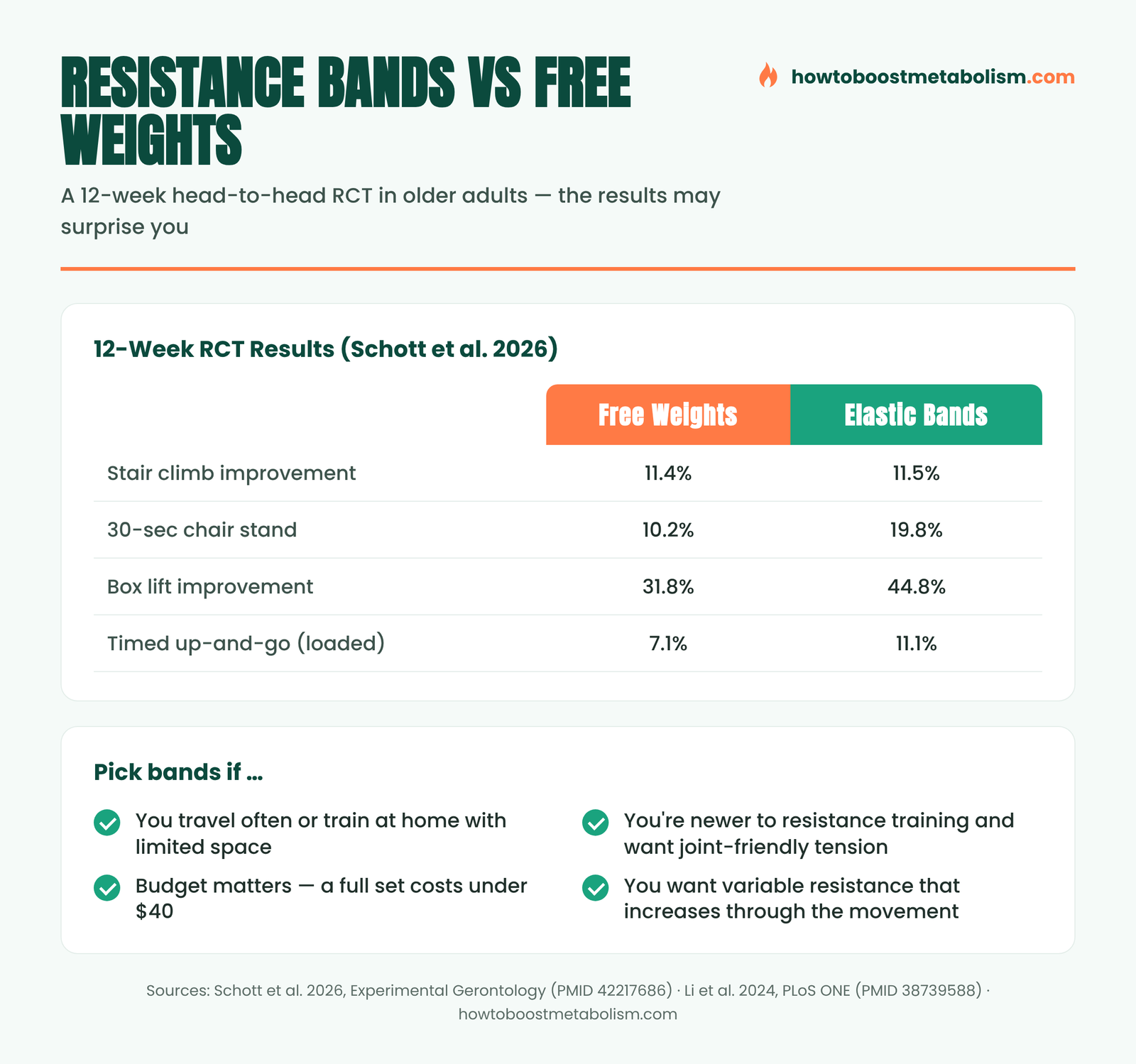
The most directly useful study here is a 2026 randomized controlled trial in Experimental Gerontology (PMID 42217686) that put a free-weight group, an elastic-band group, and a no-training control group head to head over 12 weeks of supervised, twice-weekly, full-body training in adults averaging 67 years old. Both the free-weight and band groups improved significantly compared to the control group on stair climbing, the 30-second chair stand test, a box-lift task, and a timed up-and-go test. Here’s the part that surprised the researchers: the band group actually outperformed the free-weight group on several of these functional measures, including nearly double the improvement on the chair stand test (19.8% vs. 10.2%) and the box lift (44.8% vs. 31.8%). Neither group showed a statistically significant edge on raw 1-rep-max strength tests (chest press or leg press) over the control group, though both trended upward.
The researchers’ interpretation is worth sitting with: band training may demand more motor control and stabilization because the resistance isn’t a fixed external weight, which could explain the larger transfer to real-world functional tasks like standing up from a chair or lifting a box. In plain terms: which tool is “better” seems to depend heavily on what you’re training for.
Free download
🔥 The Metabolism Starter Kit
3 honest guides: a 7-day reset plan, a foods cheat-sheet and 12 metabolism myths debunked. No spam — unsubscribe anytime.
What a Broader Review of Band Training Shows
Zooming out from that single trial, a 2024 mixed-methods systematic review in PLoS ONE (PMID 38739588) pooled 28 studies and nearly 1,700 participants on elastic-band resistance training in older adults specifically. It found consistent evidence that band training improves upper and lower limb strength, flexibility, endurance, balance, and even cardiopulmonary function, alongside mental health benefits. The same review also surfaced a practical point that often gets lost in strength debates: participants reported real preferences and barriers around each tool, and the training method people will actually stick with matters more for long-term results than theoretical superiority on paper.
At a Glance: Bands vs. Free Weights
| Factor | Resistance Bands | Free Weights |
|---|---|---|
| Cost | Low (a full set is usually under $40) | Higher, especially for a home set |
| Space needed | Minimal — fits in a drawer | Dedicated storage, often significant |
| Resistance curve | Increases as the band stretches | Constant regardless of range of motion |
| Joint feel for beginners | Often gentler, especially on sore joints | Can feel harsher without good form |
| Functional/balance carryover | Strong, per the 2026 RCT above | Solid, but slightly behind bands on some tasks |
| Ceiling for max-strength progression | Limited by band resistance levels over time | Virtually unlimited with enough plates |
| Travel-friendly | Very — packs in a bag | Not practical outside a gym |
How Training Volume Fits Into the Picture
Regardless of which tool you choose, the same underlying training-volume research applies. A 2025 network meta-analysis of 151 randomized trials in older adults (PMID 39405023) found that even a modest weekly training volume — a few sets per exercise — meaningfully improved lean body mass and muscle size, while moderate-to-higher volumes were needed specifically to maximize strength gains. That principle doesn’t care whether the resistance comes from a barbell or a loop of rubber: consistent, progressively harder sets, done regularly, are what drive the adaptation.
A Sample Full-Body Session, Either Way
The underlying movement patterns that drive strength and muscle results — a squat, a hinge, a push, a pull, and a carry or core movement — don’t change based on which tool you use. Here’s what a simple, balanced session looks like with each option, so you can see how directly they map onto each other.
| Movement Pattern | Free-Weight Version | Band Version |
|---|---|---|
| Squat | Goblet squat or barbell back squat | Band squat (band anchored under feet, held at shoulders) |
| Hinge | Dumbbell or barbell Romanian deadlift | Band-resisted hip hinge or band deadlift |
| Push | Dumbbell or barbell bench/overhead press | Band chest press or band overhead press |
| Pull | Dumbbell row or lat pulldown | Band row (anchored to a door or sturdy post) |
| Carry/Core | Farmer’s carry with dumbbells | Band anti-rotation press (Pallof press) |
Two to three sets of 8–12 reps per movement, twice a week, covers the same territory as the evidence-based progressive-overload template we outline in our guide linked below — regardless of which column you’re pulling exercises from.
Which One Should You Actually Pick?
- New to strength training, or training at home: start with bands. The learning curve is gentler, the injury risk from bad form is lower, and the 2026 RCT above shows real functional gains.
- Training for maximum strength or have years of lifting experience: free weights (or a mix of both) give you a higher ceiling for progressive overload over the long run, since band resistance is harder to fine-tune in small increments.
- Recovering from injury or managing joint pain: bands let you control resistance through the full range of motion and are often easier to modify mid-set.
- Frequent travelers, or tight on space and budget: bands are the practical winner — a full set weighs almost nothing and costs less than a single gym day pass in most cities.
- Want the best of both: plenty of effective programs combine bands for warm-ups, activation work, and higher-rep finishers with free weights for the main compound lifts.
If you are just getting started with either option, our beginner’s guide to strength training covers the fundamentals that apply no matter which equipment you choose, and our budget home gym guide has specific product categories worth owning if you are building a setup from scratch. For the structured progression piece once you have picked your tools, see how to apply progressive overload safely after 40.
Whichever tool you pick, a consistent plan matters more than the equipment itself. One structured option is Old School New Body, a dumbbell-based routine for people over 40 that takes the guesswork out of sets, reps and progression — we reviewed it in full, flaws included.
Free download: our Metabolism Starter Kit — a protein calculator, a 7-day meal framework, and a one-page supplement checklist, with zero hype.
Get the Free Starter Kit →If You Choose Bands: What to Actually Buy
Not all resistance bands are created equal, and the wrong purchase is the most common reason people abandon band training after a few weeks. A few practical pointers:
- Buy a set, not a single band. A graded set (typically labeled light, medium, heavy, extra-heavy) covers the full range from a warm-up to a genuinely challenging working set, since a single resistance level will eventually be too easy for some movements and too hard for others.
- Loop bands vs. tube bands with handles. Loop bands (continuous fabric or rubber loops) are more versatile for lower-body work like squats and hip work; tube bands with handles tend to feel more natural for upper-body pressing and rowing movements.
- Fabric-covered bands last longer and don’t pinch skin the way bare latex loop bands can, though they cost a bit more and offer slightly less precise resistance jumps.
- A door anchor is worth the extra few dollars if you plan to do rows, presses, or rotational work at home — it roughly doubles the number of exercises you can do.
- Replace bands showing visible wear. Cracking, thinning, or discoloration on rubber bands is a sign they’re close to snapping, which is the main safety risk with this equipment.
A Note on Metabolism
Neither bands nor free weights produce a dramatically different metabolic effect purely from the choice of equipment — what matters for your resting energy expenditure is the muscle you build and maintain over months and years, not which tool produced it in any single session. Both approaches, used consistently, support the same underlying goal: more lean tissue, which modestly raises daily energy needs and improves insulin sensitivity. The equipment is a means to that end, not the end itself — so pick the tool that gets you training two or three times a week for years, not the one that wins an internet argument.
Related: Technique questions like rep speed come up constantly in strength training — we broke down the research on whether slower reps build more muscle.
Related: Equipment aside, your weekly structure matters too — see full-body vs. split workouts after 40 for what the training-frequency studies found.
Related: Switching between bands and free weights can also reveal side-to-side differences — our at-home strength imbalance self-tests show you how to check properly.
Frequently Asked Questions
Do resistance bands build muscle as effectively as free weights?
For most people, especially beginners and older adults, yes — a 2026 randomized controlled trial found band training matched or exceeded free weights on several functional strength measures over 12 weeks. For maximal strength in very experienced lifters, free weights still offer a higher long-term progression ceiling.
Are resistance bands good enough for older adults?
Yes. A 2024 systematic review of 28 studies and nearly 1,700 participants found consistent strength, flexibility, balance, and functional benefits from elastic-band training in older adults, alongside mental health improvements.
Can you get the same results from bands as a full gym membership?
For general strength, functional fitness, and muscle maintenance, resistance bands can be surprisingly effective and are backed by real trial data. If your specific goal is maximal powerlifting-style strength or heavy barbell progression, a gym with free weights offers more room to grow long-term.
What’s the biggest downside of resistance bands?
The main limitation is a lower long-term ceiling for progressive overload — bands come in fixed resistance levels, which eventually makes fine-grained load increases harder compared to adding small weight plates.
Should beginners start with bands or free weights?
Bands are often a gentler entry point: they’re forgiving on joints, cheap, and research shows real functional strength gains from consistent use. Many people transition to or add free weights once they’re comfortable with basic movement patterns.
This article is for educational purposes and is not personalized medical or fitness advice. Consult a doctor or physical therapist before starting a new training program, particularly if you have joint pain, balance issues, or a chronic health condition.