
Does Creatine Cause Weight Gain? The Water Retention Myth
This article may contain affiliate links. If you buy through them, we may earn a small commission at no extra cost to you. See our Affiliate Disclosure and Medical Disclaimer.
“Creatine makes you hold water” is one of the most repeated claims in gym culture — usually offered as a reason to avoid it before a beach trip, a wedding, or a weigh-in. The claim isn’t fabricated; creatine really does increase body water. What gets lost is what kind of water, where it goes, and whether it actually causes the soft, bloated look people picture when they hear “water retention.” The trials that have actually measured this with lab methods — not a bathroom scale — tell a more specific story.
Yes, Total Body Water Goes Up — That Part Is Confirmed
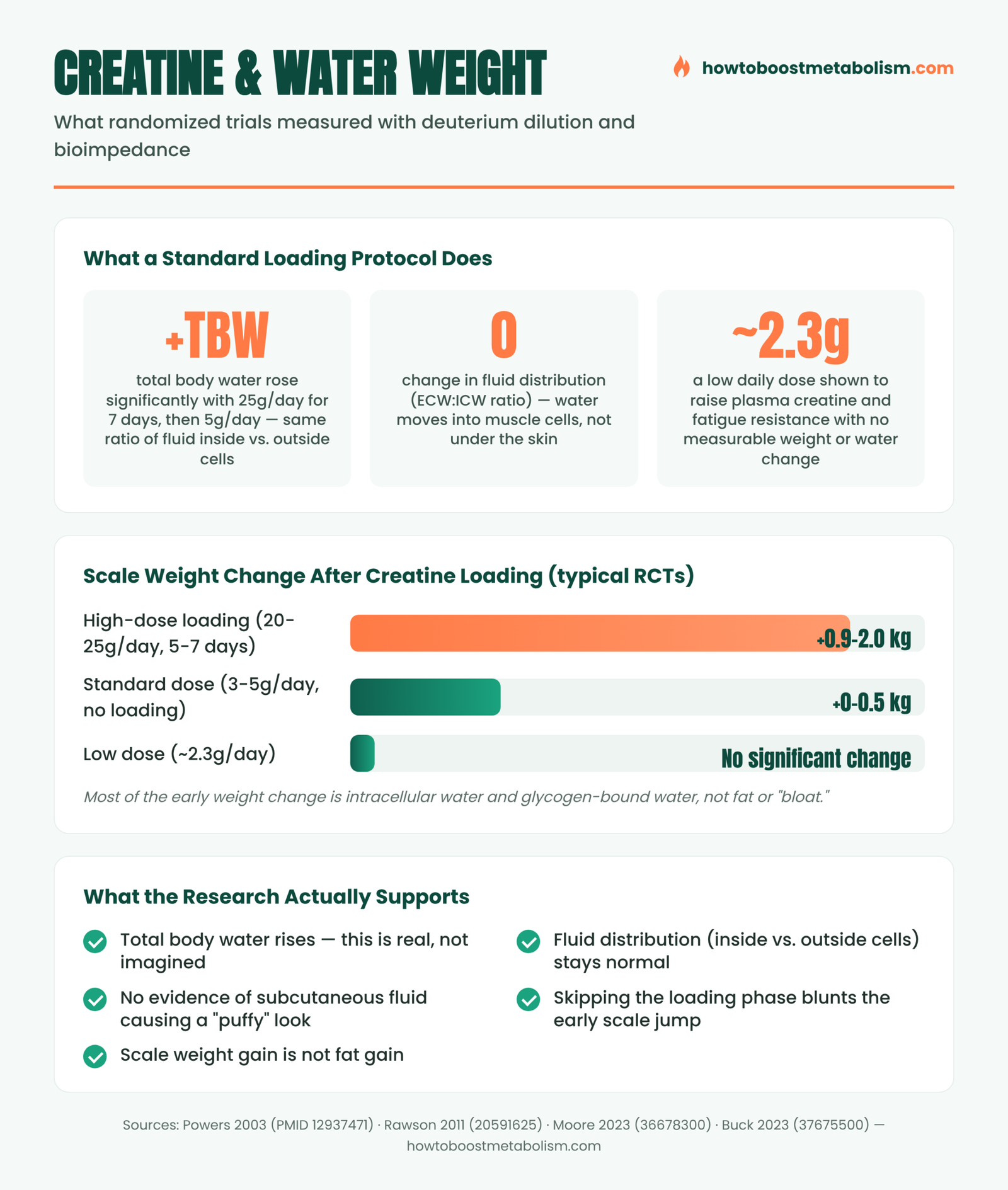
A classic 2003 study in the Journal of Athletic Training put this to a direct test. Sixteen men and sixteen women in resistance training followed a standard creatine loading protocol — 25 g/day for 7 days, then 5 g/day for 21 days — while researchers measured total body water (TBW), extracellular water (ECW), and intracellular water (ICW) using deuterium oxide and sodium bromide dilution, the gold-standard lab methods for measuring body fluid compartments (far more precise than a bioimpedance scale). The creatine group showed a significant increase in muscle creatine, body mass, and total body water. The placebo group showed only a small increase in TBW. Critically, the ratio between ECW and ICW did not change in either group — meaning the extra water went proportionally into the same compartments it would normally occupy, not disproportionately into “puffy,” under-the-skin extracellular space.
Where the Water Actually Goes
Creatine is osmotically active — it pulls water into the cells that store it, primarily skeletal muscle cells. This is intracellular water, the fluid inside muscle tissue, not fluid pooling under the skin the way sodium-driven “bloating” does. A 2023 randomized controlled trial in Nutrients tracked fluid distribution across the menstrual cycle in women taking creatine and found a measurable increase in total body water, extracellular fluid, and intracellular fluid during the luteal phase specifically — but no corresponding change in scale body weight. The researchers’ interpretation: the fluid shift is real and detectable with precise instruments, but it isn’t necessarily large enough, or distributed in a way, that shows up as weight gain on a scale in every cycle phase.
The Dose Matters More Than People Think
Most of the “creatine bloat” reputation comes from the traditional loading protocol — 20 to 25 grams a day for about a week, which does reliably produce a quick 1-2 kg (2-4 lb) jump on the scale within the first week, almost entirely from water and glycogen-bound fluid, not fat. Skip the loading phase and the picture changes. A 2011 trial in Nutrition tested a low daily dose (about 2.3 g/day, roughly a quarter of the standard maintenance dose) for six weeks and found no significant change in body mass, fat-free mass, fat mass, body fat percentage, or total body water — while still measuring a 182% increase in plasma creatine and a real improvement in resistance to muscular fatigue. In other words: the performance benefit doesn’t require the water-retention-producing high dose.
At a Glance: Dose vs. Scale Weight Change
| Protocol | Typical Early Weight Change | What It’s Made Of |
|---|---|---|
| Loading: 20-25 g/day for 5-7 days | +0.9 to 2.0 kg (2-4 lb) | Intracellular water, glycogen-bound water |
| Standard maintenance: 3-5 g/day, no loading | +0 to 0.5 kg over several weeks | Gradual water + some lean tissue |
| Low dose: ~2.3 g/day | No significant change (RCT) | Minimal — below the threshold researchers could detect |
Free download
🔥 The Metabolism Starter Kit
3 honest guides: a 7-day reset plan, a foods cheat-sheet and 12 metabolism myths debunked. No spam — unsubscribe anytime.
Does This Water Weight Look Like “Bloating”?
A separate concern is whether this shows up visually — the soft, puffy look some people associate with sodium-driven water retention. A 2023 study using multi-frequency bioelectrical impedance analysis after creatine supplementation found changes consistent with increased intracellular water in muscle, the compartment associated with muscle fullness rather than subcutaneous puffiness. This matters practically: many lower-cost body-fat scales and BIA devices can misread this intracellular water increase as a drop in body fat percentage or a change in lean mass that isn’t really happening — worth knowing if you track body composition with a home scale and see a sudden shift after starting creatine.
Why the Myth Persists Even Though It’s Partly True
Part of what makes this myth so sticky is that it isn’t fabricated — it’s a real, measured effect stretched into a bigger claim than the data supports. Creatine genuinely does increase total body water; that part of the gym-floor story is accurate. The leap happens at the next step, where “increased body water” gets reinterpreted as “makes you look soft and bloated,” a claim none of the fluid-compartment studies above actually support. It’s a useful reminder that a true fact (water goes up) and a true-sounding conclusion drawn from it (you’ll look bloated) are not the same thing, and the second one needs its own evidence.
There’s also a selection-bias element: people who stop creatine because they “feel bloated” after a few days of high-dose loading are often responding to the real, fast 1-2 kg early water shift — then crediting the feeling to the wrong cause (fat or puffiness) instead of the right one (intracellular muscle water, which reverses within days of stopping). Since that early scale jump is genuinely uncomfortable for some people psychologically, the loading-phase approach is where most of the complaints originate, not the ingredient itself.
Who Should Be More Cautious With Creatine and Fluid
The water-shifting mechanism isn’t a concern for most healthy adults, but it’s worth flagging for a few groups. Anyone with existing kidney disease should talk to a doctor before starting creatine, since it increases the kidneys’ filtration workload somewhat (this is different from causing kidney damage in healthy people, which large studies have not shown, but it matters for anyone with reduced kidney function). People managing fluid-sensitive conditions — certain heart conditions, or situations where a doctor is tracking fluid balance closely — should also get medical input first, precisely because creatine does measurably shift total body water, even if that shift isn’t the “bloating” most healthy users worry about.
Practical Takeaways
- Skip the loading phase if early water weight worries you. A standard 3-5 g/day dose from day one gets you to saturation in about 3-4 weeks instead of a week, without the rapid early jump on the scale.
- The scale jump in week one is not fat. If you’re timing creatine around a weigh-in, photo shoot, or event, start several weeks ahead — not the week of.
- Lower doses still work. Research shows measurable performance benefits even at roughly a quarter of the standard maintenance dose, with no detectable weight or water change.
- Expect body-fat scales to get confused. A sudden shift in “body fat %” or “muscle mass” readings right after starting creatine is very likely a water-compartment artifact, not a real four-week transformation.
- Stay hydrated. Because creatine draws water into muscle cells, adequate total fluid intake supports the process rather than working against it — the old idea that creatine itself causes dehydration isn’t well supported.
Free download: our Metabolism Starter Kit — a protein calculator, a 7-day meal framework, and a one-page supplement checklist, with zero hype.
Get the Free Starter Kit →The Bottom Line
The water retention claim about creatine is half right and half overstated. Total body water does increase — that’s measured, repeatable, and not in dispute. What’s missing from the gym-floor version of the story is that the water goes mainly into muscle cells, in normal proportion to the fluid already there, and that the dramatic early scale jump is specific to high-dose loading protocols, not creatine itself. Lower, slower dosing produces the same strength and fatigue-resistance benefits without the same rapid weight shift. None of it is fat gain, and none of the available evidence points to the kind of subcutaneous “bloating” people picture.
Related: If you’re choosing between formats, our creatine gummies vs. powder comparison covers the dosing math and the chemistry gummies don’t advertise.
The real payoff from creatine comes from the training you do with it. Old School New Body is a follow-along program built around short, F4X-style strength sessions for adults over 35 — handy if you want a structured routine instead of improvising workouts.
Learn More →Affiliate link — we may earn a commission at no extra cost to you. Disclosure
Frequently Asked Questions
How much weight will I gain from creatine?
With a standard loading protocol (20-25 g/day for about a week), expect roughly 0.9-2 kg (2-4 lb) in the first week, mostly water stored in muscle cells. Skipping the loading phase and using a lower daily dose produces a slower, smaller change — one low-dose trial found no significant weight change at all over six weeks.
Is creatine water weight the same as bloating?
Not based on the available measurements. Lab studies using deuterium dilution and bioimpedance show the extra water goes into intracellular fluid in muscle tissue, in the same proportion as existing body water — not the subcutaneous, sodium-driven retention most people picture when they say “bloating.”
Does creatine make you look fatter?
There’s no direct evidence for this. The water increase is intracellular (inside muscle cells), which is associated with fuller-looking muscle, not the soft, puffy appearance linked to extracellular fluid retention.
Can I avoid the water weight entirely?
You can reduce the early scale jump by skipping the loading phase and starting with a standard 3-5 g/day maintenance dose, or using a lower dose (~2-3 g/day) as shown in at least one trial with no detectable weight change — though it may take longer for muscle creatine stores to fully saturate.
Will a body-fat scale give me wrong readings after starting creatine?
It’s plausible. Because creatine shifts water into muscle cells, BIA-based scales (which estimate body fat from how electricity moves through body water) can show a shift in body fat percentage or lean mass shortly after starting creatine that reflects the water change, not an actual four-week change in fat or muscle.
Related Reading
For dosing, timing, and who benefits most, see our full creatine monohydrate review and our guide to creatine for women. For the full supplement landscape, see our evidence-ranked guide to metabolism supplements.