Alpha-Lipoic Acid for Metabolism: What the 2025 Evidence Shows
This article may contain affiliate links. If you buy through them, we may earn a small commission at no extra cost to you. See our Affiliate Disclosure and Medical Disclaimer.
Alpha-lipoic acid (ALA) shows up constantly in “metabolism support” and blood-sugar supplement stacks, usually next to claims about fat burning, glucose balance and antioxidant protection. It’s a real compound your body produces naturally in small amounts and uses in energy metabolism — that part isn’t marketing. The question is whether taking it as a supplement moves the needle on the things these products are actually sold for: blood sugar, cholesterol and weight-related markers.
A 2025 systematic review and meta-analysis set out to answer exactly that question, pooling every randomized controlled trial it could find on ALA in overweight or obese adults. We think the results deserve more attention than they’re getting, because they cut directly against how ALA is marketed.
At a Glance
| Question | What the 2025 meta-analysis found |
|---|---|
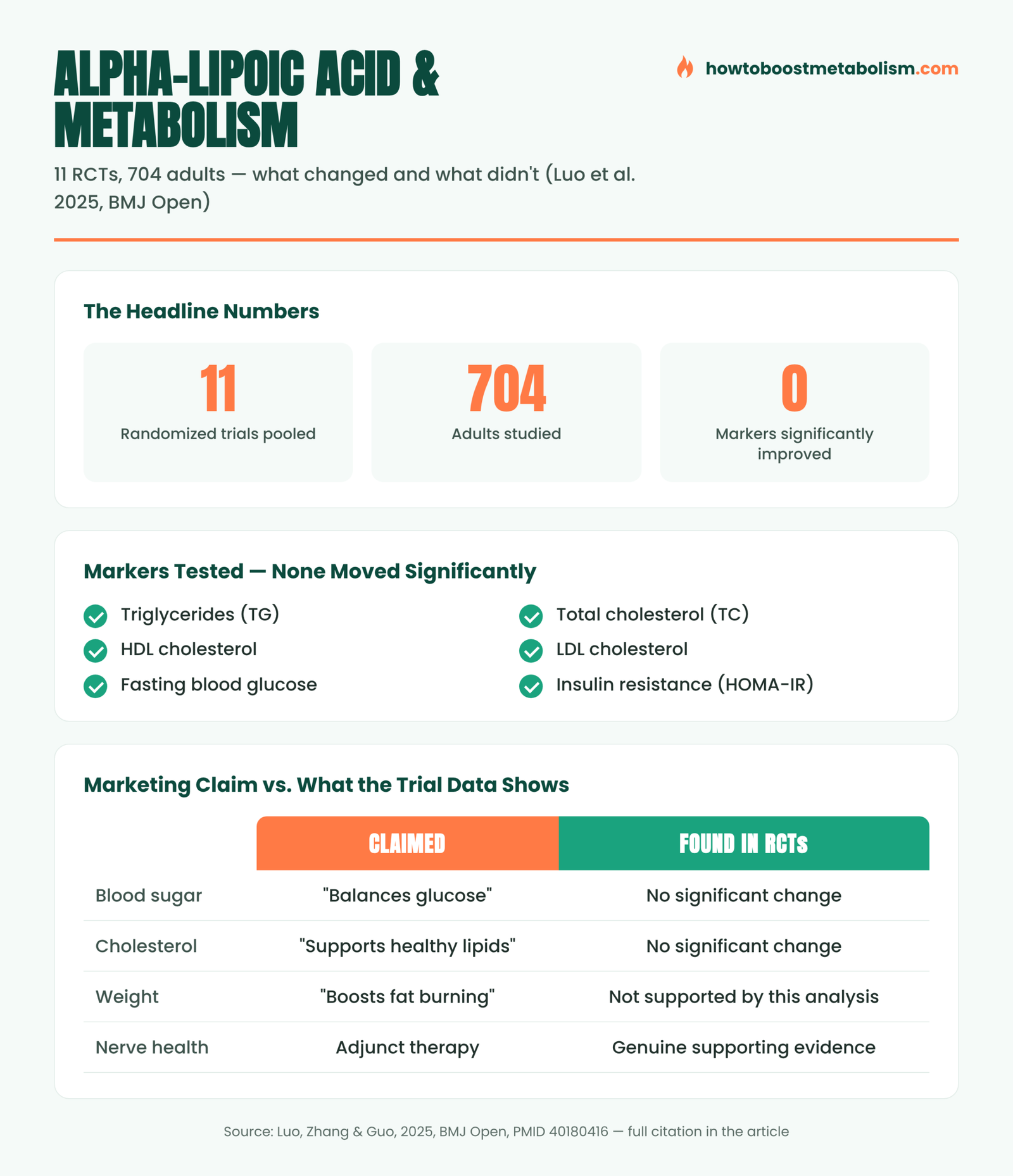
| Does ALA lower triglycerides? | No significant effect (SMD −0.08, p=0.36) |
| Does ALA improve cholesterol (TC, HDL, LDL)? | No significant effect on any of the three |
| Does ALA improve insulin resistance (HOMA-IR)? | No significant effect (SMD −0.23, p=0.23) |
| Does ALA lower fasting blood glucose? | No significant effect (SMD 0.13, p=0.39) |
| Is there a well-supported use for ALA? | Yes — as an adjunct for diabetic nerve pain, not weight/metabolic markers |
The Study: 11 Trials, 704 Adults, Six Markers
Researchers screened 431 studies and narrowed them down to 11 randomized controlled trials that met their inclusion criteria — English-language RCTs in adults with a BMI of 25 or higher, testing ALA against six measurable “intermediate disease markers”: triglycerides, total cholesterol, HDL, LDL, fasting blood glucose, and HOMA-IR (a standard measure of insulin resistance). In total, 704 adults were included across the pooled trials (Luo, Zhang & Guo, 2025, BMJ Open, PMC11969596).
The result, across every single one of those six markers, was the same: no statistically significant difference between ALA and placebo. Not a small positive trend that fell short of significance on one marker — a flat null result across triglycerides, total cholesterol, HDL, LDL, insulin resistance and fasting glucose, with low heterogeneity on most measures and no evidence of publication bias detected by the researchers’ own bias testing.
To be clear about what this does and doesn’t mean: this is a meta-analysis of existing trials, most of them short and relatively small, in a general overweight/obese population rather than people with diagnosed metabolic disease. The authors themselves note that longer trials, higher doses or studies in higher-risk populations (like people with diagnosed metabolic syndrome or type 2 diabetes) might still turn up something — that’s a reasonable scientific caveat, not an invitation to assume the opposite conclusion. But as the evidence stands in 2025, ALA has not been shown to move any of the standard metabolic or lipid markers in the population it’s most often marketed to.
Free download
🔥 The Metabolism Starter Kit
3 honest guides: a 7-day reset plan, a foods cheat-sheet and 12 metabolism myths debunked. No spam — unsubscribe anytime.
Where ALA Does Have Genuine Support
This isn’t a “supplement is fake” story — ALA has a legitimate, longer-standing use that has nothing to do with weight or blood sugar directly: as an adjunct treatment for diabetic peripheral neuropathy (nerve pain and numbness from long-term high blood sugar). A 2026 critical review of the mechanistic rationale and clinical evidence for ALA in this specific context found a more genuine evidence base, tied to its antioxidant effects on nerve tissue rather than any direct effect on glucose or lipid metabolism (Ciubotaru et al., 2026, Nutrients, PMC13209258).
In other words: ALA’s one area of genuinely supported use is a condition most metabolism-supplement buyers don’t have, and the use case most buyers are actually looking for — better blood sugar, cholesterol or weight markers — is the one the 2025 meta-analysis found no support for.
A Safety Note Worth Knowing
ALA is generally well tolerated at standard doses, but it isn’t entirely without risk. A 2026 clinical review documented a rare but real phenomenon called insulin autoimmune syndrome, where supplements and medications containing a sulfhydryl group — ALA among them — have been identified as a precipitating factor in case reports, triggering antibodies against the body’s own insulin and episodes of low blood sugar. This is uncommon, but it’s a reason to talk to a doctor before combining ALA with diabetes medication rather than assuming “antioxidant” automatically means “risk-free” (Vallianou et al., 2026, Metabolism Open, PMC13520106).
What This Means If You’re Considering ALA
- Don’t buy ALA expecting it to move your blood sugar, cholesterol or insulin resistance — the best current evidence says it won’t, in a general overweight/obese population
- If you have diabetic nerve pain, ALA has a more genuine evidence base as an adjunct — discuss it with your doctor rather than self-treating
- If you’re on diabetes medication, mention any sulfhydryl-containing supplement, including ALA, to your physician
- Spend your money first on the things with consistently strong evidence for metabolic health — protein intake, resistance training, sleep and fiber — before a supplement with a null result in its best current trial data
If you want to see what the honest evidence does support, our evidence-ranked guide to metabolism supplements covers the handful of ingredients with real randomized-trial backing, and our guide on how to spot a weight-loss supplement scam walks through the exact marketing patterns ALA products tend to use. For a supplement with more consistent glucose-related evidence, see our berberine review, and for the bigger picture on why quick fixes rarely work, see why your metabolism might feel slow.
Free download: our Metabolism Starter Kit — a protein calculator, a 7-day meal framework, and a one-page supplement checklist, with zero hype.
Get the Free Starter Kit →Frequently Asked Questions
Does alpha-lipoic acid help you lose weight?
The best current evidence — an 11-trial meta-analysis in overweight and obese adults — found no significant effect on any of six metabolic markers tested, including blood glucose and insulin resistance. There is currently no strong clinical trial evidence that ALA causes weight loss.
Is alpha-lipoic acid good for blood sugar?
In the general overweight/obese population studied in the 2025 meta-analysis, no significant effect on fasting blood glucose or insulin resistance (HOMA-IR) was found. ALA does have more established, separate evidence as an adjunct for diabetic nerve pain, which works through a different mechanism.
Is alpha-lipoic acid safe to take?
It’s generally well tolerated at typical doses, but it has been identified in case reports as a rare trigger for insulin autoimmune syndrome, particularly relevant if you’re on diabetes medication. Talk to your doctor before combining it with glucose-lowering drugs.
What is alpha-lipoic acid actually used for, if not weight loss?
Its most genuine evidence base is as an adjunct treatment for diabetic peripheral neuropathy (nerve pain from diabetes), via its antioxidant effects on nerve tissue — a different use case entirely from the fat-burning and blood-sugar-balancing claims on most supplement labels.
Why do so many metabolism supplements include alpha-lipoic acid?
It’s a real, naturally occurring antioxidant compound with a long research history, which makes it an easy ingredient to market with sciencey-sounding claims. The research history doesn’t actually support the specific weight-loss and blood-sugar claims most of these products make, based on the best current meta-analysis.