Best Metabolism Supplements 2026: Ranked by Evidence
This article may contain affiliate links. If you buy through them, we may earn a small commission at no extra cost to you. See our Affiliate Disclosure and Medical Disclaimer.
Search for the best metabolism supplements and you get two kinds of results: breathless lists of 2026 “fat-burning tonics” with no studies behind them, and medical sites that tell you nothing works. Both are wrong. A handful of supplements have real, repeatable effects on how many calories you burn, how well your body handles sugar, or how much muscle you keep — and a much larger group has effects so small they are not worth the money.
This ranking sorts them by evidence, not by commission or hype. For each one we tell you what the trials actually measured, the realistic size of the effect, and who it helps. Where we have tested a specific product, we link to our full review. Nothing here will replace a calorie deficit, protein, and strength training — but used on top of them, Tier 1 and Tier 2 can move the needle.
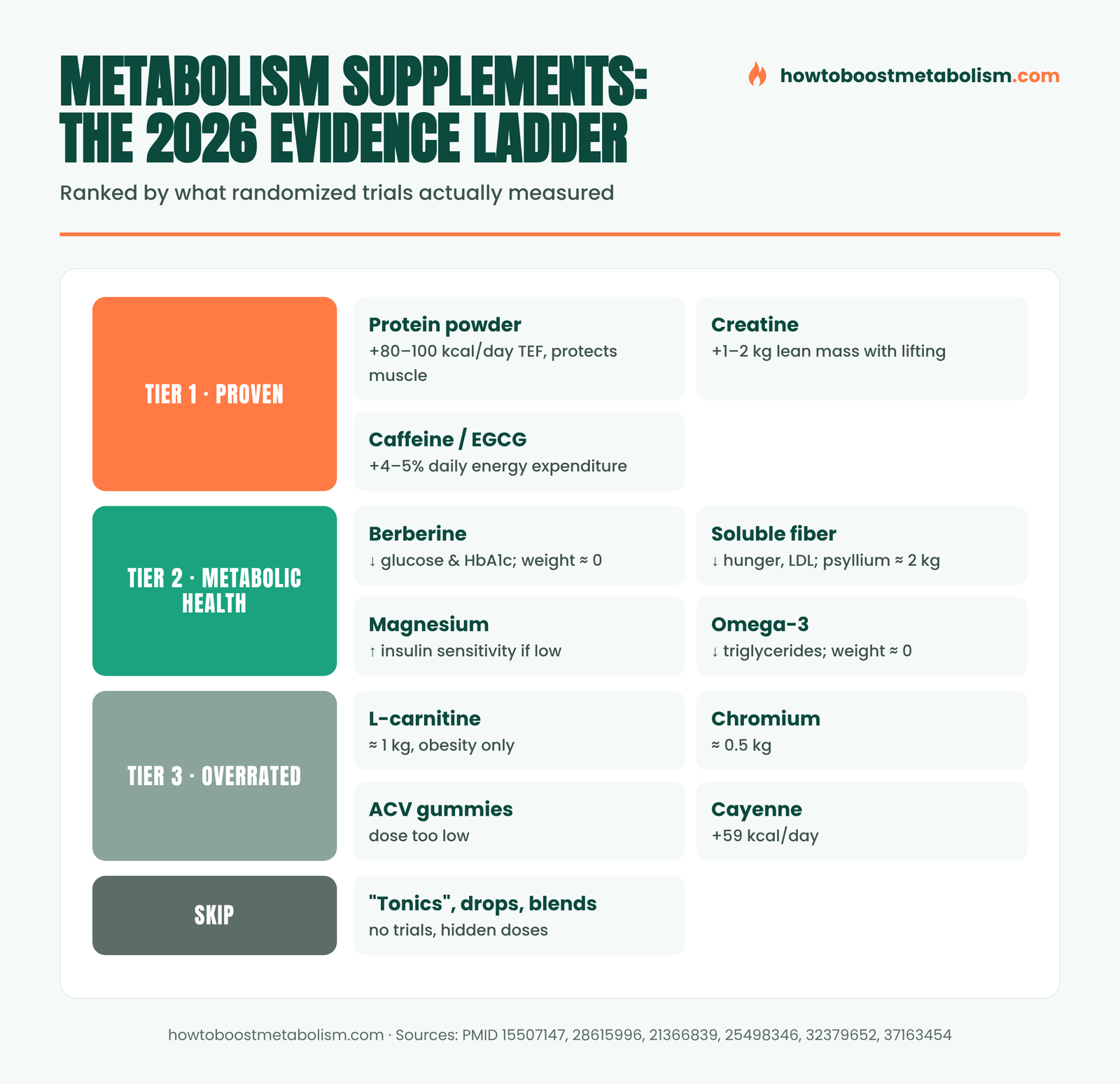
The Ranking at a Glance
| Tier | Supplements | Why |
|---|---|---|
| Tier 1 — Proven, meaningful | Protein powder, creatine monohydrate, caffeine / green tea extract | Raises calorie burn and/or preserves muscle in multiple meta-analyses |
| Tier 2 — Proven for metabolic health, small weight effect | Berberine, soluble fiber (psyllium, glucomannan), magnesium (if low), omega-3 | Improves glucose, lipids or satiety; weight change usually 0–2 kg |
| Tier 3 — Weak or overrated | L-carnitine, chromium picolinate, apple cider vinegar gummies, cayenne capsules, ashwagandha (for weight) | Effects of 0–0.5 kg or limited to specific groups |
| Skip | “Metabolism tonics,” “drops,” proprietary fat-burner blends | No trials, under-dosed, often misleading marketing |
Tier 1: Supplements With Strong Evidence
1. Protein powder (whey or a plant blend)
It feels like cheating to list a food as the number-one metabolism supplement, but the numbers justify it. Protein’s thermic effect is 20–30% of the calories it contains, compared with 5–10% for carbohydrate and 0–3% for fat (Westerterp, PMID 15507147). It is the most filling macronutrient per calorie (Leidy et al., PMID 25926512). And it is the raw material for the only tissue you can grow to permanently raise your resting metabolic rate. A powder is simply the cheapest, most convenient way to reach 1.6–2.2 g/kg a day.
Realistic effect: moving from 15% to 30% of calories from protein typically increases daily energy expenditure by 80–100 kcal and reduces spontaneous intake by considerably more. Who it is for: everyone who is not already eating enough protein — which is most people trying to lose fat. Our whey vs plant protein comparison explains which type to buy.
2. Creatine monohydrate
Creatine does not burn fat directly. It lets you do more work in the gym, and more work builds more muscle — the tissue that raises resting metabolic rate. The International Society of Sports Nutrition’s position stand (Kreider et al., PMID 28615996) calls it the most effective ergogenic supplement available and confirms long-term safety at 3–5 g per day. A meta-analysis in older adults (Chilibeck et al., PMC5679696) found that creatine plus resistance training produced about 1.4 kg more lean mass than training alone.
Realistic effect: 1–2 kg of additional lean mass over a few months of training, plus a small amount of water weight inside the muscle. Who it is for: anyone who lifts weights, including women and adults over 40 — see our guides to creatine for women and creatine after 40. Buy plain monohydrate; nothing else is better and most things cost more.
3. Caffeine and green tea extract (EGCG)
This is the only entry on the list that increases calorie burn in the way people imagine a “metabolism booster” should. A meta-analysis by Hursel and colleagues (PMID 21366839) found that catechin–caffeine mixtures raised 24-hour energy expenditure by about 4.7% — roughly 100 kcal a day — and increased fat oxidation by about 16%. The catch is the size: that is about 80–100 kcal a day in a typical adult, and the Cochrane review of green tea for weight loss (Jurgens et al., PMID 23235664) concluded the resulting weight loss is small and “not likely to be clinically important” on its own.
Realistic effect: 50–100 kcal a day, less in habitual heavy coffee drinkers. Who it is for: people who tolerate caffeine and want a modest, measurable edge. Take green tea extract with food and stay within label doses — high-dose extracts on an empty stomach have been linked to rare liver injury. Our EGCG review and coffee and metabolism guide go deeper.
Free download
🔥 The Metabolism Starter Kit
3 honest guides: a 7-day reset plan, a foods cheat-sheet and 12 metabolism myths debunked. No spam — unsubscribe anytime.
Tier 2: Proven for Metabolic Health, Modest for Weight
4. Berberine
Berberine has more randomized-trial evidence than almost any supplement in this category — just not for the thing it is marketed for. A meta-analysis of 27 trials (Lan et al., J Ethnopharmacol, PMID 25498346) found that berberine lowered fasting glucose, HbA1c, and LDL cholesterol, with glucose effects in the range of oral diabetes drugs over 2–3 months. For body composition, a 2020 dose-response meta-analysis (Xiong et al., PMID 32379652) found a reduction in BMI of 0.29 kg/m² and in waist circumference of 2.75 cm — but no significant change in body weight.
Realistic effect: meaningfully better blood sugar and insulin sensitivity; small changes in waist size; essentially no scale weight change by itself. Who it is for: people with prediabetes, insulin resistance, PCOS, or a stubborn midsection despite a reasonable diet — read our guides to berberine for metabolism and who should not take it. Standard berberine HCl is poorly absorbed; a phytosome form like Berbevis reaches comparable blood levels at a fraction of the dose, which also means fewer digestive side effects.
5. Soluble fiber: psyllium and glucomannan
Soluble fiber slows gastric emptying, blunts the glucose spike after meals, and lowers LDL. A 2023 review and meta-analysis (Gibb et al., PMID 37163454) pooled six trials of overweight adults and found that about 11 g of psyllium a day, taken just before meals for roughly five months, produced about 2 kg more weight loss than control — a notable result, with the caveat that the authors work for the maker of Metamucil. Glucomannan’s track record is more mixed: a pooled analysis of 14 trials (Sood et al., PMID 18842808) showed clear improvements in cholesterol and glucose but a weight effect under 1 kg. Who it is for: people who are hungry between meals or eat fewer than 25 g of fiber a day. See our reviews of psyllium husk and glucomannan.
6. Magnesium (only if you are low)
Roughly half of American adults eat less magnesium than recommended, and low magnesium status is associated with insulin resistance. A meta-analysis of randomized trials (PMID 27329332) found that magnesium supplementation significantly improved the HOMA-IR insulin-resistance index, with the clearest benefit — including lower fasting glucose — when taken for four months or longer; HbA1c did not change. It does nothing measurable for calorie burn in people who already have enough. Who it is for: people with low dietary intake, poor sleep, or insulin resistance. Glycinate is the gentlest form; our magnesium glycinate review covers dosing.
A related pick: vitamin D3 with K2. Vitamin D is not a fat burner, but low levels are common after 40 and are linked to poorer insulin sensitivity — and your body needs magnesium to activate vitamin D in the first place. If a blood test shows you are low, see our NOW Foods Vitamin D3 & K2 review for dosing and who it suits.
7. Omega-3 fish oil
Omega-3s reliably lower triglycerides — a 2023 meta-analysis of 90 trials (Wang et al., PMID 37264945) confirmed dose-dependent reductions — and a pooled analysis of 11 trials found improved insulin sensitivity in people with metabolic disorders (PMID 21959352). Effects on body weight are negligible. Who it is for: people who eat fish less than twice a week, especially with high triglycerides. See our Nordic Naturals review.
Free download: our Metabolism Starter Kit — a protein calculator, a 7-day meal framework, and a one-page supplement checklist, with zero hype.
Get the Free Starter Kit →Tier 3: Weak Evidence or Overrated
- L-carnitine. A 37-trial meta-analysis (PMID 32359762) found about 1.2 kg more weight loss than placebo over the study periods, mostly in adults with overweight or obesity, with a plateau around 2 g a day. Real but small, and it does nothing for calorie burn in lean, healthy people. Fine if you have it; not worth buying for metabolism. Our review.
- Chromium picolinate. About 0.5 kg over placebo across 11 trials (PMID 23495911) and no improvement in HbA1c in people with type 2 diabetes. Our review.
- Apple cider vinegar gummies. The one positive Japanese trial used 15–30 ml of liquid vinegar daily; a gummy delivers a small fraction of that acetic acid, and a widely cited 2024 trial was retracted in 2025. Our review.
- Cayenne / capsaicin capsules. Roughly 59 extra kcal a day, and only in people with a BMI over 25 (PMID 28001433). Real, tiny, and you can get it from hot sauce. Our review.
- Ashwagandha. Reduces cortisol and stress-related overeating in trials, which can help some people indirectly; it is not a metabolism supplement. Our review.
Skip: “Metabolism Tonics,” Drops, and Proprietary Blends
Every year a new wave of products — blue tonics, morning drops, “Himalayan” recipes, Mediterranean “rituals” — tops the affiliate charts. They share a pattern: a long video with a dramatic origin story, a proprietary blend that hides the dose of every ingredient, no published human trials of the product, and claims of rapid fat loss that the FTC would not allow a pharmaceutical to make. Some contain reasonable ingredients at doses too low to matter. We have examined the most-promoted ones and explain the red flags in Berberine vs “Metabolism Tonics” and our guide to spotting a weight-loss supplement scam. If a product will not show you its label before you buy, that is your answer.
How to Build a Sensible Stack
- Start with the foundation: a protein target of 1.6–2.2 g/kg, resistance training 2–4× a week, 7,000+ steps, and sleep. Supplements are a 5–10% layer on top of this; see our complete metabolism guide.
- Add Tier 1: protein powder to close the gap, creatine 3–5 g daily if you lift, caffeine or green tea extract if you tolerate it.
- Add Tier 2 only if it applies to you: berberine for blood sugar, fiber for hunger, magnesium if intake is low, omega-3 if you rarely eat fish.
- Give it 8–12 weeks and track waist measurement and training performance, not just the scale.
- Skip Tier 3 and everything in a proprietary blend. Spend the money on groceries.
Bottom Line
The best metabolism supplements in 2026 are unglamorous: protein, creatine, and a measured dose of caffeine or green tea extract, with berberine, fiber, magnesium and omega-3 for specific metabolic issues. Their effects are real but modest, and they only show up on top of a diet and training plan that already works. Everything promising to “melt fat” from a dropper has, so far, failed to produce a single controlled trial. Choose accordingly.
This article is for educational purposes and is not medical advice. Berberine, green tea extract and high-dose fish oil can interact with medications; consult your clinician before starting any supplement. Read our full Medical Disclaimer.
Related: For a deeper look at fiber specifically, see our head-to-head comparison of psyllium, glucomannan, and inulin.
Related: Curious about alpha-lipoic acid specifically? We broke down what a 2025 meta-analysis found when it tested ALA against blood sugar and cholesterol markers.
Related: Curious whether MCT oil or coconut oil actually earns a spot on this list? See our honest MCT oil vs coconut oil comparison.
Frequently Asked Questions
What is the best supplement to boost metabolism?
If we had to pick one, it would be protein powder — not because it is exotic, but because protein has the highest thermic effect of any nutrient, preserves the muscle that sets your resting metabolic rate, and reduces appetite. Creatine is a close second for anyone who lifts weights. No pill raises metabolism the way those two basics do when combined with training.
Do metabolism booster pills actually work?
Most “metabolism booster” blends rely on caffeine, which does raise energy expenditure by roughly 3–11% for a few hours, plus a list of under-dosed herbs. The caffeine effect is real but small (around 50–100 extra calories a day) and shrinks with tolerance. The 2026 “tonic” and “drops” products promoted online have no published trials at all. See our honest comparison of berberine versus metabolism tonics.
Does berberine speed up your metabolism?
Berberine does not increase calorie burn. What it does — with a solid base of randomized trials — is improve blood sugar control and insulin sensitivity, with effects on HbA1c and fasting glucose comparable to some first-line medications in short trials. A 2020 meta-analysis found modest reductions in BMI and waist circumference but no significant change in body weight. It is a metabolic-health supplement, not a fat burner.
Are metabolism supplements safe?
The ones on our Tier 1 and Tier 2 lists — protein, creatine, caffeine/green tea extract at label doses, berberine, soluble fiber, magnesium, and omega-3 — have long safety records when used as directed. Green tea extract should be taken with food and not in megadoses because of rare liver injury reports; berberine interacts with several medications and is not for pregnancy. Talk with your clinician if you take prescription drugs.
How long before a metabolism supplement works?
Caffeine works within an hour and fades within a day. Creatine saturates muscles in 1–4 weeks. Protein’s effect on body composition is measurable over 8–12 weeks with training. Berberine’s effects on glucose typically appear within 4–12 weeks. Anything promising visible fat loss in days is not describing a real mechanism.