
Do You Need Weightlifting Shoes After 40? What Helps
This article may contain affiliate links. If you buy through them, we may earn a small commission at no extra cost to you. See our Affiliate Disclosure and Medical Disclaimer.
Walk into any gym after 40 and you’ll eventually hear some version of this advice: “get real weightlifting shoes, they’ll fix your squat.” It’s one of those pieces of gear that gets recommended with total confidence, usually from someone who sells them or sells a program that uses them. The biomechanics research on heel-elevated footwear is actually more interesting and more honest than the marketing — it says the shoes genuinely change how your body moves during a squat, but whether that change matters much depends heavily on who’s wearing them.
What a Raised Heel Actually Does, Mechanically
A dedicated weightlifting shoe has a hard, largely non-compressing sole with a heel raised roughly 0.5 to 1 inch above the forefoot. That wedge effectively gives your ankle a head start on the angle it needs to reach — called dorsiflexion, the shin tilting forward over the foot — to squat to a given depth. A 2021 review in the Journal of Biomechanical Engineering pooled 14 studies on footwear and the barbell back squat and found a consistent pattern: weightlifting shoes decreased trunk lean and increased ankle plantarflexion (the opposite of dorsiflexion) compared with running shoes or barefoot lifting, letting lifters stay more upright at a given depth (PMID 33844006). That review also noted that external heel wedges — cheap foam or wooden inserts placed under the heel on flat shoes — produced broadly similar effects to dedicated weightlifting shoes, which turns out to matter for anyone deciding whether to spend real money on this.
Why Ankle Mobility Specifically Becomes an Issue After 40
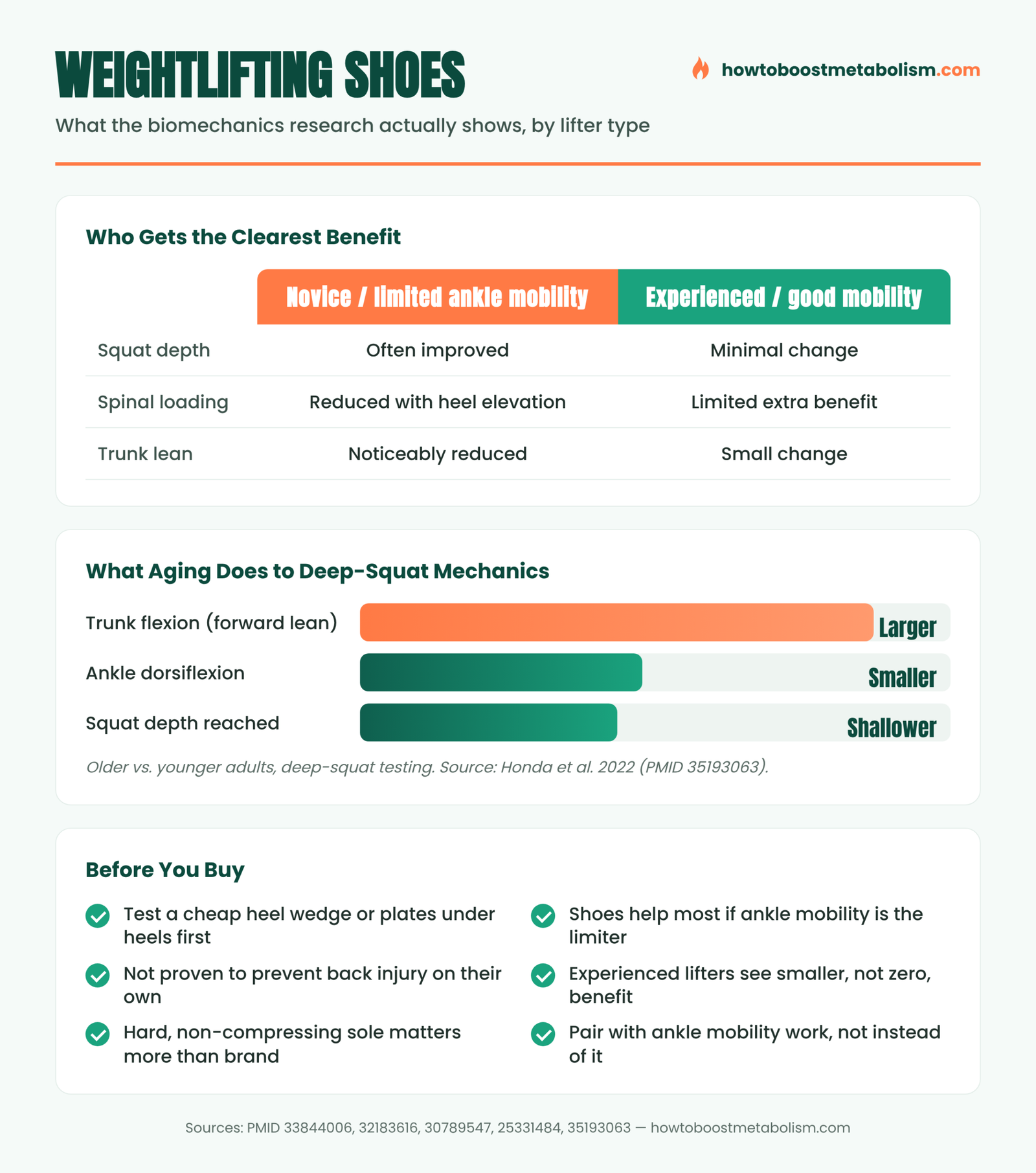
This isn’t an abstract biomechanics curiosity — it’s tied to a real, measured age-related pattern. A 2022 study in the Journal of Biomechanics compared twelve older adults (median age 76.5) with nineteen younger adults (median age 30) performing a deep squat, tracked with full motion capture and force plates (PMID 35193063). The older group reached a significantly shallower squat depth, with smaller ankle dorsiflexion and knee flexion angles and a larger forward trunk lean to compensate for the restricted range at the ankle and knee. The researchers also found older adults relied more on hip extension and less on knee extension to support body weight through the lift. None of this means everyone over 40 has restricted ankles — training history, mobility work, and genetics all vary enormously — but it does explain why heel-elevated footwear shows up disproportionately often as advice for older or returning lifters rather than for 25-year-old competitive weightlifters with naturally mobile ankles.
Free download
🔥 The Metabolism Starter Kit
3 honest guides: a 7-day reset plan, a foods cheat-sheet and 12 metabolism myths debunked. No spam — unsubscribe anytime.
The Honest Catch: It Mostly Helps People Who Need the Compensation
Here’s where the research gets more nuanced than most buying guides let on. A 2020 study in the Journal of Sports Science directly compared novice and regular (experienced) weight trainers performing back squats on a flat floor, on an elevated-heel incline board, and — for the experienced group — in dedicated weightlifting shoes (PMID 32183616). On the flat floor, novices had significantly greater loading moments around the lower spine than experienced lifters during the bottom portion of the lift. Elevating the heel closed that gap — the difference between novices and experienced lifters became non-significant. But for the already-experienced group, the study found only “limited benefits” from either the elevated heel or the weightlifting shoes. In other words, heel elevation looks most useful as a way to help people with less-developed technique or more limited mobility achieve a safer position — not as an upgrade that experienced lifters with good mobility clearly need.
A Direct Test of the “Protects Your Back” Claim
One specific claim gets repeated constantly in gym folklore: that a raised heel protects your lower back by keeping your torso more upright. A 2019 study in the Journal of Strength and Conditioning Research tested this directly in fourteen recreational lifters, comparing barefoot on flat ground, barefoot on a heel-raised platform, and wearing heel-raised weightlifting shoes, using surface EMG and 3D motion capture at 80% of 1-rep max (PMID 30789547). The result ran against the popular claim: none of the heel-raised conditions significantly changed thoracolumbar or lumbar paraspinal muscle activation, knee extensor activation, or trunk and knee angles. The authors concluded plainly that heel-raised weightlifting shoes are “unlikely to provide significant protection against back injuries” for recreational lifters. That doesn’t mean the shoes are useless — it means the honest case for them rests on squat depth and comfort, not on an unproven injury-prevention claim.
| Claim about weightlifting shoes | What the evidence actually shows | Source |
|---|---|---|
| They let you squat deeper with a more upright torso | Supported — consistent across 14 pooled studies | PMID 33844006 |
| They help novices/limited-mobility lifters most | Supported — bigger benefit for novices than experienced lifters | PMID 32183616 |
| They prevent lower-back injury during squats | Not supported — no significant change in EMG or trunk angle | PMID 30789547 |
| A cheap heel wedge works about as well | Supported — “similar” effects to dedicated shoes per review | PMID 33844006 |
| Barefoot/minimalist is actually better for depth | Mixed — running shoes increased depth vs. barefoot in one trial | PMID 25331484 |
What About Barefoot or Minimalist Training?
The picture gets messier here, which is honestly the appropriate amount of uncertainty for a question this specific. A 2015 study in the European Journal of Sport Science compared running shoes, weightlifting-style footwear, and barefoot squatting in experienced male lifters, tracking 3D kinematics and EMG (PMID 25331484). Counterintuitively, running shoes were associated with increased squat depth and knee flexion compared to barefoot — the opposite of what the minimalist-training argument would predict. Yet when researchers asked participants which footwear they subjectively preferred, barefoot won by a significant margin, despite the biomechanics not clearly supporting it as superior. That gap between measured biomechanics and subjective preference is a useful reminder that footwear choice is partly a comfort and feel question, not purely a mechanical optimization problem.
Sole Stiffness Matters as Much as Heel Height
One detail the 2021 review flagged for future research is worth knowing now: it’s not just the heel height that changes squat mechanics, but how much the sole compresses under load (PMID 33844006). A soft running shoe or a cushioned casual sneaker compresses unevenly as you load the bar, which can subtly shift your base of support and balance mid-rep. A hard, largely incompressible sole — whether it’s a dedicated weightlifting shoe, a flat minimalist shoe, or lifting barefoot on a firm floor — gives a more stable, predictable platform regardless of the heel height. That’s part of why experienced lifters often default to flat, hard-soled shoes even without heel elevation: the stability benefit of a firm sole doesn’t require a raised heel to show up.
A Practical Way to Decide, Before You Spend $150
- Test the cheap version first. Put a pair of 5-10lb plates under your heels (safely, on a stable flat surface) during a few warm-up squat sets and see if your depth or comfort noticeably improves.
- If it helps, you’re probably ankle-mobility limited. That’s a strong signal dedicated weightlifting shoes — or continued targeted ankle mobility work — will be worth it.
- If it makes little difference, save the money. Based on the experienced-lifter data (PMID 32183616), you may be in the group that doesn’t get much marginal benefit.
- Don’t buy them expecting back protection. That specific claim isn’t supported by the controlled research (PMID 30789547) — buy them for depth and comfort, not injury prevention.
- Pair shoes with mobility work, not instead of it. Shoes compensate for limited ankle dorsiflexion; they don’t improve it. Ongoing calf and ankle mobility work addresses the actual limitation.
Where This Fits Into a Broader Return-to-Training Plan
If you’re newer to structured lifting, or coming back to it after years away, squat depth and footwear are a small piece of a much bigger picture that includes load selection, exercise order, and realistic progression. Beginner-oriented programs designed specifically for people getting back into training after 40 tend to use moderate loads and a gradual ramp precisely because that’s where most of the early risk and most of the early progress live — not in equipment choices.
If you’re easing back into structured training after a break, a program built for exactly that — moderate loads, a beginner-friendly ramp, no assumption you already own specialty gear — can matter more than any single piece of equipment. Old School New Body‘s F4X method is designed around this kind of restart for lifters 40 and up.
Check It Out →Affiliate link — we may earn a commission at no extra cost to you. Disclosure
Related Reading
If limited ankle mobility is turning out to be your real limiter, our guide on the Bulgarian split squat covers a single-leg alternative that’s often more forgiving of mobility restrictions. For the broader question of returning to barbell training safely, see barbell vs. dumbbell training after 40. And if you’ve already looked into whether a weightlifting belt is worth adding to your setup, our breakdown of lifting belts after 40 covers that related piece of equipment in the same honest, evidence-first way.
Free download: our Metabolism Starter Kit — a protein calculator, a 7-day meal framework, and a one-page supplement checklist, with zero hype.
Get the Free Starter Kit →Frequently Asked Questions
Do weightlifting shoes actually help you squat deeper?
Indirectly, yes, for a specific reason: a raised heel reduces how much ankle dorsiflexion (shin-to-floor angle) you need to reach a given squat depth. A 2021 engineering review of 14 studies found weightlifting shoes consistently decreased trunk lean and increased plantarflexion relative to running shoes or barefoot lifting (PMID 33844006). If limited ankle mobility is what’s capping your depth, the shoes compensate for that limitation rather than making your ankles more flexible.
Does ankle mobility really get worse with age, or is that a myth?
It’s a documented, measured pattern, not a myth. A 2022 biomechanics study comparing older adults (median age 76.5) to younger adults (median age 30) during a deep squat found the older group had significantly smaller ankle dorsiflexion and knee flexion angles, a shallower squat depth overall, and more forward trunk lean to compensate (PMID 35193063). The exact age where this becomes noticeable varies a lot by individual training history, but the underlying mechanical trend is real.
Do experienced lifters actually need weightlifting shoes, or just beginners?
The evidence leans toward beginners and people with limited ankle mobility benefiting more. A 2020 study comparing novice and regular weight trainers found that elevating the heel reduced spinal loading in novices specifically, while regular, experienced lifters saw only limited additional benefit from either elevated heels or weightlifting shoes (PMID 32183616). If your squat technique and ankle mobility are already solid, specialized shoes are more of a marginal upgrade than a necessity.
Can I just use a squat wedge or plates under my heels instead of buying shoes?
Based on the research, functionally, yes. The 2021 review found that elevating the heel with external squat wedges produced effects “similar” to wearing dedicated weightlifting shoes (PMID 33844006). A heel wedge or a pair of 5-10lb plates under your heels is a reasonable, nearly free way to test whether heel elevation actually helps your depth and comfort before spending $120-200 on dedicated shoes.
Will weightlifting shoes protect my lower back during squats?
Don’t count on it as the primary reason to buy them. A well-controlled 2019 study specifically testing this claim found that heel-raised foot postures — whether from a platform or weightlifting shoes — did not significantly change trunk or lower extremity muscle activation, or trunk and knee angles, in recreational lifters (PMID 30789547). The researchers concluded that weightlifting shoes are “unlikely to provide significant protection against back injuries” on their own. Squat depth comfort, not back protection, is the better-supported reason to consider them.
This article is for general educational purposes and is not medical advice. If you have a diagnosed ankle, knee, or spine condition, talk to a physical therapist or doctor before changing your squat setup or footwear. See our Medical Disclaimer.