Will Lifting Weights Make Women Bulky? The Science
This article may contain affiliate links. If you buy through them, we may earn a small commission at no extra cost to you. See our Affiliate Disclosure and Medical Disclaimer.
It’s one of the most persistent myths in fitness, and it still stops a lot of women from picking up anything heavier than a pink dumbbell: the fear that lifting real weight will make them “bulky.” It shows up in gym small talk, in comment sections, in the instinct to default to high-rep, light-load “toning” routines instead of genuine progressive overload. It’s also a myth that’s been directly tested, repeatedly, by exercise physiologists — and the honest answer is more reassuring, and more interesting, than either side of the usual internet argument makes it sound.
The Hormone That Actually Drives Large Muscle Growth
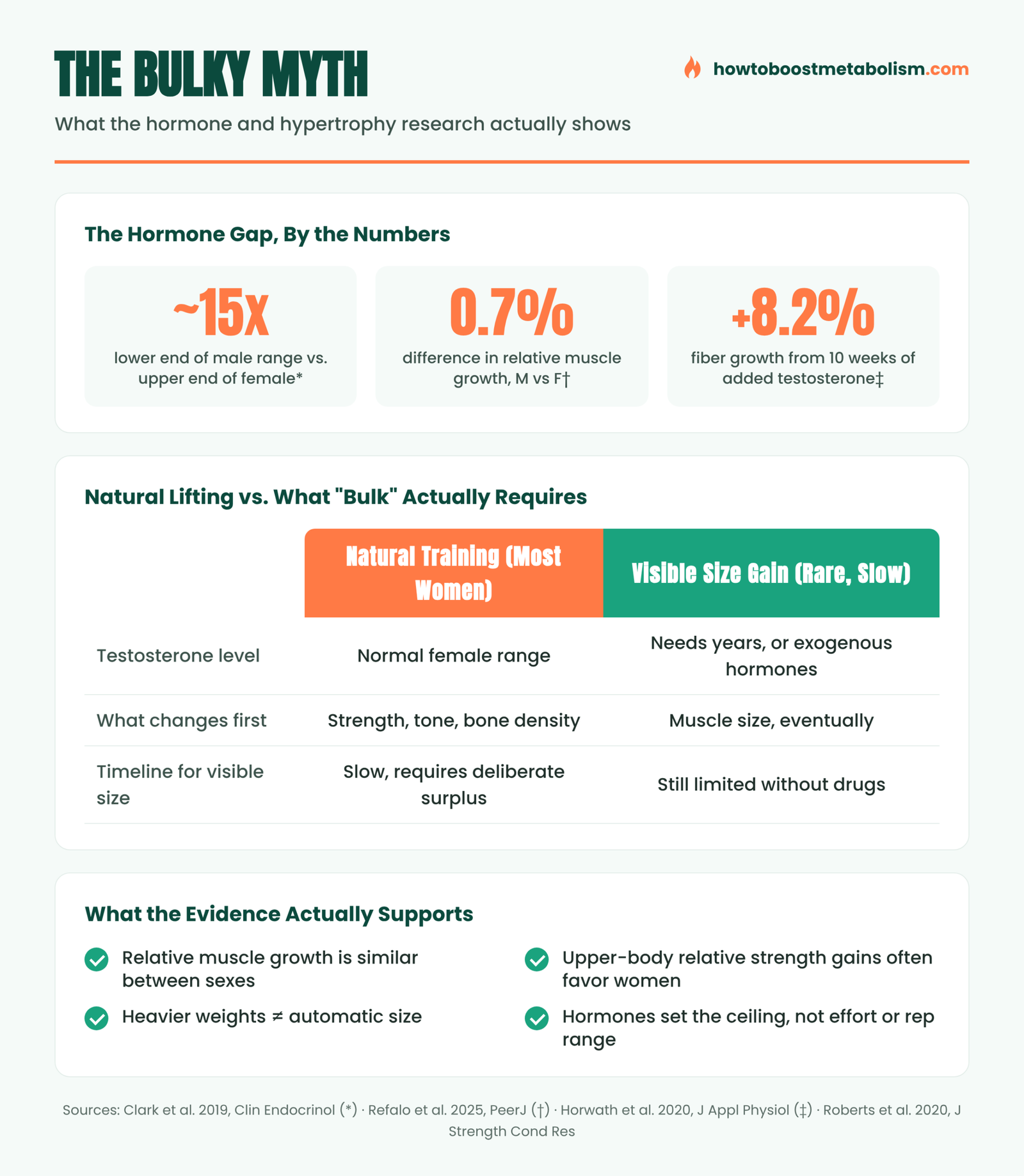
The biological story starts with testosterone, which promotes muscle growth both by stimulating protein synthesis and by reducing protein breakdown (Vingren et al., 2010). It’s the single biggest reason men, on average, build muscle mass faster and to a greater absolute degree than women. The scale of the hormonal gap between the sexes is larger than most people realize: a review compiling data across multiple studies of healthy adults found a clear, non-overlapping bimodal distribution, with the lower end of the normal male testosterone range sitting four to five times higher than the upper end of the normal female range — roughly 8.8–30.9 nmol/L in men versus 0.4–2.0 nmol/L in women (Clark et al., 2019). That’s not a subtle difference; it’s close to an order of magnitude, even comparing the closest edges of each range.
This matters directly for the “bulky” question, because it sets a biological ceiling. The amount of large-scale muscle hypertrophy associated with male bodybuilders is driven substantially by testosterone levels that most women’s bodies simply don’t produce without outside intervention.
So Do Women Build Less Muscle From the Same Training?
This is where it gets genuinely interesting, because the answer is more nuanced than “men build more muscle, full stop.” A 2025 meta-analysis using Bayesian statistics pooled 29 studies in which men and women completed the exact same resistance training program, then compared changes in muscle size (Refalo et al., 2025). Absolute increases in muscle size did slightly favor men (which tracks with men typically starting with more muscle mass and larger individual fibers) — but relative increases in muscle size, meaning the percentage change from each person’s own starting point, were essentially identical between sexes, with the model estimating only a 0.7% difference that wasn’t considered meaningful. An earlier, separate meta-analysis looking specifically at muscle hypertrophy outcomes between sexes found no statistically significant difference at all (Roberts et al., 2020).
In other words: pound for pound, relative to where each person started, women’s muscles respond to resistance training about as well as men’s do. What differs is the absolute starting point and ceiling, not the underlying adaptive capacity.
| What’s being measured | What the research shows |
|---|---|
| Relative muscle growth from the same program | No meaningful difference (Refalo et al., 2025; Roberts et al., 2020) |
| Absolute muscle growth | Slightly greater in men, driven by starting mass and fiber size |
| Relative upper-body strength gains | Significantly favor women (Roberts et al., 2020) |
| Relative lower-body strength gains | No significant difference between sexes |
| Visible, large-scale “bulk” | Primarily hormone-driven; requires years, surplus, or exogenous testosterone |
Free download
🔥 The Metabolism Starter Kit
3 honest guides: a 7-day reset plan, a foods cheat-sheet and 12 metabolism myths debunked. No spam — unsubscribe anytime.
What Happens When You Actually Add Testosterone to the Equation
One study gets at the mechanism almost perfectly. Researchers gave 35 young, recreationally trained women either a modest daily dose of testosterone (10mg) or a placebo for 10 weeks, then took muscle biopsies before and after (Horwath et al., 2020). The testosterone group saw their serum testosterone rise roughly 5-fold, along with a significant 1.9% increase in total lean mass and a 2.4% increase in leg lean mass. At the muscle fiber level, overall fiber cross-sectional area increased by 8.2%, driven mainly by growth in type II (fast-twitch, power-oriented) fibers, alongside increased capillary density around those fibers. This is a genuinely useful study for answering the “bulky” question precisely because it isolates the variable: when you deliberately raise a woman’s testosterone — something that doesn’t happen from lifting weights alone — measurable fiber-level muscle growth follows within weeks. That confirms the mechanism is real, while also demonstrating just how much of a deliberate hormonal push was required to produce a modest, single-digit percentage change. Ordinary strength training, without that hormonal intervention, doesn’t put most women anywhere near that pathway.
There’s a parallel data point from a different population: women with polycystic ovary syndrome (PCOS), who have naturally elevated androgen levels relative to other women, showed significantly greater strength gains from a progressive resistance program than women without PCOS, even though body composition changes were otherwise similar between the groups (Kogure et al., 2018). It’s further evidence that androgen levels — not effort, rep range, or how heavy the weights feel — are the dial that actually controls hypertrophy potential.
A Brief History of Where This Myth Came From
A recent narrative review tracing the history of resistance training in women points out that cultural attitudes, not physiology, kept women out of serious strength training for most of the 20th century (Kraemer et al., 2025). The review’s broader point is that the mechanisms behind resistance-training adaptations in women are largely the same neuroendocrine and immune pathways seen in men, just operating through a different hormonal balance (notably much less testosterone, and the added influence of estrogen) — and that despite those subtle physiological differences, women achieve real, measurable gains in strength, power, and athletic performance from the same kind of progressive training men use. The “myth of the toning routine” as something distinct from “real” strength training doesn’t have a solid physiological basis — it’s a cultural holdover more than a biological finding.
Estrogen Isn’t Just “the Opposite” of Testosterone
It’s worth saying plainly that estrogen isn’t simply a passive non-factor in all of this — it appears to play its own distinct role in how women adapt to resistance training. The same narrative review on resistance training in women notes that adaptations are mediated through a mix of hormones including estrogen, growth hormone, and insulin-like growth factor-1, not testosterone alone, and that this different hormonal mix may contribute to differences in substrate use, fatigue resistance, and recovery between the sexes, even where the raw hypertrophy response ends up looking similar (Kraemer et al., 2025). Some research has suggested estrogen may have a protective effect against exercise-induced muscle damage, which is one proposed explanation for why women often report recovering faster between hard training sessions than men do at a similar relative intensity — though this is an active area of ongoing research rather than a fully settled question. The takeaway isn’t that one sex’s hormonal profile is “better” for training; it’s that women’s physiology isn’t a smaller, weaker version of men’s — it’s a different system that happens to respond to the same basic stimulus (progressive overload) in a largely comparable way, just without the testosterone-driven ceiling that produces dramatic size.
If the “bulky” fear has been holding you back from genuine progressive overload, a structured program built around steady strength progression is the most direct way to see what your body actually does with real training. Anabolic Fasting combines a training progression with an intermittent-fasting approach — its sales page markets “building muscle and burning fat at the same time,” which is a marketing claim, not a guarantee, so evaluate the program by its structure rather than that promise.
Learn More →Affiliate link — we may earn a commission at no extra cost to you. Disclosure
What This Actually Means for How You Train
If you’re a woman avoiding heavier weights specifically out of fear of getting bulky, the evidence suggests that fear is doing you a disservice. What you’re far more likely to get from genuine progressive overload is meaningful strength (often disproportionately in the upper body, per Roberts et al., 2020), improved bone density, better insulin sensitivity, and the same relative muscle-building response as anyone else doing the same program — not a sudden transformation into a different body type. Visible size, if that’s even a goal, is a slow, deliberate process requiring years of consistent training and a sustained caloric surplus — not a side effect that happens accidentally from lifting something heavier than you’re used to. For a deeper look at realistic timelines for building muscle, our guide on how much muscle you can actually build after 50 covers the pace question in more detail, and our piece on strength training through menopause looks specifically at what heavier lifting does for bone density in that stage of life.
Free download: our Metabolism Starter Kit — a protein calculator, a 7-day meal framework, and a one-page supplement checklist, with zero hype.
Get the Free Starter Kit →Frequently Asked Questions
Will lifting heavy weights make me bulky as a woman?
For the overwhelming majority of women training naturally, no — not in the sense of rapid, dramatic size gain. The primary driver of large muscle hypertrophy is testosterone, and the normal female testosterone range sits dramatically below the normal male range — roughly 0.4–2.0 nmol/L in women versus 8.8–30.9 nmol/L in men, a four- to fivefold gap even between the closest ends of each range (Clark et al., 2019). That hormonal ceiling is the main reason “bulky” muscle size, the kind associated with male bodybuilders, isn’t something that happens by accident from a few months of lifting weights.
If hormones limit size, why do some women still get visibly muscular?
Genetics, years of progressive training, deliberate caloric surplus, and in some documented competitive and research contexts, exogenous hormone use. A controlled trial giving healthy young women a modest daily dose of testosterone for 10 weeks found it produced an 8.2% increase in average muscle fiber size, driven mostly by growth in type II (power) fibers, plus measurable increases in lean mass (Horwath et al., 2020) — which confirms the mechanism (testosterone drives fiber hypertrophy in women too) while also showing how much deliberate hormonal intervention was required to produce it. Visible size without that intervention takes a long time, consistent progressive overload, and usually an intentional calorie surplus — it doesn’t sneak up on someone doing a few strength sessions a week.
Do women actually build the same amount of muscle as men from the same workout?
In relative terms, yes, essentially. A 2025 Bayesian meta-analysis pooling 29 studies that had men and women complete identical resistance training programs found men showed slightly greater absolute muscle growth (expected, given men generally start with more muscle mass and larger fiber cross-sectional area), but relative increases in muscle size — the percentage change from each person’s own starting point — were statistically similar between the sexes (Refalo et al., 2025). An earlier meta-analysis specifically on hypertrophy outcomes found no significant difference between men and women at all (Roberts et al., 2020).
Do women get stronger from lifting, even without getting “bulky”?
Yes, often dramatically so, and sometimes more than men in relative terms. The same 2020 meta-analysis found women showed a significantly larger effect size than men for relative upper-body strength gains, while lower-body strength gains were statistically similar between sexes (Roberts et al., 2020). Strength and visible muscle size are related but separate outcomes — you can get meaningfully stronger well before any noticeable change in size shows up, which is exactly what most women training with weights actually experience.
Does training like a bodybuilder (heavy weights, low reps) make you bulkier than lighter weights and more reps?
The specific rep range or load you choose isn’t what determines whether you end up “bulky” — your hormonal profile and total training volume over time matter far more than whether a given set is 5 reps or 15. The deeper driver of extensive muscle size is the hormonal environment discussed above, which doesn’t change based on rep scheme. If anything, lifting heavier, in a reasonable rep range, tends to build strength more efficiently per session than avoiding weight out of a fear of size gain that the evidence doesn’t really support.