NEAT: How Non-Exercise Movement Boosts Your Metabolism
This article may contain affiliate links. If you buy through them, we may earn a small commission at no extra cost to you. See our Affiliate Disclosure and Medical Disclaimer.
Two people can be the same height, weight, and age, eat similar diets, and even go to the gym the same number of times a week — and still burn meaningfully different numbers of calories per day. A large part of that gap usually isn’t genetics or a mysteriously “fast” or “slow” metabolism in the way it’s often talked about. It’s NEAT: non-exercise activity thermogenesis, the energy cost of everything you do that isn’t sleeping, eating, or structured exercise. It’s one of the most underrated and most practical levers for improving your daily energy balance, and unlike a lot of metabolism advice, it doesn’t require supplements, special timing, or willpower in a gym.
What Is NEAT, Exactly?
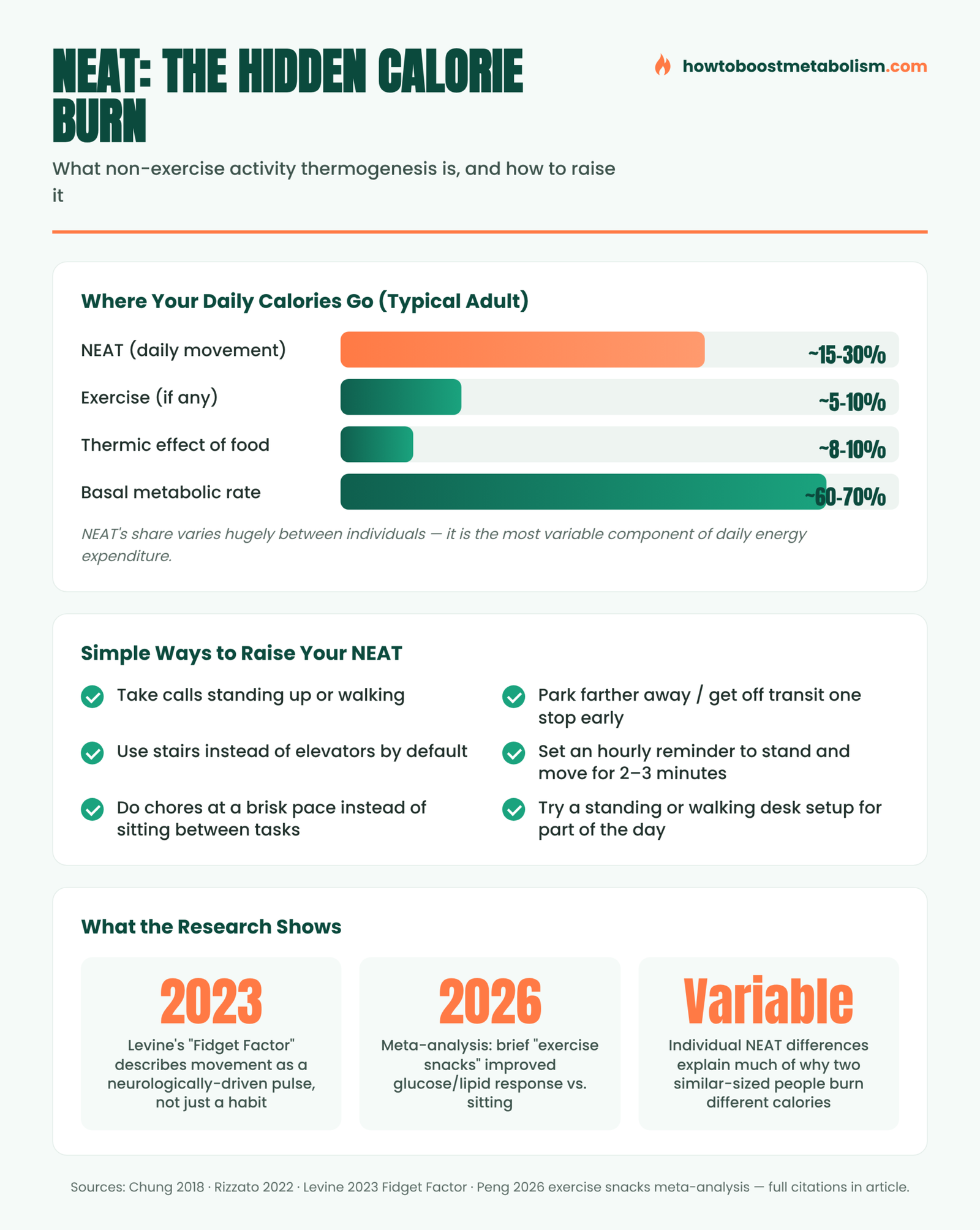
NEAT covers an enormous range of everyday movement: walking to your car, standing at your desk, doing laundry, gardening, fidgeting while you work, taking the stairs, even shifting your posture while sitting. Researchers describe it as the most variable component of total daily energy expenditure — more variable than basal metabolic rate, and for many people, more variable than the calories burned through formal exercise (Chung et al., 2018).
The term was popularized by endocrinologist James Levine, whose research at the Mayo Clinic helped establish that differences in spontaneous daily movement — not deliberate exercise — could account for significant variation in how people respond to the same diet. In more recent work, Levine has framed this as a “Fidget Factor”: a largely involuntary, neurologically-driven pulse to move that modern chair-based, desk-bound life increasingly suppresses (Levine, 2023).
How Much Does NEAT Actually Matter?
There’s no single number that applies to everyone — and that’s the point. NEAT is highly individual. Some people are naturally fidgety, pace while on the phone, and take the stairs without thinking about it; others default to the most energy-efficient path through their day without realizing it. Over weeks and months, that gap compounds. For context, total daily energy expenditure is typically broken down into basal metabolic rate (the energy your body uses at rest, usually the largest share), the thermic effect of food (energy used to digest what you eat), exercise, and NEAT — and of these, NEAT is the one you have the most day-to-day control over, because it isn’t locked in by your biology the way basal metabolic rate largely is. For the full picture of how these pieces fit together, see our breakdown of BMR, RMR, and TDEE explained.
Free download
🔥 The Metabolism Starter Kit
3 honest guides: a 7-day reset plan, a foods cheat-sheet and 12 metabolism myths debunked. No spam — unsubscribe anytime.
The Modern Workplace Problem
A 2022 review in Frontiers in Public Health described the shift toward desk-based office work over the past several decades as a major, largely overlooked driver of reduced daily energy expenditure — the review’s authors went as far as calling the modern office environment a contributor to the obesity trend, arguing that workplace design itself has quietly reduced how much people move during the parts of the day they spend working (Rizzato et al., 2022). This matters because for people with desk jobs, work hours represent a huge, mostly sedentary block of the day — exactly the block where small, deliberate changes can add up the most. See our guide on standing vs. sitting calories for how the numbers actually compare, and our tips for staying active in a desk job.
“Exercise Snacks”: A Practical Middle Ground
Not everyone has time for a 45-minute workout, and not everyone wants one. “Exercise snacks” — short, deliberate bursts of movement spread through the day, like a brisk two-to-five minute walk or a quick set of bodyweight squats — sit in the gap between pure NEAT and structured training. A 2026 systematic review and meta-analysis in Diabetes, Metabolic Syndrome and Obesity examined their acute effects on glucose and lipid metabolism in people with metabolic disorders, including type 2 diabetes and obesity, and found these brief bouts of activity improved post-meal glucose and lipid responses compared with staying seated (Peng et al., 2026). They’re a low-barrier way to raise both structured activity and NEAT simultaneously, especially for people who find a full workout session intimidating or logistically difficult to fit in.
Simple, Realistic Ways to Raise Your NEAT
- Walk more of your daily errands. Parking farther away, getting off public transit a stop early, or walking to a coworker’s desk instead of messaging adds up invisibly.
- Stand and move during calls. Phone calls and audio-only meetings are an easy, no-cost opportunity to pace or stand.
- Use the stairs by default. Reserve the elevator for when you’re carrying something heavy or genuinely pressed for time.
- Set a movement reminder. An hourly alarm to stand, stretch, or take a short walk interrupts long sedentary stretches, which research links to reduced daily energy expenditure.
- Do chores at a brisk pace. Vacuuming, gardening, and cleaning all count, and doing them with intention rather than half-heartedly adds real energy expenditure.
- Consider a standing or walking desk for part of the day. It won’t replace exercise, but it reduces total sedentary time, which the workplace research above flags as a meaningful factor.
A Realistic Weekly Target
| Habit | Realistic Frequency | Rough Effect |
|---|---|---|
| Extra walking (errands, parking, stairs) | Daily | Adds up over weeks, highly individual |
| Standing during calls/meetings | Most workdays | Reduces total sedentary time |
| Hourly movement breaks | Workdays | Interrupts prolonged sitting |
| “Exercise snacks” (2–5 min bouts) | 3–5x/day | May improve post-meal glucose/lipid response |
None of these need to be dramatic to matter. The research on NEAT consistently points to the same conclusion: consistency across an entire day, repeated across weeks, is what adds up — not a single heroic workout.
Why Some People Resist Weight Gain More Than Others
One of the more striking findings to come out of NEAT research is that when researchers deliberately overfeed volunteers by the same number of extra calories, people don’t gain the same amount of weight. Some participants store a large share of the surplus as fat; others burn off a meaningful portion of it through spontaneous, largely unconscious increases in movement and fidgeting — without deciding to “exercise more.” This kind of built-in variability in NEAT response is part of why identical diets can produce different outcomes in different people, and it’s a more evidence-grounded explanation than vague claims about someone having a naturally “fast” or “slow” metabolism. It also cuts both ways: the same unconscious mechanism that can protect one person from weight gain can work against someone else during a calorie deficit, since the body sometimes responds to sustained dieting by quietly reducing spontaneous movement, not just by lowering basal metabolic rate. We cover that adaptive response in detail in our guide to breaking a weight-loss plateau.
NEAT Across Different Lifestyles
How much NEAT opportunity you have varies a lot by job and daily routine, which is worth being honest about rather than treating everyone’s situation as the same:
| Lifestyle | NEAT Challenge | Practical Fix |
|---|---|---|
| Desk job, long commute | Long uninterrupted sitting blocks | Hourly stand-up breaks, walking meetings, standing desk for part of the day |
| Parent of young kids | High activity but often overlooked as “exercise” | Recognize it already counts — no need to add more on top of an exhausting day |
| Remote worker | No commute means less incidental walking | Deliberately replace the commute with a walk at the same time of day |
| Physically active job (retail, trades) | Already high NEAT | Focus effort on strength training and recovery instead, not more incidental movement |
Does NEAT Need a Supplement?
Honestly, no — NEAT is fundamentally a behavior, not something you take. That said, if you’re meaningfully increasing your daily movement after a more sedentary period, basic recovery support like adequate magnesium intake is worth knowing about, since magnesium plays a role in normal muscle function and many adults fall short of recommended intakes (Rosanoff et al., 2012). This is a supporting detail, not a requirement — most people raising their NEAT through walking and daily movement don’t need anything beyond a reasonably balanced diet.
What We Don’t Recommend
Skip any product or plan that claims to “hack” NEAT with a pill, patch, or special supplement timing — there isn’t credible evidence for that. NEAT responds to behavior, specifically how much you move across an entire day, not to anything you swallow. If a product’s main pitch is boosting NEAT without you changing how you move, treat that claim skeptically.
The Bottom Line
NEAT is one of the few metabolism levers that’s both well supported by research and genuinely within your control day to day, without needing a gym membership, a supplement budget, or a drastic diet change. It won’t replace strength training for building muscle, and it won’t replace a sustainable eating pattern for weight loss — but stacked on top of both, raising your daily movement is one of the more realistic, sustainable ways to shift your energy balance over months and years rather than days. If you’re building a broader plan, our evidence-ranked guide to metabolism supplements covers where supplements can reasonably help once your movement and nutrition basics are already in place.
Free download: our Metabolism Starter Kit — a protein calculator, a 7-day meal framework, and a one-page supplement checklist, with zero hype.
Get the Free Starter Kit →Frequently Asked Questions
What does NEAT stand for?
NEAT stands for Non-Exercise Activity Thermogenesis — the energy you burn through everyday movement that isn’t sleeping, eating, or structured exercise. That includes walking around your home, fidgeting, taking the stairs, standing instead of sitting, doing chores, and even the small postural adjustments you make while sitting at a desk (Chung et al., 2018).
How many calories can NEAT really burn?
It varies enormously between individuals — researchers have documented differences of several hundred to over a thousand calories per day between people of similar size, driven almost entirely by how much they move outside of formal exercise (Levine, 2023). There’s no single universal number, which is exactly what makes NEAT such an underrated lever — small daily movement adds up differently for everyone, but it always adds up to something.
Is NEAT more important than going to the gym?
They’re not really competing. Structured exercise is excellent for building strength, cardiovascular fitness, and muscle — things NEAT doesn’t replace. But because NEAT fills far more hours of the day than a gym session does, it can represent a larger share of total daily energy expenditure for many people, which is why raising it is a practical lever even for someone who already exercises regularly.
Does a standing desk actually increase NEAT meaningfully?
Standing burns modestly more calories than sitting, and workplace-focused research has highlighted desk-based sedentary time as a significant, modifiable contributor to low daily energy expenditure (Rizzato et al., 2022). A standing desk alone won’t transform your metabolism, but combined with regular walking breaks it’s a reasonable piece of a bigger NEAT strategy — see our standing vs. sitting calorie breakdown for the numbers.
What are “exercise snacks” and are they the same as NEAT?
Exercise snacks are short bursts of deliberate movement — a few minutes of brisk walking, bodyweight squats, or stair climbing spread through the day — and they sit somewhere between NEAT and structured exercise. A 2026 systematic review and meta-analysis found these brief bouts improved post-meal glucose and lipid responses in people with metabolic disorders compared with sitting still (Peng et al., 2026). They’re a practical, low-barrier way to raise both your movement and your NEAT at once.
This article is for informational purposes only and is not medical advice. See our full medical disclaimer.