Reverse Dieting: Does It Fix a Slow Metabolism? (2026)
This article may contain affiliate links. If you buy through them, we may earn a small commission at no extra cost to you. See our Affiliate Disclosure and Medical Disclaimer.
If you have ever finished a diet and felt like your body was punishing you for it — hungrier, colder, gaining weight on calories that used to make you lose — you have probably heard that reverse dieting is the fix. Add calories back slowly, the theory goes, and your metabolism will climb back up with them instead of storing the surplus as fat.
It is a tidy story, and physique coaches have sold it for a decade. The problem is that nobody had actually tested it in a controlled trial until 2025. Now someone has, and the result is awkward for the reverse-dieting industry. In this guide we walk through what really happens to your metabolism after a diet, what the first randomized study of reverse dieting found, and the post-diet plan that the evidence actually supports.
Reverse Dieting at a Glance
| The claim | Slowly adding calories back after a diet “repairs” a slowed metabolism and prevents fat regain |
| Typical protocol | +50 to +150 kcal per week (or +5–10% per week) for 8–16 weeks until you reach maintenance |
| Evidence for the metabolism claim | None from controlled trials. One randomized trial (2025) found no benefit over immediately eating at maintenance |
| What does recover metabolism | Eating at maintenance, regaining some lean mass, and time |
| Our verdict | Useful as a psychological bridge for some people; not a metabolic tool |
Why Your Metabolism Really Slows After a Diet
Two separate things happen when you lose a significant amount of weight, and reverse dieting only pretends to address one of them.
1. You are a smaller person
Most of the drop in your daily calorie burn is simple arithmetic. A lighter body costs less energy to run and move around. Lose 30 pounds and your resting metabolic rate falls because there are fewer pounds of tissue to maintain, and every step, stair, and workout burns less. This part is not damage and it does not “recover” — it is just the new, correct number for your new body. Our guide to BMR, RMR, and TDEE explains how to estimate it.
2. Adaptive thermogenesis
On top of that, the body burns fewer calories than its new size predicts. Researchers call this adaptive thermogenesis. Rosenbaum and Leibel’s review in the International Journal of Obesity (PMID 20935667) describes the mechanics: lower leptin and thyroid hormone output, reduced sympathetic nervous system activity, more efficient muscle, and a quiet drop in fidgeting and spontaneous movement. Trexler and colleagues (PMID 24571926) summarized the size of this effect in dieting athletes: typically on the order of 5–15% below predicted resting metabolic rate, with larger drops in people who lose more weight, faster.
The Biggest Loser numbers
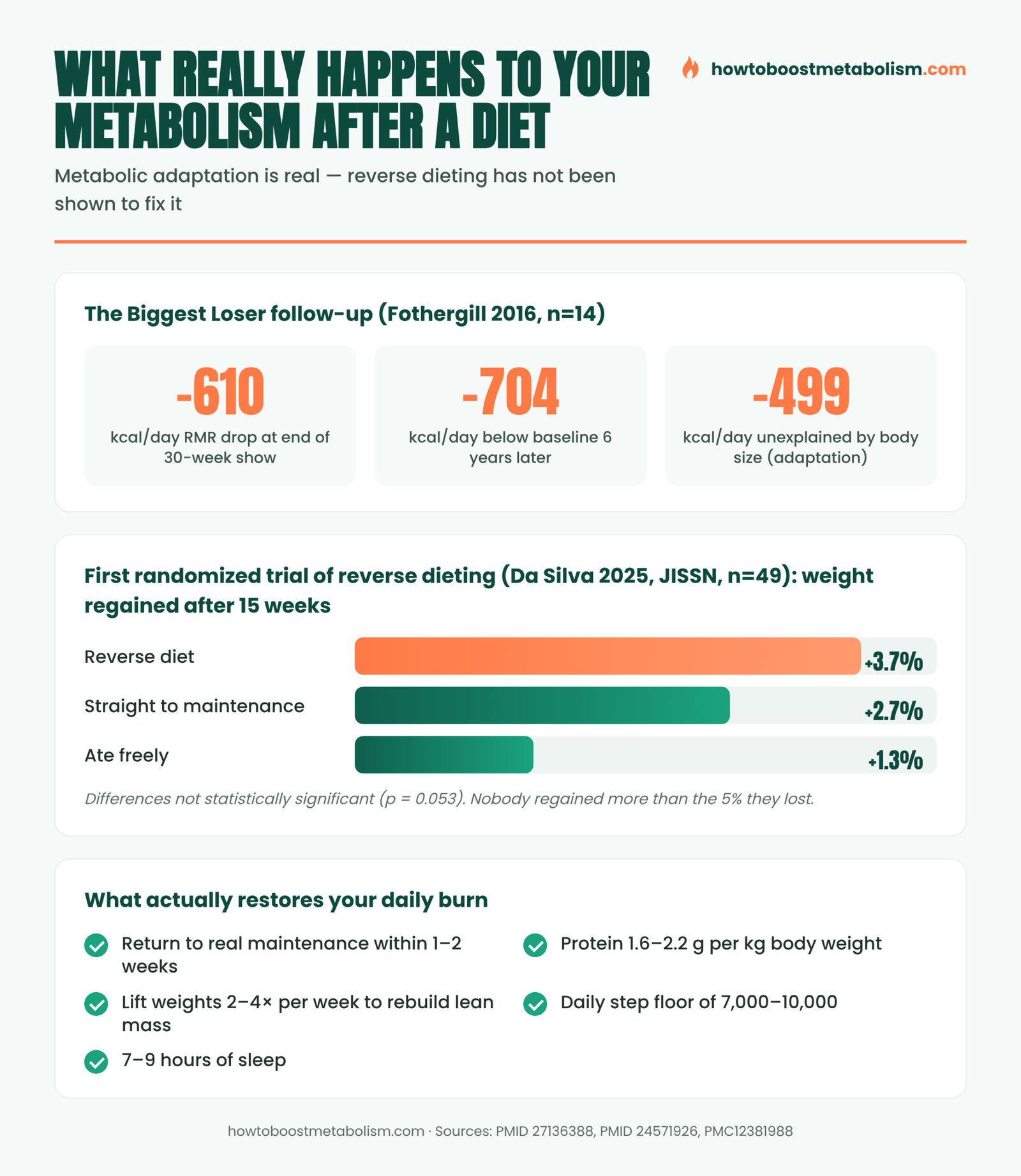
The most dramatic illustration comes from the 2016 follow-up of fourteen Biggest Loser contestants (Fothergill et al., Obesity, PMID 27136388). At the end of the 30-week competition their resting metabolic rate had fallen by about 610 kcal/day. Six years later, after regaining an average of 41 kg of the 58 kg they had lost, their RMR was still about 700 kcal/day below their original baseline, and roughly 500 kcal/day of that could not be explained by body composition. The people who kept the most weight off had the largest metabolic slowdown.
That study is the origin of the “damaged metabolism” idea. But read it carefully and it says something different: the adaptation tracked how hard people were still working to stay lighter. It was not a permanent injury from dieting too fast. It was the body’s ongoing response to being held below its preferred weight.
Free download
🔥 The Metabolism Starter Kit
3 honest guides: a 7-day reset plan, a foods cheat-sheet and 12 metabolism myths debunked. No spam — unsubscribe anytime.
The First Randomized Trial of Reverse Dieting (2025)
For years the only evidence for reverse dieting was coaching anecdotes and a few before-and-after case reports. That changed in 2025 when a team including Eric Trexler published a randomized trial in the Journal of the International Society of Sports Nutrition (Da Silva et al., PMC12381988, doi 10.1080/15502783.2025.2550185).
What they did
Forty-nine resistance-trained men and women aged 18–50 first dieted until they had lost 5% of their body weight. Then they were randomly assigned to one of three 15-week post-diet strategies: a classic reverse diet (calories increased gradually each week, about 8.5% per week for men and 11.7% for women), an immediate return to a freshly calculated maintenance intake, or an ad libitum control that was simply told to eat normally.
What they found
- Every group regained some weight — but none regained more than the 5% they had lost.
- Relative weight regain was 3.7% in the reverse-diet group, 2.7% in the immediate-maintenance group, and 1.3% in the ad libitum group. The differences did not reach statistical significance (p = 0.053).
- “Weight gain efficiency” — how much weight came back per extra calorie eaten — was also not different between groups.
In plain language: the group doing the slow, careful reverse diet did not regain less fat than people who just went straight back to maintenance. If anything, they trended toward regaining slightly more. The authors concluded that a gradual increase in calories “may not be more effective at minimizing weight regain than less structured approaches.”
The limits of the study
It was a preliminary analysis with a modest sample, the diet phase was a relatively mild 5% loss, and participants were trained lifters, not people coming off a 60-pound diet. A larger loss might change the picture. But the burden of proof is on the people selling reverse dieting as a metabolic repair protocol, and right now the only controlled data says it does not do what they claim.
Why Reverse Dieting Feels Like It Works
Plenty of people swear by it, and they are not lying. Three things are going on.
- Metabolic rate rises when you eat more, no matter how you do it. The thermic effect of food goes up with every extra calorie, spontaneous movement returns, and thyroid and leptin signalling normalize. A reverse diet gets credit for a recovery that would have happened anyway.
- You are still in a slight deficit for weeks. If you add 50 calories a week starting from a 500-calorie deficit, you are dieting for another two months. People lose a little more weight, feel proud of it, and attribute it to a “faster metabolism.”
- It is structured. The transition out of a diet is where most regain happens, and any plan that keeps you tracking and weighing beats no plan. That is a real benefit — just not a metabolic one.
What Actually Restores Your Metabolism After a Diet
The honest answer is less exciting than a protocol with a name, but it is backed by far more evidence.
Go to your real maintenance, promptly
Recalculate your maintenance calories for your new body weight and move there within one to two weeks. The 2025 trial’s “immediate maintenance” group did at least as well as the reverse dieters. Lingering in a deficit prolongs hunger, low energy, and the hormonal downshift you are trying to escape. If the scale drifts up more than 2–3 pounds beyond water-weight refill in the first weeks, trim 100–150 calories and reassess.
Keep protein high
Protein does three jobs here: it has the highest thermic effect of any macronutrient, it protects lean mass while your intake is still settling, and it is the most filling calorie you can eat. Wycherley and colleagues’ meta-analysis (PMID 23097268) found that higher-protein diets preserved significantly more fat-free mass and resting energy expenditure during weight loss. Aim for 1.6–2.2 g per kg of body weight; see our protein intake guide for the math.
If hitting that number from food is a struggle — and after a long diet, appetite is often unreliable — a plain whey isolate is the cheapest, most-researched way to close the gap. It is 27 g of protein for about 110 calories per scoop, with essentially no fat or sugar.
Rebuild muscle — it is the only part of your metabolism you control
Here is the lever reverse dieting ignores entirely. The portion of your metabolic slowdown that comes from lost lean tissue can only be reversed by regaining lean tissue. Progressive resistance training two to four times a week, combined with adequate protein, is the one intervention that raises resting metabolic rate rather than just normalizing it. Morton and colleagues’ meta-analysis of 49 trials (PMID 28698222) found that protein plus resistance training reliably increased fat-free mass, with benefits plateauing around 1.6 g/kg. Our honest look at muscle and metabolism covers the realistic numbers.
If you are over 40 and have never followed a structured strength program, a simple, joint-friendly plan matters more than an optimal one. The Old School New Body F4X method is a short, moderate-weight program designed for exactly this group; our full review covers what is inside and what we did not like, including marketing claims on its sales page that are not supported by sources.
For 40+ beginners: Old School New Body (F4X) — a 90-minute-a-week resistance plan with a 60-day money-back guarantee. Digital download; read our review first.
Check Availability →Affiliate link — we may earn a commission at no extra cost to you. Disclosure
Keep moving, especially the movement you do not notice
A large part of adaptive thermogenesis is the quiet disappearance of non-exercise activity: fidgeting, pacing, taking the stairs. Setting a daily step floor — 7,000 to 10,000 depending on your starting point — restores most of it. Our guide to walking for metabolism explains how to pick a target.
Sleep and stress
Short sleep raises hunger hormones and lowers the energy you spend moving the next day. If you are finishing a diet tired and wired, fixing sleep will do more for weight maintenance than any calorie-adding schedule. See sleep and metabolism.
Free download: our Metabolism Starter Kit — a protein calculator, a 7-day meal framework, and a one-page supplement checklist, with zero hype.
Get the Free Starter Kit →Reverse Diet vs Maintenance vs Ad Libitum: Which Should You Choose?
| Strategy | Pros | Cons | Best for |
|---|---|---|---|
| Reverse diet (+50–150 kcal/week) | Structured, gradual; keeps you tracking | No measured metabolic benefit; prolongs the deficit; most time-consuming | People who find an abrupt change frightening and want a tracked transition |
| Immediate maintenance | Fast end to hunger and fatigue; performed as well in the 2025 trial | Requires an honest maintenance estimate; a few pounds of water/glycogen regain in week one can feel alarming | Most people — especially those who tracked during the diet |
| Ad libitum (eat intuitively) | Least effort; lowest regain in the 2025 trial | Works poorly for people whose hunger cues are unreliable after a long diet | Experienced, non-binge-prone eaters coming off a short, mild diet |
Who Should NOT Rely on Reverse Dieting
- Anyone using it as a reason to stay in a deficit for months after the diet is “over.” That is just a longer diet with a nicer name, and extended restriction is what drives the hormonal adaptation you are trying to undo.
- People coming off a very low-calorie diet (under 1,200 kcal) who feel unwell: they should return to maintenance quickly, ideally with medical oversight, not over 16 weeks.
- Anyone with a history of disordered eating, for whom a weeks-long schedule of micromanaged calorie increases can reinforce the problem. A dietitian is the right next step.
Bottom Line
Metabolic adaptation after a diet is real, measurable, and sometimes stubborn. Reverse dieting is a reasonable way to manage the transition if you like structure, but the first randomized trial found it does nothing special for your metabolism, and it kept people hungry longer. Move to your real maintenance intake, keep protein near 2 g/kg, lift weights, walk, and sleep. Those are the tools that put calories back into your daily burn — not the speed at which you add them to your plate.
This article is for educational purposes and is not medical advice. If you have a history of an eating disorder, thyroid disease, or diabetes, talk with your clinician before changing your diet. Read our full Medical Disclaimer.
Frequently Asked Questions
What is reverse dieting?
Reverse dieting is a post-diet strategy where you add calories back gradually — typically 50 to 150 calories per week — instead of jumping straight to maintenance. The idea is to give your metabolism time to “catch up” so you regain less fat. It is popular with physique coaches, but until 2025 it had never been tested in a randomized trial.
Does reverse dieting actually boost your metabolism?
Not in any way that has been measured. The first randomized trial (Journal of the International Society of Sports Nutrition, 2025) compared a slow reverse diet with an immediate return to maintenance and with eating freely for 15 weeks. The reverse-diet group regained slightly more weight, not less, and the differences were not statistically significant. Metabolic rate recovers as you eat more and regain some weight regardless of how fast you add the calories.
How long does it take for your metabolism to recover after dieting?
The part driven by lost body mass does not “recover” unless you regain the mass. The extra slowdown beyond that — adaptive thermogenesis — shrinks when you return to maintenance calories, but in people who keep large amounts of weight off it can persist for years. The Biggest Loser follow-up found a residual adaptation of about 500 kcal/day six years later in people who kept most of their weight off.
Is reverse dieting better than just eating at maintenance?
The one randomized trial found no advantage. Reverse dieting may still be useful psychologically — it gives structure to a scary transition — but you should not expect it to burn more calories than simply calculating your new maintenance and eating there.
What should I do after a diet instead?
Move to your new maintenance calories within a week or two, keep protein at 1.6–2.2 g per kg of body weight, lift weights two to four times a week to rebuild or protect muscle, keep daily steps high, and weigh yourself regularly so a 2–3 lb drift is corrected early. These are the levers with evidence behind them.